
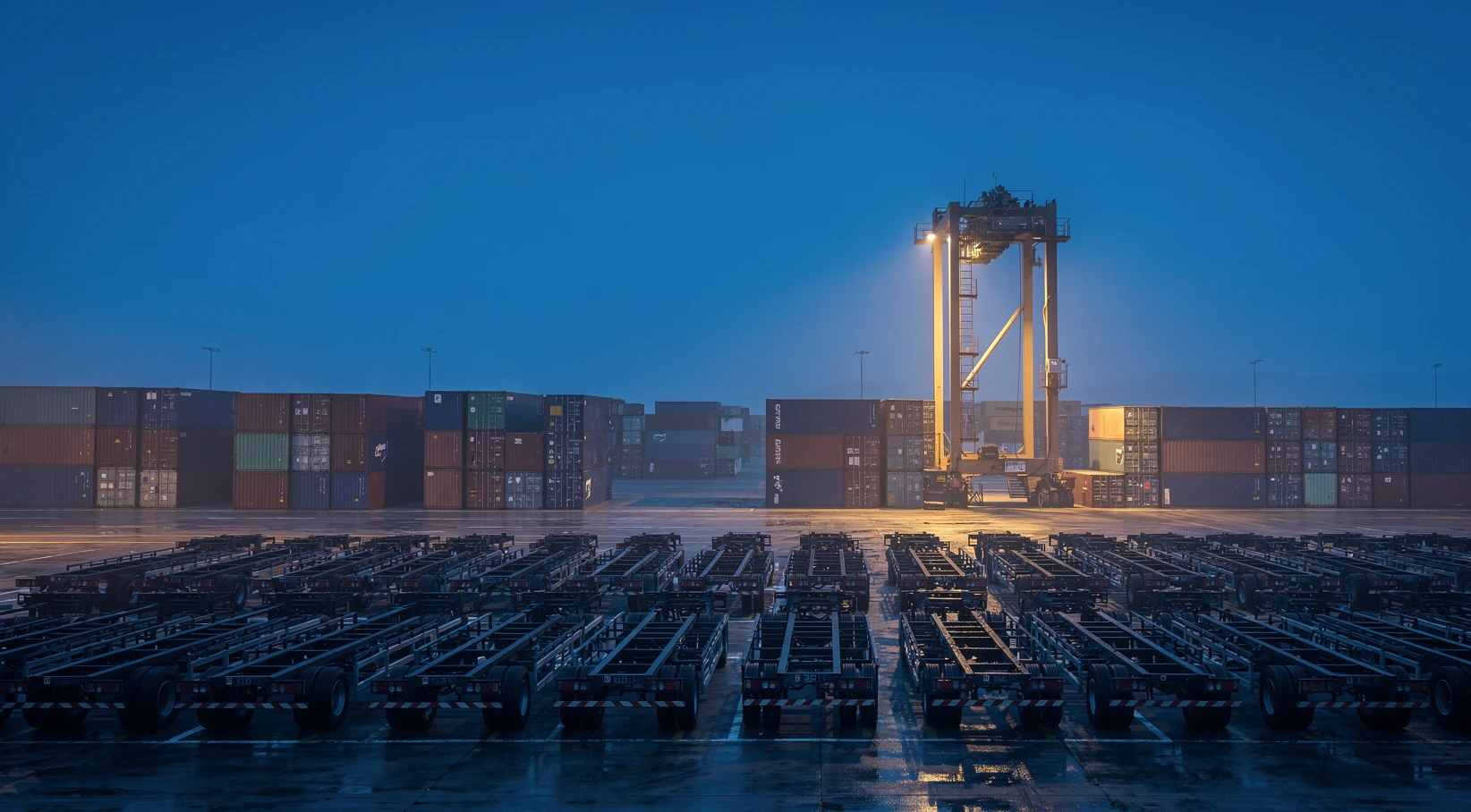
Few line items surprise an importer as sharply as a demurrage and detention invoice. The freight quote said one number, the container landed, and six weeks later a bill arrives for several thousand dollars in charges nobody budgeted. In principle the charges are defensible: ocean carriers and marine terminals use them to keep containers circulating and yards clear. In practice the clock often starts before a seller even knows the vessel has discharged, and the invoice arrives long after the cargo has been sold.
This guide explains what demurrage and detention are, how the free time clock actually runs, who receives the bill, what United States rules require an invoice to contain, and the operating habits that keep the charges small. It is written for online sellers and retail importers moving containerized freight, not for freight professionals who already live inside carrier tariffs every day.
In short
- Demurrage is generally charged when a container sits inside the marine terminal past its free time. Detention is generally charged when the container has left the terminal and is held too long outside it before being returned empty.
- Free time is short and it is not standard. Depending on the carrier, the terminal and the contract, importers commonly see somewhere in the region of 3–5 free days, and the clock frequently starts on availability rather than on the day a truck can realistically collect.
- The Federal Maritime Commission has tightened billing practices. Following the Ocean Shipping Reform Act of 2022, the FMC issued a demurrage and detention billing rule that sets out required invoice contents and time limits for billing and disputes. Verify the current text and dates directly with the Federal Maritime Commission.
- Most surprise bills are caused by four things: a customs or agency hold, no available chassis or appointment, a receiving warehouse that cannot take the container, and a party who did not know they were on the hook.
- The cheapest fix is upstream. Confirming free time in writing, pre booking drayage, filing customs documents early and reconciling invoices within the dispute window costs far less than negotiating after per diem has escalated.
What demurrage and detention actually mean
The two words get used interchangeably in conversation, and that is the first place money leaks. They describe different situations, they are usually billed by reference to different clocks, and the operational fix for one rarely fixes the other.
Demurrage, in the ocean container context, is the charge that accrues while a loaded import container remains inside the marine terminal beyond the free time allowed. The container is sitting on the terminal’s ground, occupying a slot the terminal wants back. Detention is the charge that accrues once the container has been picked up and taken outside the terminal gate, and is then held longer than the free time allowed before it is returned empty. The carrier wants its equipment back in rotation.
Export shipments invert the picture. On the export side, detention typically runs while a shipper holds an empty container for loading, and demurrage can run if the loaded box arrives at the terminal earlier than the receiving window and waits for its vessel. The direction of travel changes which charge you are exposed to, which is why a seller who both imports finished goods and exports returns can meet both charges in the same month.
A third term muddies things further. Many terminals also assess their own storage or ground rent, billed by the terminal operator rather than the ocean carrier, and it can run alongside carrier demurrage on the same container. Two invoices for what looks like one delay is not necessarily double billing; it can be two different parties charging for two different things. Reading which entity issued the invoice is the fastest way to tell them apart.
| Aspect | Demurrage (import) | Detention (import) |
|---|---|---|
| Where the container is | Inside the marine terminal | Outside the terminal gate |
| What is being charged for | Use of terminal space by loaded cargo | Use of carrier equipment beyond free time |
| Who typically bills it | Ocean carrier, and separately the terminal for storage | Ocean carrier |
| Clock usually starts | After free time following cargo availability | After free time following gate out |
| Clock usually stops | When the container leaves the terminal | When the empty is accepted at the return location |
| Most common trigger | Customs hold, no appointment, no chassis | Warehouse cannot unload, empty return refused |
| Fastest lever | Pre booked drayage and early document filing | Same day unload and a confirmed return location |
Understanding the split matters because the parties who can fix each problem are different. Demurrage is usually a document and appointment problem. Detention is usually a warehouse and empty return problem. Sending the same escalation email to the same person for both is why so many importers feel they are shouting into a void.
How the clock runs: free time, per diem tiers and the day cargo becomes available
Free time is the number of days the carrier or terminal allows before charges begin. It is granted in the carrier’s tariff or negotiated in a service contract, and it varies by port, by trade lane, by container type and by the commodity inside. Treating it as a fixed industry standard is the single most expensive assumption in the process.
Two details cause most of the damage. The first is when the clock starts. Free time commonly runs from the date the cargo is made available, which can be the discharge date or the date of the terminal’s availability notice, not the date a truck can physically collect the box. If the terminal has no open appointment for four days, a large share of the free time can evaporate before anyone has done anything wrong.
The second is whether weekends and holidays count. Some tariffs count calendar days, some count working days, and some exclude days the terminal is closed. Over a long weekend that distinction can be worth several days of per diem on a single container, and multiplied across a peak season booking it stops being a rounding error.
Why the rate escalates instead of staying flat
Demurrage and detention rates are frequently tiered. The first band of chargeable days carries one rate, the next band a higher one, and later bands higher still. The design intent is behavioral: the charge is meant to push cargo out of the yard and equipment back into rotation, which is the incentive principle the Federal Maritime Commission has articulated in its guidance on these practices. The practical consequence is that a container stuck for two weeks does not cost twice a container stuck for one week; it usually costs considerably more.
Published rates change frequently and differ by port and carrier, so any figure quoted in a blog post ages badly. Treat rate cards as something to pull fresh from the carrier or terminal for your specific lane rather than something to memorize, and build the current numbers into your cost model the same way you would build in duty. If you have not yet modeled these charges at all, the cleanest place to add them is alongside freight and duty in your landed cost calculation, where they behave like a risk-weighted contingency rather than a fixed cost.
The gap between free time and actual dwell
Container dwell time at large gateway ports is heavily influenced by conditions no single importer controls: vessel bunching, labor availability, chassis pools, rail car supply and weather. When average dwell rises above typical free time across a port, demurrage stops being an exception and becomes a structural cost of using that gateway.
That is the point at which the decision moves up a level, from operations to network design. Sellers who repeatedly eat charges at one port often find the answer is a different gateway, a different inland routing or a transload strategy rather than better expediting. Those trade-offs sit inside the wider question of how goods flow from vessel to customer, which our retail logistics guide covers across the full chain from port to doorstep.
Who actually receives the bill
The most common cause of a genuinely shocking invoice is not the amount. It is that the recipient did not believe the charge was theirs to pay.
Two documents usually decide the answer. The first is the Incoterms rule on the commercial invoice, which allocates cost and risk between buyer and seller at a defined point in the journey. Under a rule where the buyer takes over at origin, the buyer generally carries destination charges including demurrage risk; under a delivered rule, more of that exposure typically sits with the seller. Getting this wrong at quotation time creates a dispute months later, which is why the mechanics are worth reading carefully in our explainer on Incoterms 2020 for retail importers.
The second is who is named as the consignee and, separately, who acts as the importer of record. These are not always the same party, and the entity that contracts with the ocean carrier for carriage or storage is a distinct role again. When a seller uses a third party to clear cargo but is named as consignee on the bill of lading, the seller can end up receiving charges it assumed the third party had absorbed. The roles and liabilities are set out in our piece on the importer of record and customs bonds.
United States rules have narrowed this ambiguity. The Federal Maritime Commission’s billing rule addresses which parties may properly be invoiced for demurrage and detention, with the effect of limiting billing to a defined party rather than allowing a carrier to pursue whoever is convenient. The precise wording, the effective dates and any subsequent amendments should be confirmed against the rule text on the Federal Register and the FMC’s own guidance, because this area has seen active rulemaking and litigation.
One practical habit follows from all of this: before the vessel sails, write down in one line who pays demurrage, who pays detention and who is named as consignee. If any party hesitates to put that in writing, the exposure is real and it is probably yours.
What United States rules require on the invoice
The Ocean Shipping Reform Act of 2022 directed the Federal Maritime Commission to address billing practices that importers had complained about for years, principally invoices that arrived long after the fact with too little detail to check. The Commission subsequently issued a demurrage and detention billing requirements rule setting out what an invoice must contain and the windows in which billing and disputes must happen.
The broad shape of the requirements, as described by the FMC, is that an invoice should identify the container and the shipment, state the dates and the basis on which charges accrued, identify the rate and the total, explain how to request mitigation or waiver, and be issued within a defined period after charges stop accruing. There are also defined periods for the billed party to raise a request and for the biller to respond.
| Invoice element | Why it matters to an importer | What to do if it is missing |
|---|---|---|
| Container and bill of lading identifiers | Lets you match the charge to a specific shipment | Request the detail before paying; an unmatched charge cannot be verified |
| Start and end dates of the charge | Shows whether free time was calculated correctly | Compare against terminal availability and gate records |
| Rate applied and the tier basis | Reveals escalation and arithmetic errors | Check against the tariff or service contract in force on those dates |
| Statement of the basis for the charge | Separates carrier demurrage from terminal storage | Ask which entity is charging and under what authority |
| How to dispute or request mitigation | Tells you where and by when to object | Ask in writing immediately; silence can be read as acceptance |
| Issue date relative to accrual | Late invoices may fall outside permitted windows | Note the dates and raise the timing point explicitly |
Two caveats belong here. First, the specific contents, deadlines and covered parties are defined in the rule text itself, and figures repeated secondhand go stale; confirm the current requirements with the FMC before relying on them. Second, these are United States rules. An importer clearing cargo in the European Union, the United Kingdom or elsewhere is operating under a different framework, and the local carrier tariff plus national competition and transport regulators define what recourse exists.
Where the bills actually come from
Across most importer post mortems, the same handful of causes account for the overwhelming majority of charges. None of them are exotic. All of them are visible in advance if someone is looking.
Customs and agency holds
A container placed on hold by US Customs and Border Protection or by a partner government agency cannot leave the terminal, but the free time clock does not necessarily pause out of sympathy. Exams take days, and the container accrues charges while it waits. Filing accurate entry documents early, classifying goods carefully and responding to information requests the same day are the levers that matter. Note also that duty questions and demurrage questions are separate: recovering duty through a program such as duty drawback does nothing to recover storage charges.
No chassis, no appointment, no driver
Even a perfectly cleared container needs a chassis, a driver and a terminal appointment on the same day. In constrained markets any one of the three can be the binding constraint, and the importer with a standing drayage relationship gets the slot that the importer calling on the day does not.
The receiving warehouse cannot take it
This is the classic detention driver. The box gates out, arrives at a facility with no dock door or no labor, and sits on the yard as a very expensive storage unit. A single missed unload can convert a cheap shipment into a loss-making one, particularly when the empty return then misses the free time window as well.
Empty returns refused
Detention keeps running until the empty is accepted, and terminals periodically restrict which empties they will take on which days. An importer who unloads promptly can still accrue detention because there was nowhere to hand the box back. Documenting refused returns contemporaneously, with dates, times and locations, is the evidence that supports a later mitigation request.
Nobody owns the file
The quietest cause is organizational. Freight is booked by one person, cleared by another, received by a third, and the invoice lands with a fourth who has no context. Clarity about who is watching each container, and who escalates when it stops moving, prevents more charges than any amount of after-the-fact negotiation. If your team is unsure which service provider is responsible for which step, the division of labor is explained in our comparison of a freight forwarder versus a customs broker.
| Cause | Charge it usually triggers | Who can realistically prevent it | Lead time to fix |
|---|---|---|---|
| Customs or agency hold | Demurrage | Importer and customs broker | Before filing entry |
| No terminal appointment | Demurrage | Drayage provider | Days before availability |
| Chassis shortage | Demurrage | Drayage provider and carrier | Weeks, via contracted pools |
| Warehouse cannot unload | Detention | Importer and receiving facility | Weeks, via labor planning |
| Empty return refused | Detention | Carrier and drayage provider | Same day, with documentation |
| Unclear Incoterms allocation | Both, disputed | Buyer and supplier at quotation | Before the purchase order |
| Invoice ignored until overdue | Both, unmitigated | Finance and operations | Immediately on receipt |
What to check before the container ships
Most of the leverage in this process exists before the vessel departs. Once the container is on the water, the options narrow to expediting and negotiating, both of which are more expensive than planning.
Get free time in writing, per lane
Ask the carrier or forwarder for the free time applicable to your specific booking, in days, with a statement of whether the count is calendar or working days and what event starts the clock. A verbal assurance that “you get a few days” is not a commercial term. Where volumes justify it, extended free time is a negotiable item in a service contract, and it is often cheaper to buy days upfront than to pay per diem later.
Pre book drayage against the estimated availability date
Book the truck before the ship arrives, not after the notice lands. Give the drayage provider the bill of lading, the estimated availability window and the delivery address early enough that they can secure an appointment on the first available day rather than the first day they have capacity.
Line up documents so clearance is not the bottleneck
Commercial invoice, packing list, bill of lading, any agency-specific certificates and the correct tariff classification should be with the broker well before arrival. Documents that arrive on the day of discharge start the process late by definition, and late clearance is the most common demurrage cause of all.
Confirm the receiving end can actually receive
Check dock availability, labor and inbound appointment rules at the delivery facility for the specific week the container is due. A third party logistics provider with a two week inbound backlog is a detention bill waiting to be issued, no matter how smoothly the port leg goes.
Decide who is watching the container
Name one person accountable for each shipment from availability notice to empty return, and give them the authority to authorize an expensive truck when the alternative is a more expensive per diem. The economics of paying a premium for same day drayage look very different when set against a tiered detention rate.
Common mistakes and compliance risks to avoid
Certain errors recur often enough to be worth naming directly, because each one is cheap to avoid and expensive to repeat.
Paying the invoice without reconciling it is the first. Charges are calculated from dates and rates, and both can be wrong. Matching the billed period against terminal availability records, gate transactions and empty return receipts is ordinary accounts payable discipline applied to a document most finance teams have never been trained to read.
Missing the dispute window is the second, and it is the one that forecloses every other option. Where rules or contracts define a period for requesting mitigation or waiver, an objection raised after that period may simply be out of time regardless of its merit. Log the invoice date on arrival and diarize the deadline the same day.
Assuming a service provider has absorbed the charge is the third. Forwarders and brokers act on instructions and generally pass through carrier and terminal charges unless a contract says otherwise. Read the rate agreement to see what is included, and ask explicitly whether demurrage and detention are inside or outside the quoted number.
Confusing customs duty with equipment charges is the fourth. They are levied by different parties for different reasons under different legal authorities, and a refund or recovery on one side has no bearing on the other. Teams that manage both under a single “import costs” heading tend to discover the distinction during a dispute rather than before one.
The compliance dimension deserves a plain statement. Attempting to reduce charges by misdescribing cargo, misdeclaring value or misclassifying goods to speed clearance is not a cost-saving tactic; it is a customs violation with penalty exposure that dwarfs any per diem saved. CBP publishes its enforcement priorities and penalty framework publicly, and importers should treat accurate declaration as non negotiable. The legitimate levers are earlier filing, better documents, better appointments and better warehouse planning.
How to dispute an invoice and where the rules can change
A disciplined dispute follows a predictable sequence. Acknowledge the invoice in writing on the day it arrives so there is a dated record. Assemble the evidence: availability notice, terminal records, appointment attempts, gate in and gate out times, empty return receipts and any written refusal to accept the empty. Then set out, factually and without argument, which days you believe were incorrectly charged and why.
Where the invoice lacks the information needed to verify it, say so explicitly and request the missing elements, since the sufficiency of invoice contents is itself part of what the FMC billing rule addresses. Where the delay was caused by circumstances the carrier or terminal controlled, describe them with dates rather than adjectives.
If a bilateral resolution fails, the Federal Maritime Commission operates processes for parties who believe charges were assessed contrary to the applicable rules, including a charge complaint mechanism and formal complaint routes. Details of eligibility, evidence and time limits are published by the Commission, and they change; check the current process on the FMC website rather than relying on secondhand summaries.
This is also the part of the topic most likely to be out of date the moment it is written. Ocean shipping regulation in the United States has been actively revised since 2022, carrier tariffs change on their own schedules, and terminal practice varies port by port. Any rule, rate, threshold or deadline that matters to a decision should be confirmed at the primary source, which for these purposes means the FMC, the Federal Register, US Customs and Border Protection for entry and hold matters, and the individual carrier or terminal tariff for commercial terms.
Structurally, the best defense remains a supply chain that does not depend on everything going right. Buffer inventory, more than one gateway, contracted drayage capacity and receiving facilities with slack all reduce the number of days a container can sit accruing charges. Those are the same design choices that determine service levels and delivery promises more broadly, which is the wider subject of our guide to modern retail logistics.
Important: this is general information, not legal, tax or customs advice
Everything above is written to explain how demurrage and detention generally work and what options importers typically have. It is general information and education, not legal, tax or customs advice, and it is not a substitute for professional guidance on your own shipments, contracts or disputes.
Rules, rates, free time allowances and dispute deadlines vary by carrier, terminal, port, country and contract, and they change. Figures and requirements described here reflect a general understanding as of August 2026 and should be verified against the primary sources before you act on them: the Federal Maritime Commission and the Federal Register for United States ocean shipping rules, US Customs and Border Protection for entry, examination and hold matters, and the applicable carrier or terminal tariff for commercial terms on your booking.
For a specific situation, particularly a disputed invoice, a contract negotiation or anything with penalty exposure, a licensed customs broker, a trade attorney or a qualified tax advisor is the right party to consult. No statement here should be read as an accusation of wrongdoing against any carrier, terminal or other named party; regulatory actions and third-party allegations are described as claims, not as proven conduct.
Frequently asked questions
What is the simplest way to remember the difference between demurrage and detention?
Demurrage is generally about the container sitting inside the terminal past free time, and detention is generally about the container being held outside the terminal past free time before the empty is returned. One is a yard problem, the other is a warehouse and empty return problem.
How much free time do importers usually get?
It varies by carrier, port, trade lane and contract, and figures around 3–5 days are commonly cited for imports, but there is no universal standard. The only reliable answer is the free time stated in the carrier tariff or service contract for your specific booking, which you should request in writing before shipment.
Does the free time clock stop while customs holds my container?
Not necessarily. Practice varies by carrier and terminal, and a hold placed by US Customs and Border Protection or a partner agency does not automatically suspend accrual. Confirm the treatment in the applicable tariff and document the hold dates carefully, because they are central evidence in any later mitigation request.
Can I be billed if I am not the importer of record?
Possibly, depending on your role. Liability generally follows the contractual relationships and the party named on the shipping documents rather than the customs role alone, and the FMC billing rule addresses which parties may properly be invoiced. Clarify the allocation with your supplier and forwarder in writing before the goods ship.
Are demurrage and detention charges negotiable?
Frequently, in two ways. Free time and rates can be negotiated in advance as part of a service contract where volumes justify it, and individual invoices can be reduced through a mitigation or waiver request supported by evidence. Both work far better with documentation than with argument.
What should I do the day a demurrage invoice arrives?
Acknowledge it in writing, record the date, check whether the invoice contains the information needed to verify it, reconcile the billed days against your own records, and note the deadline for raising a dispute or mitigation request. Missing a deadline can remove options that the facts would otherwise have supported.
Do these rules apply outside the United States?
No. The Ocean Shipping Reform Act of 2022 and the FMC billing rule are United States measures. Importers clearing in the European Union, the United Kingdom or elsewhere operate under different frameworks, and the applicable carrier tariff plus the relevant national regulator define the available recourse.
Can I insure against demurrage and detention?
Some cargo and trade credit products, and some contractual arrangements with forwarders, address delay-related costs in limited circumstances, but standard cargo insurance is generally about loss or damage rather than equipment charges. Check the specific policy wording with your broker rather than assuming coverage exists.
Is paying quickly cheaper than disputing?
Only if the invoice is correct. Charges are computed from dates and rates that can be misstated, and reconciliation costs an hour where an unchecked payment can cost thousands. Pay promptly once verified, but verify first.