
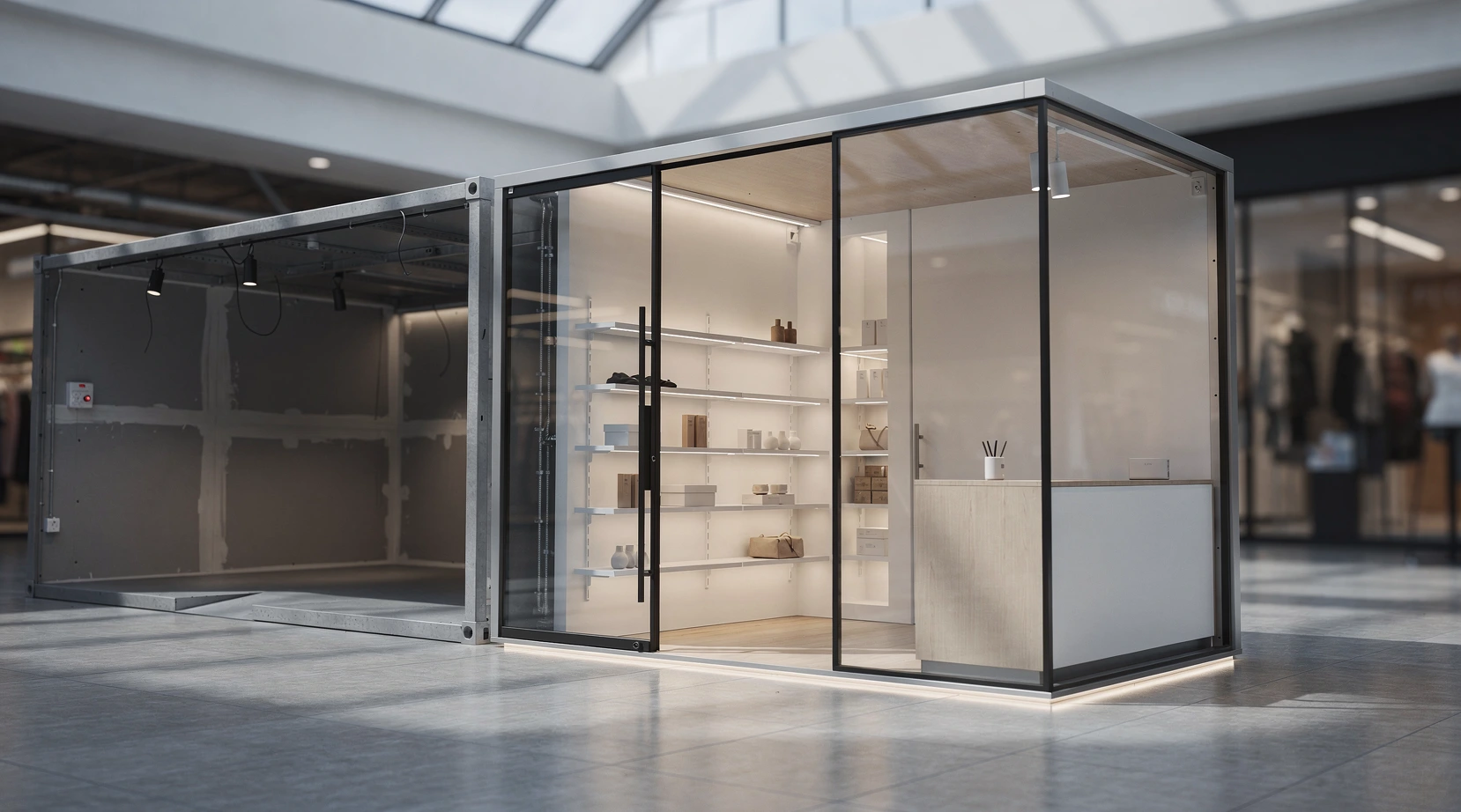
A pop-up looks like the cheap way into physical retail. Three months, a fitted space, a landlord who wants footfall as badly as the brand wants a storefront, and a document that runs to twelve pages instead of ninety. The economics only hold if the document says what the brand thinks it says.
Most short-term retail deals are not leases at all in the ordinary sense. They are licences to occupy, concession agreements, or turnover-based tenancies drafted to sit outside the protections and obligations that attach to a conventional commercial lease. That drafting choice is deliberate on the landlord side, and it moves real money and real risk.
What follows is a plain reading of the clauses that decide whether a pop-up makes money: how percentage rent is triggered, who pays to strip the space back out, what a deposit really secures, and which exit routes exist when trading disappoints. The clauses are usually negotiable, and rarely negotiated, because they are rarely read before the fit-out contractor is booked.
In short
- Short-term retail deals are usually structured as a licence to occupy rather than a lease, which changes what the occupier can enforce and what protections apply.
- Percentage rent only bites above a sales threshold, and the way that threshold is defined matters more than the headline percentage.
- Reinstatement is the single most commonly underbudgeted line: the obligation to return the unit to its prior condition can rival the fit-out cost.
- Deposits, insurance certificates and personal or parent-company guarantees are gating items that stall handover more often than rent negotiation does.
- The quoted rent is typically 60% to 80% of true occupancy cost once service charge, marketing levy, utilities and business rates or property taxes land.
Licence versus lease: why the difference matters for pop-ups
The label on the front page is not decisive. Courts in both the United States and the United Kingdom look at the substance of the arrangement, principally whether the occupier has exclusive possession of a defined space for a defined term. A document titled “licence” that hands over the keys to a self-contained unit with a lock the landlord cannot pass may still be construed as a tenancy.
That matters because the consequences diverge sharply. A lease creates an interest in land that can usually be assigned, may attract transfer taxes, and in some jurisdictions carries statutory renewal rights. A genuine licence is a personal permission: it is generally not assignable, it can be drafted to be revocable on short notice, and it does not create the same bundle of rights.
For a brand testing a market, a licence is often the right instrument. The risk is assuming a licence carries lease-like security, then discovering mid-campaign that the operator can relocate the unit, change the opening hours, or terminate on fourteen days’ notice because the document said so.
What a licence actually gives you
A well-drafted retail licence specifies the exact unit or pitch, the permitted use, the trading hours, the term, and the fee. It will usually reserve to the landlord a right of entry, a right to relocate within the scheme, and a right to terminate for breach. Anything the brand needs that is not written down is not part of the deal.
Three omissions recur: which utilities are connected and metered, whether the brand may use the loading bay and when, and any landlord commitment on scheme footfall or anchor tenancy. The absence of the third means a half-empty centre is a commercial disappointment rather than a breach.
Where security of tenure enters the picture
In England and Wales, business tenancies can carry security of tenure under Part II of the Landlord and Tenant Act 1954, which gives a qualifying tenant the right to renew at the end of the contractual term. Parties can contract out by following a statutory procedure, and the Act also excludes certain short tenancies: section 43(3) addresses tenancies granted for a term certain not exceeding six months, subject to conditions on renewal and prior occupation. The current text and its exact conditions are published by the UK government at legislation.gov.uk, and the operation of those conditions is fact-specific.
This is why so many UK pop-up documents are written for a term of under six months, or as licences, or with an express exclusion of sections 24 to 28. A brand that signs a six-month deal and then rolls it over informally can inadvertently build up the occupation history that changes the analysis.
The United States has no direct federal equivalent. Commercial landlord and tenant law is state law, and holdover consequences, notice periods and remedies vary substantially between states. The US Small Business Administration publishes general orientation material on commercial leasing at sba.gov, but the operative rules are the ones in the governing state and in the document itself.
| Feature | Licence to occupy | Short-term lease | Concession agreement |
|---|---|---|---|
| Nature of right | Personal permission | Interest in land | Right to trade within host’s business |
| Exclusive possession | Not intended | Yes | No, space stays under host control |
| Typical term | Days to 6 months | 3 months to 3 years | Season to multi-year |
| Assignable | Usually not | Sometimes, with consent | Usually not |
| Rent basis | Fixed fee, sometimes turnover | Base rent plus percentage | Commission on sales |
| Who takes the payment | Brand | Brand | Host, then remits |
| Staff employer | Brand | Brand | Brand or host, varies |
| Termination | Short notice, as drafted | Per break clause | Per performance thresholds |
The concession column deserves attention because it is a genuinely different animal. In a concession the host retails the goods through its own till, keeps a commission, and remits the balance, which means the brand carries inventory risk but not the payment relationship. That structure sits closer to the wholesale arrangements covered in the retail store operations playbook than to a property deal, and it needs a different set of operational controls.
Base rent, percentage rent and the sales threshold that triggers it
Percentage rent is the mechanism that makes short-term retail palatable to both sides. The landlord accepts a lower fixed floor in exchange for participation in upside. The brand caps its downside if the location underperforms. The whole arrangement turns on two numbers: the percentage rate and the threshold above which it applies.
Three structures dominate. Pure percentage rent, with no fixed floor, is common in mall pop-ups and specialty leasing programmes. Base rent plus percentage above a breakpoint is the standard mall inline structure. Base rent against percentage, where the brand pays whichever is higher rather than both, appears in weaker centres and in landlord-side incentive deals.
Confusing the second and third structures is expensive. “Plus” and “against” differ by the entire base rent once sales clear the threshold, and the distinction often hides in a single preposition.
How a natural breakpoint is calculated
A natural breakpoint is the sales level at which the percentage rate applied to gross sales exactly equals the annual base rent. It is derived, not negotiated: divide the annual base rent by the percentage rate. An artificial breakpoint is any threshold the parties set by agreement instead, and it can sit above or below the natural figure.
The mechanics are straightforward arithmetic once the inputs are fixed. The table below works through a three-month pop-up at three sales outcomes, using a base rent of $12,000 for the term and a 10% rate over a natural breakpoint. These figures are illustrative rather than market benchmarks.
| Scenario | Gross sales, 3 months | Base rent | Natural breakpoint | Percentage rent due | Total rent | Rent as % of sales |
|---|---|---|---|---|---|---|
| Under-trading | $80,000 | $12,000 | $120,000 | $0 | $12,000 | 15.0% |
| At plan | $120,000 | $12,000 | $120,000 | $0 | $12,000 | 10.0% |
| Over-trading | $200,000 | $12,000 | $120,000 | $8,000 | $20,000 | 10.0% |
| Over-trading, artificial breakpoint at $60,000 | $200,000 | $12,000 | $60,000 | $14,000 | $26,000 | 13.0% |
| Over-trading, percentage against base | $200,000 | $12,000 credited | n/a | $20,000 gross | $20,000 | 10.0% |
Two observations follow. With a natural breakpoint, rent as a share of sales flattens at the percentage rate once the brand clears plan, which is the point of the structure. With an artificial breakpoint set below natural, the effective rate keeps climbing, and the brand is paying for its own success at a marginal rate well above the headline 10%.
What counts as gross sales
The definition of gross sales is where the real negotiation happens, and it is usually a dense paragraph rather than a clause anyone flags. Landlord-favourable drafting sweeps in everything and deducts almost nothing. The items worth checking, in rough order of financial impact:
- Returns and refunds. Whether they are deducted, and whether returns of items sold elsewhere but processed at this unit count against it.
- Sales tax or VAT. Gross sales should normally be net of transaction taxes, but this is not universal in first drafts.
- Online orders. Whether ecommerce orders fulfilled from, collected at, or merely placed on a device in the unit are captured. This is the fastest-growing dispute in percentage rent.
- Gift cards. Whether the sale is recognised at issue or at redemption, and what happens to cards redeemed at other locations.
- Employee discounts, damaged goods and shrink. Usually excluded, but only if said.
The online clause is the one to watch. A brand that runs a “scan to buy” wall or fulfils click-and-collect from the pop-up can find a substantial slice of digital revenue folded into the gross sales base for a physical unit, purely because the definition said “orders placed at or through the premises”. Reporting obligations follow the same definition, so the brand also needs a point-of-sale configuration that can actually produce the required split. The weekly reporting discipline described in store KPIs worth tracking weekly is what makes a percentage rent certification defensible when the landlord exercises its audit right.
Audit rights themselves deserve a look. Most percentage rent clauses let the landlord inspect records after the term ends, and many shift the audit cost to the tenant if it finds an understatement above a stated tolerance. A brand that cannot reconstruct daily sales a year later is exposed either way.
Fit-out, reinstatement and who pays to put the space back
Fit-out is the line every brand budgets. Reinstatement is the line that surprises them. The two are governed by different clauses that are frequently inconsistent with each other, because the fit-out schedule is negotiated by the projects team and the reinstatement wording is boilerplate nobody revisits.
Landlord’s works versus tenant’s works
The document should draw a clear line: what condition the landlord delivers, and what the brand adds. Shell and core means a bare unit, sometimes without a finished floor, ceiling or shopfront. A fitted or turnkey unit arrives with flooring, lighting, a service counter and often a till position, which is what makes mall specialty leasing programmes viable for a six-week campaign.
Where a landlord offers a fit-out contribution or rent-free period, three details decide what it is worth: whether the contribution is paid on completion or amortised against rent, whether it requires the landlord’s nominated contractor, and whether the rent-free period is genuinely free or merely deferred.
The reinstatement clause
Reinstatement, called restoration or surrender condition in US drafting, obliges the occupier to return the unit to a defined state at the end of the term. Three variants appear, and the difference between them is large:
- Remove tenant’s fixtures and make good. The narrowest obligation. Strip out what you installed, repair the damage caused, leave the rest.
- Return to the condition set out in the schedule of condition. Manageable, provided a photographic schedule was actually attached at the start. Without one, the argument is unwinnable.
- Return to shell and core, or to base building condition. The widest, and the one that catches brands out. If the unit was handed over fitted, this wording can require the brand to remove a fit-out it never installed.
The practical defence is a schedule of condition: dated photographs and a written inventory, agreed by both parties and annexed to the document before handover. It takes an hour on site and it is the single highest-return hour in the whole process. Without it, the end-of-term negotiation is the brand’s recollection against the landlord’s specification.
A dilapidations settlement, where the landlord takes a cash sum instead of physical works, is often cheaper for a short-term occupier. Ask whether the landlord will price that option at the outset.
Deposits, insurance and the certificates a landlord will ask for
Handover delays in pop-up deals are rarely about rent. They are about the documents a managing agent needs before it releases keys, and a deposit that has to clear.
Deposit forms and what they secure
A rent deposit typically runs from one to three months of gross rent for an established covenant, and higher for a new entity, an overseas parent or a brand with no trading history. The form matters as much as the amount. A rent deposit deed held in a designated account, a bank guarantee, a letter of credit and a parent-company guarantee sit in descending order of preference from the brand’s perspective, because they differ in how much working capital they tie up and how easily the landlord can draw on them.
Four questions are worth asking before signing. What events allow the landlord to draw down. Whether the deposit must be topped up after a draw. Whether interest accrues to the brand. And the mechanics and deadline for return, which should be a stated number of days after the later of expiry and completion of reinstatement, not “as soon as reasonably practicable”.
Insurance certificates
The insurance schedule is the most common cause of a missed opening date, because brokers need lead time and landlords will not compromise. A typical deal asks for public or general liability cover, employer’s liability or workers’ compensation, stock and contents cover, and evidence that the landlord and managing agent are named as interested parties.
Employer’s liability insurance is compulsory for most employers in Great Britain under the Employers’ Liability (Compulsory Insurance) Act 1969, with the requirement and the current minimum cover level set out by the Health and Safety Executive; verify the current position at the HSE before relying on a figure. In the United States, workers’ compensation is mandated at state level and both the coverage trigger and the exemptions differ by state, so the governing state’s rules control. Product liability is a separate consideration for anyone selling own-brand goods, and it is not automatically inside a general liability policy.
Two operational points. Cover must run from the date of fit-out access, not the trading start date. And the insured name must match the contracting entity on the licence exactly, because a certificate naming the wrong entity is the most common rejection.
Utilities, service charges and the costs quoted as extras
The headline rent is a fraction of occupancy cost. Building the full stack before signing is the difference between a pop-up that clears its contribution target and one that quietly loses money at plan.
| Cost line | Usually in the quoted rent? | Typical basis | What to check |
|---|---|---|---|
| Base rent or licence fee | Yes | Fixed, per term or per month | Whether payable in advance and in what instalments |
| Percentage rent | No | Rate over breakpoint | Gross sales definition and reporting cadence |
| Service charge | No | Per square foot or per square metre | Whether capped, and whether reconciled at year end |
| Marketing or promotional levy | No | Fixed or percentage of rent | What the brand actually receives for it |
| Business rates or property tax | No | Statutory assessment | Who is the liable party for a short occupation |
| Utilities | Sometimes | Metered or apportioned | Whether a separate meter exists at all |
| Insurance rent | No | Recharge of landlord’s premium | Whether it covers the brand’s own risks (it does not) |
| Fit-out and reinstatement | No | Project cost | Reinstatement standard in the document |
| Card and payment fees | No | Percentage of sales | Whether a landlord-nominated terminal is mandated |
| Staffing | No | Hours times rate | Mandated trading hours drive this, not the brand’s plan |
Apportioned utilities are the quiet problem. Where a pop-up unit has no separate meter, the charge is typically a per-square-foot estimate, which can bear no relation to actual consumption. A unit running refrigeration, heavy lighting or a coffee machine may be undercharged; a rail-and-till clothing pop-up in a scheme with energy-intensive neighbours may subsidise them.
Business rates and property tax treatment for short occupations is genuinely jurisdiction-specific. In England, liability, reliefs and any small business or empty property relief position depend on the rating list and the occupier’s circumstances, and the position is administered by the local billing authority with valuations set by the Valuation Office Agency. Confirm liability with the billing authority rather than accepting a landlord’s summary, and note that in some schemes the landlord retains rateable occupation and recharges a share instead. Brands trading on a UK high street should also check whether the location falls inside a business improvement district, since the BID levies and grants that fund main street retail can add a further charge or, occasionally, unlock a grant a short-term occupier qualifies for.
Mandated trading hours are the last hidden cost. A scheme that requires trading from 09:00 to 21:00 seven days a week sets the staffing bill regardless of when the brand’s customers actually shop. Modelling that against the unit’s likely traffic curve, using the approach in how to build a store labor schedule that survives peak season, will often show that two or three of the mandated hours are structurally loss-making, which is a point to raise before signing rather than after.
Exit clauses, break rights and holding over by accident
A short term looks like its own exit. It is not, because the obligations that survive the term are the expensive ones, and because leaving is a process rather than a date.
Break rights in short-term deals are usually mutual and notice-based, and the notice period is where the asymmetry hides. A landlord break on 30 days with a tenant break on 90 days means the brand carries the risk of a scheme repositioning while the landlord carries none of the risk of a failed campaign. Making the notice periods symmetrical is a routine ask and it is frequently conceded.
Conditional break rights are the trap. Where a break is exercisable only if the tenant has paid all sums due and complied with all covenants, a trivial arrears balance or an unremedied minor breach can invalidate an otherwise valid break notice. Narrowing that condition to “principal rent paid” is standard practice and materially improves the reliability of the right.
Holding over is the accidental version. Where a brand stays past expiry, whether because a campaign is extended informally or because reinstatement runs late, the consequences are set by the document and by local law. Many US commercial leases specify a holdover rent of 150% or 200% of the prior rate; UK arrangements may create a periodic tenancy or, in some circumstances, engage the statutory framework the parties tried to avoid. Neither outcome is a rounding error, and both are avoidable with a documented extension signed before expiry.
The exit checklist that actually prevents disputes is short. Confirm the reinstatement standard and book the strip-out contractor before the final trading week. Take dated photographs at handback and get written confirmation the unit has been accepted, with a date for deposit return. Then close out the service charge reconciliation and the percentage rent certification, because that obligation typically survives the term.
Negotiating points that landlords usually concede
Short-term retail is a volume business for the landlord side, and specialty leasing teams are measured on occupancy as much as on rate. That creates room on terms even where there is little room on the fee, and the terms are frequently worth more than the discount a brand would have asked for instead.
The points most often conceded, in rough order of how reliably they land:
- A schedule of condition annexed to the document. Almost never refused, because it protects the landlord too, and it removes the largest end-of-term uncertainty.
- Narrowing the reinstatement standard from base building to “remove tenant’s additions and make good”, particularly where the unit was delivered fitted.
- Symmetrical break notice periods and an unconditional or lightly conditioned tenant break.
- A gross sales definition that excludes transaction taxes, refunds and ecommerce not fulfilled from unit stock.
- A service charge cap for the term, or a fixed inclusive figure instead of an estimate plus reconciliation.
- A stated deposit return deadline measured in days from handback acceptance.
- Access for fit-out ahead of the rent commencement date, which is effectively a rent-free period by another name.
- Capping and time-limiting any guarantee rather than accepting an open-ended one.
Two asks generally fail. Landlords rarely commit on footfall, tenant mix or anchor occupancy, because they cannot control it and will not warrant it. Relocation rights are usually retained, though a brand can often secure a contribution towards a landlord-initiated move plus a right to terminate if the alternative unit is materially worse.
Sequencing matters as much as the asks. Raise reinstatement, gross sales definition and insurance requirements in the first exchange, not after heads of terms are agreed, because a managing agent who has already reported a deal internally has less flexibility to reopen the commercial paperwork. A brand contemplating a permanent unit after a successful pop-up will also find that the diligence in the checklist before you sign a lease covers ground a short-term document deliberately leaves out, and that the two processes should not be run the same way.
The wider point is that a pop-up is an operating commitment, not just a property one. Staffing, stock allocation, shrink control and daily reporting all have to work from day one in a unit that will only exist for eight weeks, which is why the disciplines set out in the retail store operations playbook are worth applying at small scale rather than improvising them.
General information, not legal advice
This article explains how short-term retail occupancy documents are commonly structured. It is general information and education, not legal, tax or property advice, and it is not a substitute for advice on a specific document or situation. Nothing here should be read as a recommendation about what any particular brand ought to sign or refuse.
Commercial property law differs by jurisdiction and, in the United States, by state. Statutory rules, tax thresholds, insurance minimums and business rates or property tax positions change, and the figures and provisions referenced here may have been amended since publication. Where a specific rule matters, verify it at the official source: legislation.gov.uk for UK statute, HM Revenue and Customs for stamp duty land tax on leases, the Valuation Office Agency and the local billing authority for business rates, the Health and Safety Executive for compulsory employer’s liability insurance, and the relevant state agency in the United States.
Before signing a pop-up licence or lease, brands should take advice from a qualified property solicitor or real estate attorney, a chartered surveyor or licensed broker, and where tax is engaged, a tax adviser. The cost of a few hours of review is small against a reinstatement obligation or a percentage rent dispute discovered after the term has ended.
FAQ on pop-up leases
Is a pop-up licence a lease?
Often not, but the label is not decisive. Courts look at substance, principally whether the occupier has exclusive possession of a defined space for a defined term. A document titled “licence” that grants exclusive possession of a lockable unit may be construed as a tenancy, with different consequences for assignment, taxes and statutory protections. The analysis is fact-specific, so have a property lawyer review it.
How is percentage rent calculated?
A stated percentage is applied to gross sales above a threshold called a breakpoint. A natural breakpoint equals annual base rent divided by the percentage rate, so the two rent components meet exactly at that sales level. An artificial breakpoint is set by agreement instead. Check whether percentage rent is payable in addition to base rent or against it, because the difference is the whole base rent.
Do online sales count towards percentage rent?
It depends entirely on how the document defines gross sales. Landlord-favourable drafting can capture orders placed on a device in the unit, collected at the unit, or fulfilled from unit stock. Brands running click-and-collect should negotiate that definition, because a broad clause pulls digital revenue into the rent base for a small footprint.
What is reinstatement and why is it expensive?
Reinstatement, or restoration in US drafting, is the obligation to return the unit to a defined condition at the end of the term. It is expensive when the standard is “base building” or “shell and core”, because that can require removing a fit-out the brand did not install. A dated, agreed schedule of condition annexed before handover is the cheapest protection available and takes about an hour on site.
How big a deposit should a pop-up expect?
Commonly one to three months of gross rent for an established covenant, and more for a new entity, an overseas parent or a brand with no trading record. The form matters as much as the amount, because a rent deposit deed, a bank guarantee and a parent-company guarantee tie up different amounts of working capital. Agree the drawdown triggers and a return deadline in the document.
Which insurances will a landlord require?
Typically public or general liability, employer’s liability or workers’ compensation, and stock and contents cover, with the landlord and managing agent named as interested parties. Employer’s liability is compulsory for most employers in Great Britain under the Employers’ Liability (Compulsory Insurance) Act 1969; confirm the current minimum with the Health and Safety Executive. In the United States, workers’ compensation requirements are set by each state. Cover must start at fit-out access, not at trading start.
Who pays business rates or property tax on a pop-up?
It varies by scheme and jurisdiction. In some deals the occupier becomes the rateable occupier and is billed directly; in others the landlord retains rateable occupation and recharges a share. In England, liability and reliefs are administered by the local billing authority with valuations from the Valuation Office Agency, so confirm with the authority rather than a landlord summary.
What happens if a pop-up stays past its end date?
That is holding over, and the consequences are set by the document and by local law. Many US commercial leases specify holdover rent at 150% or 200% of the prior rate. In England and Wales, staying on can create a periodic tenancy or, depending on the facts, engage the statutory framework the parties intended to exclude. An extension documented and signed before expiry avoids both outcomes.
What is the single most useful thing to negotiate?
For a short-term occupier, the reinstatement standard, paired with an annexed schedule of condition. Rent is visible and modelled; reinstatement is invisible until handback and is the line most often missing from the pop-up budget entirely. Narrowing the standard to “remove tenant’s additions and make good” removes the largest single uncertainty in the deal.