
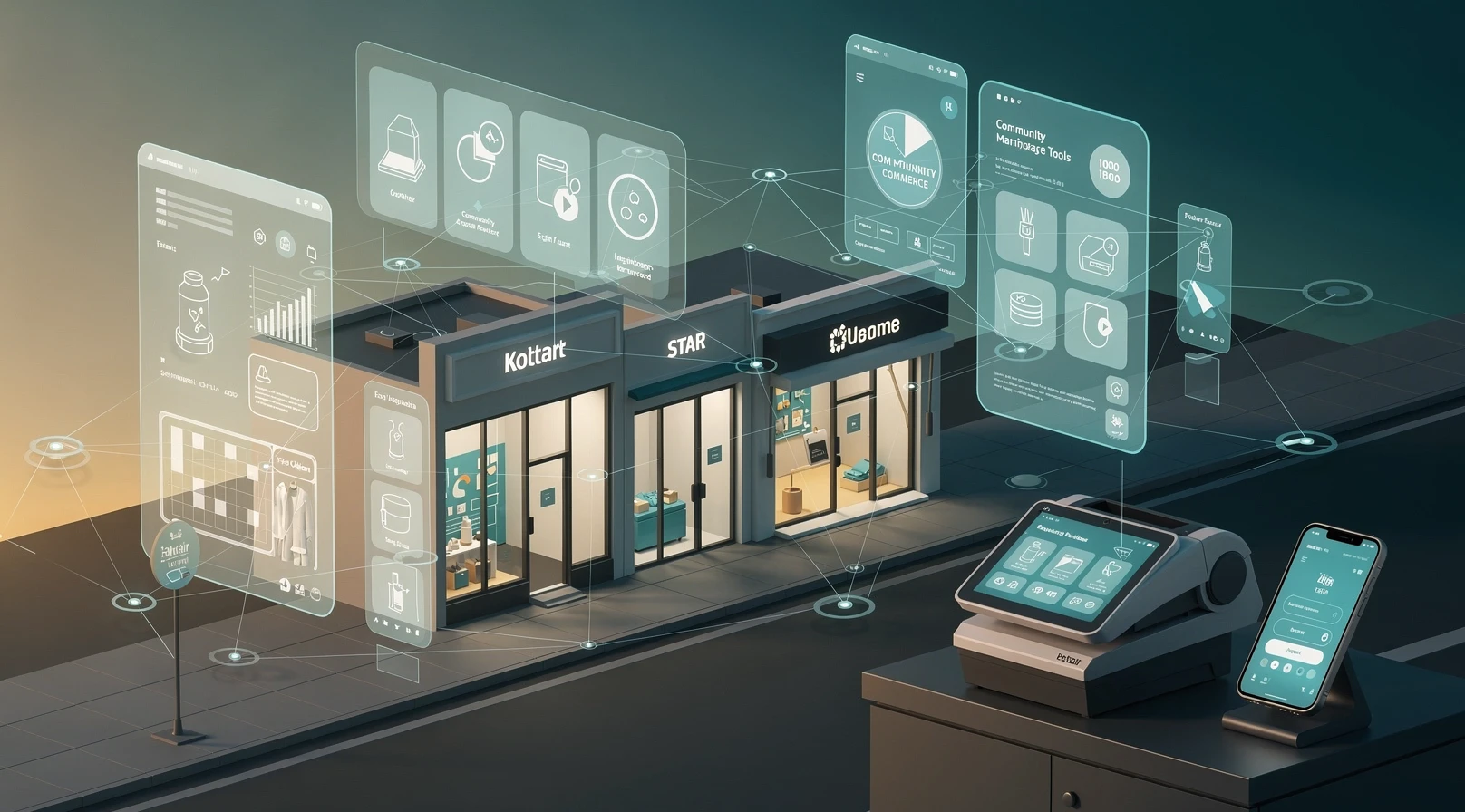
Community commerce stopped being a marketing buzzword sometime around 2024, and by 2026 it is a line item in real budgets. Independent retailers, regional chains, and direct-to-consumer brands now treat the neighborhood, the group chat, and the local marketplace as sales channels that deserve their own tooling. The question has shifted from whether to invest to which vendors actually move revenue.
This guide breaks down the software and service categories that power community commerce in 2026, names the vendors worth shortlisting, and shows how to sequence a rollout without overpaying. It is written for retail and e-commerce operators who need a working buyer’s map, not a vision deck. Every recommendation below assumes a real budget, a small team, and the goal of turning existing relationships into repeatable sales.
In short
- Community commerce tools now span five practical layers: point of sale, loyalty and CRM, group buying and local marketplaces, messaging, and events or pop-up logistics.
- No single platform owns the category, so most teams run a small stack of two to four vendors stitched together by a POS or CRM at the center.
- Pricing in 2026 skews toward usage-based and per-location models, which rewards starting narrow and expanding once a channel proves itself.
- The biggest failure mode is buying a marketplace or app before you have an audience to put on it. Audience first, tooling second.
- Fastest payback tends to come from loyalty and messaging tools that reactivate existing local customers rather than acquisition-heavy platforms.
Why community commerce tools matter in 2026
Acquisition costs on the big ad platforms kept climbing through 2025, and small retailers felt it most. When a single click costs more than a coffee, the math for winning a stranger stops working. Community commerce flips that logic by monetizing relationships that already exist: repeat customers, local followers, and neighbors who trust a recommendation from someone they know.
The tooling matured to match. What used to require a developer and a stack of loose plugins now ships as configurable products with local retail features built in. That maturity is exactly why a buyer’s guide is useful in 2026. There are now enough credible vendors that choosing badly is a real risk, and switching later is painful.
The stakes are strategic, not just tactical. As we argued in our overview of the future of local retail and main street commerce, the shops that survive the next decade are the ones that own their customer relationships instead of renting them from a platform. Community commerce tools are how that ownership gets operationalized.
There is also a defensive angle. National chains and quick-commerce apps keep pushing into local delivery, so an independent that cannot reach its own customers directly is exposed. The right stack narrows that gap without demanding enterprise budgets. A shop that can text two hundred regulars about a Friday drop competes on a footing that a paid-ad-only rival cannot easily match, because that reach is owned rather than rented and costs almost nothing to use again.
Key terms and definitions
Before shortlisting vendors, it helps to fix the vocabulary. The phrase community commerce gets stretched to cover very different things, and vendors exploit that ambiguity in their pitches.
Community commerce
At its core, community commerce means selling through and to a defined group of people who share a place, an interest, or an affiliation. That group might be a neighborhood, a hobbyist forum, a school network, or a loyal customer base. The defining trait is that trust and repeat contact do the work that paid ads do elsewhere.
Group buying and social selling
Group buying pools demand so a community can unlock wholesale-style pricing or a shared delivery run. Social selling layers commerce onto conversations, whether that is a live shopping stream, a curated group chat, or a creator recommending products to followers. Both mechanics reward a warm audience and punish a cold one.
Local marketplace
A local marketplace aggregates independent sellers or shops under one neighborhood-facing storefront, often with shared pickup, delivery, or events. Think of it as a digital high street rather than a global bazaar. These platforms live or die on local liquidity, meaning enough buyers and sellers in the same square mile.
How the community commerce stack works in practice
A working stack in 2026 rarely comes from one vendor. Instead, operators assemble a small set of specialized tools around a hub, usually the point of sale or the customer database. Data flows from the hub outward, and orders flow back in.
The typical pattern looks like this. The POS captures every in-store and pickup transaction. A CRM or loyalty layer tags those customers and segments them. A messaging tool reaches the segments with offers or event invites. A marketplace or group-buying app handles the transactional community layer. Reporting ties it together so you can see which channel actually paid off.
The hub-and-spoke model
Most successful small retailers treat one system as the source of truth and let everything else orbit it. For a shop with a physical counter, that hub is almost always the POS. For a brand born online, it is more often the e-commerce platform or the CRM. Picking the hub early prevents the classic mess of three systems each claiming to own the customer.
Where integrations break
The weakest joints are usually between the marketplace app and the POS, and between the loyalty tool and the messaging tool. When those handoffs rely on manual exports, staff quietly stop doing them within a month. Native integrations or a lightweight automation layer are worth paying for precisely because they survive a busy Saturday.
For a deeper look at converting a local following into transactions rather than just reach, our piece on turning a local following into sales walks through the audience-building side that sits upstream of any tool.
The core tool categories and vendors worth knowing
Community commerce is not one product category, it is five that work together. Below is a practical map of each layer, what it does, and the kinds of vendors to shortlist. Specific product names shift, so evaluate against your own transaction volume and integration needs rather than a logo.
| Layer | Job to be done | Vendor types to shortlist | Typical 2026 pricing model |
|---|---|---|---|
| Point of sale | Capture every sale, unify in-store and pickup | Square, Clover, Lightspeed, Shopify POS | Per location plus payment processing |
| Loyalty and CRM | Identify, segment, and reactivate customers | Loyalty apps, email or SMS platforms, retail CRMs | Per contact or per active member |
| Group buying and marketplace | Pool local demand, host community storefronts | Local marketplace platforms, group-order apps | Commission per order or flat monthly |
| Messaging | Reach segments with offers and event invites | SMS, email, and chat broadcast tools | Per message or per subscriber |
| Events and pop-ups | Run markets, drops, and community gatherings | Ticketing, RSVP, and mobile checkout tools | Per event or per ticket fee |
Point of sale and in-store tech
The POS is the anchor for most community commerce stacks because it sees every real transaction. In 2026 the leading options bundle inventory, basic loyalty, and mobile checkout, which reduces how many other tools you need. Choosing here has long consequences, so weigh the ecosystem and not just the monthly fee. Our comparison of choosing a retail POS in 2026 across Square, Clover, and Lightspeed covers the tradeoffs in detail.
Loyalty and CRM
Loyalty is where community commerce usually earns its fastest return, because reactivating a known customer costs a fraction of finding a new one. The vendors worth a look combine points or membership mechanics with clean segmentation and a messaging channel. The programs that work locally do more than issue points, as our look at local loyalty programs that actually circulate dollars locally explains.
Group buying and local marketplaces
This layer is the most crowded and the most uneven. Some marketplaces genuinely bring new local buyers, while others are thin directories that ask you to do the audience work yourself. Test liquidity before committing: ask how many active buyers the platform actually has within your delivery radius, not nationally.
Messaging and community channels
SMS and email remain the workhorses because you own the list and reach is not throttled by an algorithm. Group chats and community apps add a conversational layer, but they require moderation time that many small teams underestimate. Budget staff hours, not just software fees.
The practical rule is to pick one owned channel and run it well before adding a second. A tidy text list of a few hundred engaged locals beats a sprawling presence across five channels you cannot keep current. Consistency, not reach, is what makes messaging the reliable revenue engine of a community stack.
How to evaluate a community commerce vendor
Category maps are useful, but the deal is won or lost during evaluation. Two vendors in the same layer can look identical on a feature sheet and behave completely differently once your Saturday rush hits. Use a consistent checklist so you compare substance rather than sales decks.
Data ownership and portability
Ask who owns the customer data and how you export it if you leave. Some marketplaces and loyalty apps treat your customer list as their asset, which quietly locks you in. Insist on full export of contacts, orders, and loyalty balances in a standard format before you sign. Ownership of the relationship is the entire point of community commerce, so a tool that dilutes it is disqualifying.
Integration depth
A native, two-way integration with your hub is worth more than a longer feature list. Confirm that sales, contacts, and inventory sync automatically, not through a nightly file you have to babysit. Where a native connector does not exist, check whether a reliable automation layer can bridge the gap without constant repair.
Pricing traps
Usage-based pricing is fair when it tracks value, but read the meter carefully. Per-message fees, per-active-member charges, and transaction commissions can stack into a surprise once a channel scales. Model your cost at three times current volume, not today’s, so a success does not turn into a budget shock.
Support and roadmap
Small retailers rarely get enterprise support, so ask what real help looks like at your tier. A responsive help channel and a credible product roadmap matter more than a flashy demo. Vendors that serve independents well tend to publish clear documentation and ship steady improvements rather than headline features.
What is changing in community commerce tooling
The category is not static, and a few shifts in 2026 are worth factoring into any purchase so you do not buy into a dead end. None of these are reasons to wait, but they should shape which vendors you trust with a multi-year relationship.
Loyalty is getting smarter
Loyalty tools increasingly use purchase history to trigger the right offer automatically rather than blasting the whole list. That raises the return on the reactivation phase, but only if the underlying customer data is clean. It also rewards operators who invested early in a proper CRM hub instead of a scattered set of exports.
Payments and commerce are converging
The line between the POS, the checkout, and the loyalty layer keeps blurring, with more vendors bundling payments into a single relationship. That can simplify the stack, but it raises the switching cost, so weigh the convenience against the lock-in. Favor vendors that keep your data portable even when the payment rails are theirs.
Unified commerce reaches independents
Features that used to be exclusive to large chains, such as unified online and in-store inventory, are now within reach of single-location shops. That closes part of the gap with national competitors and quick-commerce apps. For an independent, the practical win is showing accurate stock across every channel a community customer might use.
Comparing build, buy, and platform approaches
Once you know the layers, the real decision is how much to assemble yourself versus buy off the shelf versus lean on a single platform. Each path fits a different stage and budget, and picking wrong wastes both money and momentum.
| Approach | Best for | Upfront effort | Monthly cost profile | Main risk |
|---|---|---|---|---|
| All-in-one platform | Single-location shops, limited staff | Low | Predictable, mid-range | Outgrowing the platform’s ceiling |
| Best-of-breed stack | Multi-location or fast-growing brands | Medium | Variable, scales with usage | Integration upkeep and data silos |
| Custom build | Large operators with developers | High | High fixed, low marginal | Slow to launch, maintenance burden |
For most independents in 2026, the honest answer is start with an all-in-one and graduate to a best-of-breed stack only when a specific bottleneck justifies it. Custom builds rarely pay off below a few million dollars in annual revenue, because the maintenance tax eats the flexibility gains.
A useful test: if a proposed tool cannot show payback within two full quarters, it belongs on a later phase of the roadmap. Community commerce rewards patient sequencing over a big-bang launch.
Common mistakes and how to avoid them
The pattern of failure in community commerce is remarkably consistent. Most of it comes from buying tools in the wrong order or expecting software to manufacture an audience it cannot create.
Buying the marketplace before the audience
The single most common error is signing up for a local marketplace or group-buying app while having no warm audience to point at it. Empty storefronts stay empty. Build the list and the relationships first, then add the transactional layer once there is demand to channel.
Ignoring the integration tax
Every extra vendor adds a seam that can leak data or break during an update. Teams routinely underestimate the ongoing hours needed to keep a four-tool stack in sync. Favor fewer tools with native integrations over a sprawling best-of-breed setup you cannot maintain.
Treating events as one-offs
Pop-ups and local markets are among the highest-return community tactics, yet many retailers run them without capturing a single email or phone number. That wastes the most valuable output of the event. Pair every gathering with a capture tool, a theme our guide to pop-up markets and the rise of community-led retail events explores in depth.
Confusing reach with revenue
A large group chat or follower count feels like progress, but it only matters if it converts. Track sales attributable to each channel, not vanity metrics. If a community tool cannot tie back to orders, it is a cost center wearing a growth costume. The fix is simple discipline: attach a code, a link, or a segment to every campaign so the revenue is traceable back to the tool that produced it.
Examples from US retail and e-commerce
Abstract advice only goes so far, so consider how the categories play out in practice across US operators of different sizes. These composite patterns reflect what actually works in 2026 rather than vendor case studies.
A single-location bookshop leans on an all-in-one POS with built-in loyalty, runs a monthly SMS list to regulars, and hosts author events that feed new contacts back into that list. The entire stack is two vendors, and the events do the acquisition that ads used to.
A regional coffee chain with eight locations runs a best-of-breed setup: a multi-location POS as the hub, a dedicated loyalty app, and an SMS platform for drop announcements. The added complexity is justified because per-location data and segmentation drive real repeat visits across the network.
A direct-to-consumer apparel brand uses its e-commerce platform as the hub, layers on a group-buying mechanic for limited drops, and coordinates local pop-ups in three cities. Here the community is interest-based rather than strictly geographic, which shows how flexible the model has become.
A neighborhood hardware store offers a fourth pattern. It runs a modest POS, a text-message list for seasonal reminders, and a spot on a local marketplace that already had real buyers nearby. Because the marketplace supplied genuine local demand rather than an empty directory, the store treated it as an acquisition channel and funneled those new buyers into its own text list. The tooling stayed small, but the sequencing turned borrowed reach into owned relationships.
According to the US Census Bureau retail trade data, nonstore and specialty retail continue to outpace traditional formats, which is exactly the tailwind community-first operators are riding. The common thread across all four examples is a clear hub, a warm audience, and disciplined sequencing. None of them led with the flashiest tool, and none tried to run every layer at once. They picked a hub, proved a channel, and only then expanded.
How to budget and sequence your rollout
The safest way to enter community commerce is to phase the spend so each layer proves itself before the next arrives. This keeps risk low and forces the discipline that makes the whole model work.
Phase one: capture and reactivate
Start with the hub and a way to reach existing customers. That usually means a capable POS plus a loyalty or messaging tool. This phase should pay for itself through repeat visits before anything else is added. Most shops see a return here within a single quarter.
Phase two: convene and convert
Once you can reliably reach your base, add the community layer: events, pop-ups, or a group-buying mechanic. This is where reach turns into occasions to buy. Fund it from the reactivation gains earned in phase one, not from a separate budget.
Phase three: expand and integrate
Only after the first two phases are steady should you consider a local marketplace or a deeper best-of-breed stack. By this point you have both an audience and the operational habits to run more tools without dropping them. Broader industry benchmarks compiled by outlets such as Statista can help sanity-check your channel targets against category norms.
Sequencing this way also protects cash flow. Because 2026 pricing skews usage-based, a phased rollout means you only pay for scale once you have the volume to justify it. It also keeps your team focused, since each phase has one clear job to prove before the next begins.
Read against the longer arc we set out in our look at the future of local retail and main street commerce, this phased approach is less about a single purchase and more about building an operating habit. Each tool you add should deepen the relationship you already own rather than chase a new one from scratch.
Frequently asked questions
What is the difference between community commerce and social commerce?
Social commerce sells through social media features and creator networks, wherever those audiences happen to be. Community commerce is narrower and place or affiliation based, centered on a defined group that shares a neighborhood, interest, or membership. The two overlap when a local shop sells through a community group chat, but community commerce emphasizes owned relationships over rented platform reach.
How many tools do I actually need to start?
Two is usually enough to begin: a point-of-sale hub and one way to reach customers, such as a loyalty app or an SMS platform. Adding more before you have an audience to serve tends to create maintenance work without revenue. Expand the stack only when a specific bottleneck, like event capture or multi-location reporting, forces the issue.
Which layer gives the fastest return on investment?
Loyalty and messaging tools typically pay back fastest because reactivating a known customer costs far less than acquiring a new one. A well-run SMS or email program can lift repeat visits within weeks. Marketplaces and group-buying apps take longer because they depend on building local liquidity first.
Are local marketplaces worth joining in 2026?
They can be, but only if the platform already has active buyers within your delivery radius. Thin marketplaces effectively ask you to supply the audience, which defeats the purpose. Before committing, ask for real local buyer counts and test with a limited catalog rather than migrating your whole store.
Should a small shop build custom tools or buy off the shelf?
Almost always buy. Custom builds rarely pay off below a few million dollars in annual revenue because the maintenance burden outweighs the flexibility for smaller operators. Start with an all-in-one platform and only move to a best-of-breed or custom setup when a clear, revenue-limiting constraint appears.
How do I measure whether a community tool is working?
Tie every tool to attributable orders, not vanity metrics like follower counts or chat size. Set a simple payback threshold, such as covering its cost within two quarters, and cut anything that cannot meet it. If a tool cannot show its contribution to revenue, treat it as a cost until proven otherwise.
What is the biggest mistake first-timers make?
Buying the transactional layer, a marketplace or group-buying app, before building any warm audience to put on it. Empty storefronts stay empty. The reliable sequence is audience first through capture and reactivation, then community occasions, and only then a marketplace expansion.
How does community commerce fit a national or online-first brand?
For online-first brands the community can be interest-based rather than strictly local, using group buying for limited drops and coordinated pop-ups in key cities. The same hub-and-spoke logic applies, with the e-commerce platform or CRM as the hub. This flexibility is a large part of why the model scaled beyond neighborhood shops by 2026.