
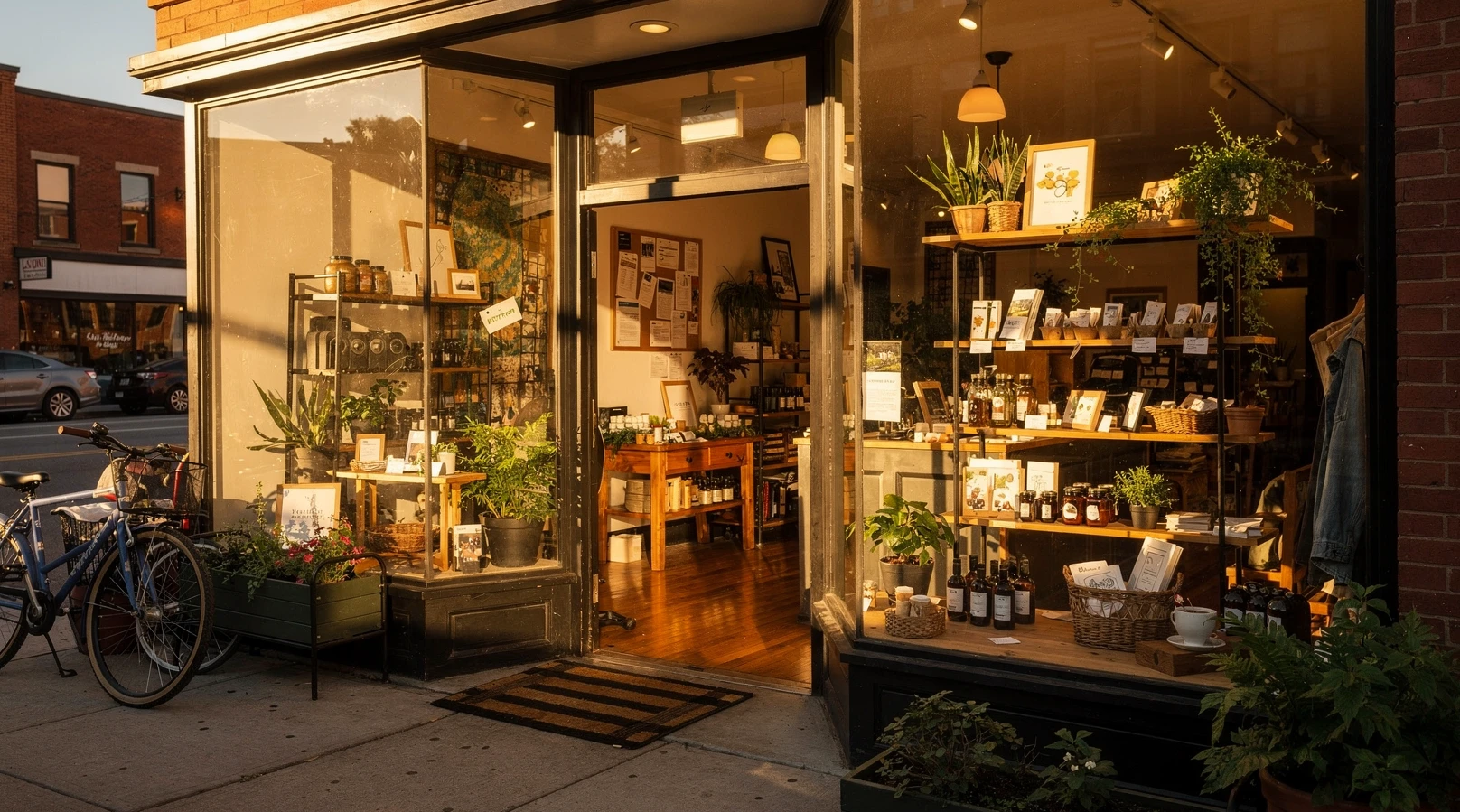
A 4,000-follower Instagram account does not pay rent. Plenty of independent shops have built a warm, chatty local audience and still watch slow Tuesdays, dead inventory, and margins that never recover from the last markdown cycle. Community commerce is the discipline that fixes the disconnect between attention and revenue: it treats your neighborhood following as a sales channel with funnels, segments, and retention math, not as a vanity metric you check between customers.
This guide is for owner-operators and small retail teams who already have some local presence and want it to produce trackable dollars. It assumes you cannot hire an agency, you run the register yourself some days, and you need tactics that survive contact with a real store. The numbers and workflows below come from how thriving independents in 2026 actually convert: small, repeatable plays that compound, not a single viral moment.
In short
- Community commerce is the practice of converting a local audience (in person, on social, on a list) into repeat, measurable retail sales rather than passive followers.
- The two metrics that matter are follower-to-customer conversion rate and repeat purchase rate; track them monthly or you are guessing.
- Owned channels (email and SMS) outperform rented social reach for actual sales, often by 5x to 10x on revenue per recipient.
- Segmentation beats blasting: a 200-person VIP list usually outsells a 4,000-person follower count.
- The fastest wins are a first-purchase trigger, a lapsed-customer winback, and an in-store capture loop that feeds the list every day.
What community commerce actually means for a local store
Community commerce is selling through relationships in a defined geography rather than through paid acquisition at scale. The unit of value is not a click; it is a person who knows your store, trusts your taste, and lives close enough to walk in. For a local retailer that means your following, your email list, your text subscribers, your loyalty members, and the regulars who never gave you a single digital handle all belong to one channel.
The reason this matters now is cost. Paid social acquisition for independents has gotten expensive and noisy, while the people who already chose your block are cheap to reach and far more likely to buy again. The boring constraints of physical retail, the ones covered in Rent, parking and zoning: the boring truths of main street retail, also push in the same direction: when your fixed costs are tied to a specific location, your most profitable growth comes from selling more to the people already near that location.
Practically, a community commerce program has three jobs. First, capture: turn every interaction (a purchase, a browse, an event, a comment) into a contact you own. Second, segment: sort those contacts by value and recency so you talk to a first-timer differently than a weekly regular. Third, activate: send the right offer or message to move each segment to the next purchase. Skip any one of the three and the program leaks.
The metrics that separate a following from a business
Answer-first: the only numbers worth obsessing over are follower-to-customer conversion rate, repeat purchase rate, customer lifetime value (LTV), and revenue per email or text sent. Likes, reach, and follower counts are leading indicators at best and distractions at worst.
Follower-to-customer conversion rate is the share of your audience that bought in a given window. If you have 4,000 followers and 160 of them purchased this quarter, you are at 4 percent, which is roughly the realistic ceiling for passive social reach. The fix is almost never more followers; it is moving people onto owned channels where the conversion math improves dramatically.
Here is what those benchmarks look like in practice for a typical independent retailer running a basic program:
| Channel | Typical conversion to purchase | Revenue per recipient (monthly) | Cost to reach |
|---|---|---|---|
| Organic social followers | 1 to 4 percent | $0.05 to $0.30 | Low but declining reach |
| Email list | 2 to 5 percent per send | $0.50 to $2.00 | Near zero |
| SMS list | 10 to 25 percent per send | $2.00 to $8.00 | Per-message fee |
| Loyalty / VIP segment | 20 to 40 percent per campaign | $5.00 to $15.00 | Near zero |
The table makes the strategy obvious: a follower is worth a few cents a month, a VIP loyalty member can be worth a hundred times that. Your job is not to grow the cheap top of the list; it is to move people down it. Tracking which posts and offers actually drive store visits requires the same rigor you would apply to foot traffic data and what main street retailers should actually track, because a community campaign that spikes attention without lifting visits or sales is theater, not commerce.
Build the capture loop before you build the audience
Answer-first: never spend on growing a following until you have a reliable system that turns the audience you already have into owned contacts. A bigger rented audience just leaks faster.
The capture loop is the engine. Every day your store should be converting anonymous attention into a name, an email, and ideally a phone number, with explicit consent. The mechanics are mundane and that is the point: they run whether or not you feel inspired.
- At the register: ask for an email or text opt-in tied to a concrete benefit (“text JOIN to get first dibs on restocks and 10 percent off today”). Train every shift to ask, every time, and track the daily capture count.
- On the receipt and bag: print a short code or QR that joins the list, with a one-line reason to scan it.
- In the window and at the door: a static signup that works for the foot traffic that never buys on the first pass.
- On social: every bio and pinned post drives to the list, not just to the follow button. Treat a new follower as a lead to convert, not a finish line.
- At events and pop-ups: capture is the primary KPI of any event, ahead of same-day sales, because the list is what monetizes the relationship for months afterward.
A store that captures 8 to 15 new opted-in contacts a day builds a serious owned audience inside a year without spending a cent on reach. That list, segmented and worked, is the asset. The followers are just the top of the funnel.
Consent and hygiene matter as much as volume. Use a clear opt-in with the benefit stated up front, log the source of each contact (register, event, web, social), and honor unsubscribes instantly so your deliverability and trust stay intact. A clean, permission-based list of 1,500 names will out-earn a scraped or padded list of 5,000 every time, because the people on it actually opened the door. Treat the capture count as a daily scoreboard the way a restaurant watches covers: a number you read every shift and coach the team against, not a quarterly afterthought.
Segment so a 200-person list outsells 4,000 followers
Answer-first: segment by recency and value (a simple RFM model: recency, frequency, monetary) so your messages match where each person is in their buying cycle. Undifferentiated blasting trains people to ignore you.
You do not need expensive software to start. Four segments cover most independents:
| Segment | Definition | Primary goal | Cadence |
|---|---|---|---|
| VIP / regulars | 3+ purchases or top 10 percent spend | Reward, early access, referrals | Frequent, high-touch |
| Recent buyers | Bought in last 60 days | Second purchase, cross-sell | Triggered + monthly |
| One-time buyers | One purchase, 60+ days ago | Bring back to second purchase | Winback sequence |
| Leads / followers | On list, never purchased | First purchase | Welcome sequence |
The leverage hides in the math. A 200-person VIP segment converting at 30 percent on a $60 average order produces $3,600 from one campaign. A 4,000-person follower blast converting at 2 percent on the same order value produces $4,800 but reaches almost nobody twice and costs you reach every time the algorithm shifts. The VIP segment is the durable asset; it compounds, it refers, and it does not depend on a platform’s mood.
This is also where personality and provenance pay off. Customers buy from people, and the operators who win at community commerce tell a consistent story across every touch. The vendor and tooling choices that support that storytelling are laid out in tools and vendors for small business stories in 2026, and they matter because a segment only responds when the message in front of it feels like it came from a store the customer actually knows.
The three campaigns that pay for the whole program
Answer-first: build a welcome sequence, a winback sequence, and a VIP early-access loop first. These three triggered flows produce the majority of community-driven revenue for most small retailers, and they run automatically once set.
The welcome sequence turns a new contact into a first purchase. Send three to four messages over the first two weeks: a thank-you with the promised incentive, a story about the shop and what makes the buy worthwhile, a single best-seller or category nudge, and a gentle expiry reminder on the incentive. Expect 15 to 30 percent of new contacts to make a first purchase inside that window when the offer is concrete.
The winback sequence targets one-time buyers who have gone quiet for 60 to 90 days. Lead with a reason to return that is not always a discount: a new arrival in the category they bought, an event, or a “we saved you something” personal touch. A two-message winback commonly reactivates 8 to 15 percent of lapsed buyers, which is pure recovered revenue from people you already paid to acquire.
The VIP early-access loop rewards your best customers with first pick on restocks, limited drops, and events before the general list. This does two things: it lifts repeat rate among your most valuable segment, and it generates the social proof and word of mouth that feeds the top of the funnel for free. VIPs who feel like insiders refer at several times the rate of ordinary buyers.
One operational note that touches all three: when you start moving real volume through your store, the mechanics of getting paid stop being invisible. The fees, settlement timing, and chargeback exposure baked into every swipe are worth understanding before you scale promotions, and how card networks really work behind every retail checkout is a useful primer so your margin math survives a busy campaign weekend.
Run events and drops as commerce, not as parties
Answer-first: every in-person event should have a capture target, a conversion mechanic, and a follow-up plan attached before you book it. An event without those three is a cost center wearing a marketing costume.
Community commerce thrives on scarcity and presence. Limited drops, maker nights, member-only previews, and seasonal pop-ups give people a concrete reason to show up at a specific time, which is the one thing pure online retail cannot manufacture. The discipline is to attach numbers to the warm feelings.
Set three targets per event: contacts captured, on-site purchase rate, and post-event 30-day repeat rate from attendees. Promote primarily to your owned list and VIP segment first, then to followers, so your most likely buyers fill the room before you spend reach on strangers. After the event, the follow-up sequence is where most of the revenue actually lands: attendees who did not buy on the night convert through a timely reminder far more often than cold leads ever will.
Common mistakes
The most expensive error is chasing follower growth as the goal. Followers are a leading indicator that decays; owned contacts are an asset that appreciates. Money spent growing reach before you can convert it is money lit on fire.
The second is blasting one message to everyone. Sending the same promotion to a VIP and a never-buyer trains both to tune you out and quietly erodes your deliverability and your brand. Segment from day one, even crudely.
The third is discounting as the only lever. Reflexive markdowns teach your community to wait for the next sale and shred the margin that community commerce is supposed to protect. Lead with access, story, and newness; use price as a deliberate tool, not a default.
The fourth is not measuring store impact. If you cannot tie a campaign to visits or sales, you cannot tell which plays to repeat. Even a manual tally of “how did you hear about this” at the register beats flying blind on engagement metrics that never touch the till.
The fifth is treating the program as a campaign instead of a system. Community commerce works because the capture loop and triggered flows run every day without your attention. One-off bursts of effort produce one-off bursts of revenue and then nothing.
FAQ
How is community commerce different from regular social media marketing?
Social media marketing optimizes for reach and engagement on rented platforms. Community commerce optimizes for repeat purchases from a local audience you own across email, text, loyalty, and in-store relationships. The difference shows up in the metrics: social marketing celebrates followers and likes, while community commerce tracks conversion rate, repeat purchase rate, and revenue per recipient. Social can feed the top of the funnel, but the durable sales come from moving that audience onto owned channels and working it with segmentation and triggered flows.
How many followers do I need before this works?
Far fewer than most owners assume. The program works at almost any scale because it is built on conversion and retention, not audience size. A store with 300 engaged local contacts and a working capture loop will out-earn a store with 10,000 passive followers and no system. Start with the audience you have, install the capture loop and the three core flows, and let the owned list grow organically from daily store traffic. Chasing a follower threshold before building the engine just delays the revenue.
Should I prioritize email or SMS for my local audience?
Build both, but treat them differently. SMS has dramatically higher open and conversion rates and is ideal for time-sensitive plays like drops, restocks, and event reminders, so reserve it for high-value, low-frequency messages. Email carries the storytelling, the longer welcome and winback sequences, and the segmented newsletters that build relationship over time. SMS costs per message and tolerates almost no over-sending, while email is nearly free and forgives a higher cadence. Most successful independents run email as the workhorse and SMS as the sharp instrument.
What is a realistic repeat purchase rate to aim for?
For independent retail, moving repeat purchase rate from a baseline near 20 percent toward 35 or 40 percent is a strong and achievable goal within a year of running structured flows. The biggest single lever is the second purchase: customers who buy twice are far more likely to become regulars than first-timers are to buy at all. That is why the welcome sequence and the recent-buyer cross-sell deserve your first attention. Track the rate monthly by segment so you can see which flows are actually lifting it.
Do I need expensive software to run a community commerce program?
No. You can start with a basic email platform, a simple SMS tool, and your point-of-sale system’s built-in customer records. The segments described here can be managed with tags and manual lists at first. Software helps once volume grows and you want automation, deeper RFM scoring, and tighter point-of-sale integration, but the strategy is not gated behind a big stack. Spend on tools only after the manual version is producing measurable revenue, so you are automating something that already works rather than buying a system and hoping.
How do I measure whether a campaign actually drove store sales?
Use trackable mechanics: unique codes or coupons per campaign, SMS keywords, and post-purchase “how did you hear about us” capture at the register. Compare sales and visits in the campaign window against a normal baseline week. For events, track contacts captured, on-site conversion, and 30-day repeat rate from attendees. The goal is attribution good enough to decide what to repeat, not academic precision. Even rough tracking beats engagement metrics that never connect to revenue, and it sharpens fast once you make it a habit.
How often should I message my community without burning them out?
Cadence follows segment and channel. VIPs tolerate and even want frequent, high-value contact; never-buyers need a tighter welcome sequence and then restraint. On email, a weekly or biweekly rhythm plus triggered flows works for most stores. On SMS, hold to a few high-value messages a month. Watch your unsubscribe and reply behavior as the real signal: rising opt-outs mean you are sending too much or too little value, not just too often. Relevance, driven by segmentation, buys you far more frequency than volume ever will.
What is next
Start this week by installing the capture loop at your register and shipping a three-message welcome sequence, then layer in the winback and VIP flows over the following month so the system runs without you. Keep your eye on conversion and repeat rate rather than follower counts, and remember that the broader forces shaping independent retail, the kind tracked in coverage of rent, parking and zoning realities on main street, all reward the same move: sell more to the people who already chose your block. For context on how the wider industry narrative affects what your community responds to, the analysis of U.S. retail sales data from the Census Bureau is a steady reference point worth checking each quarter.