
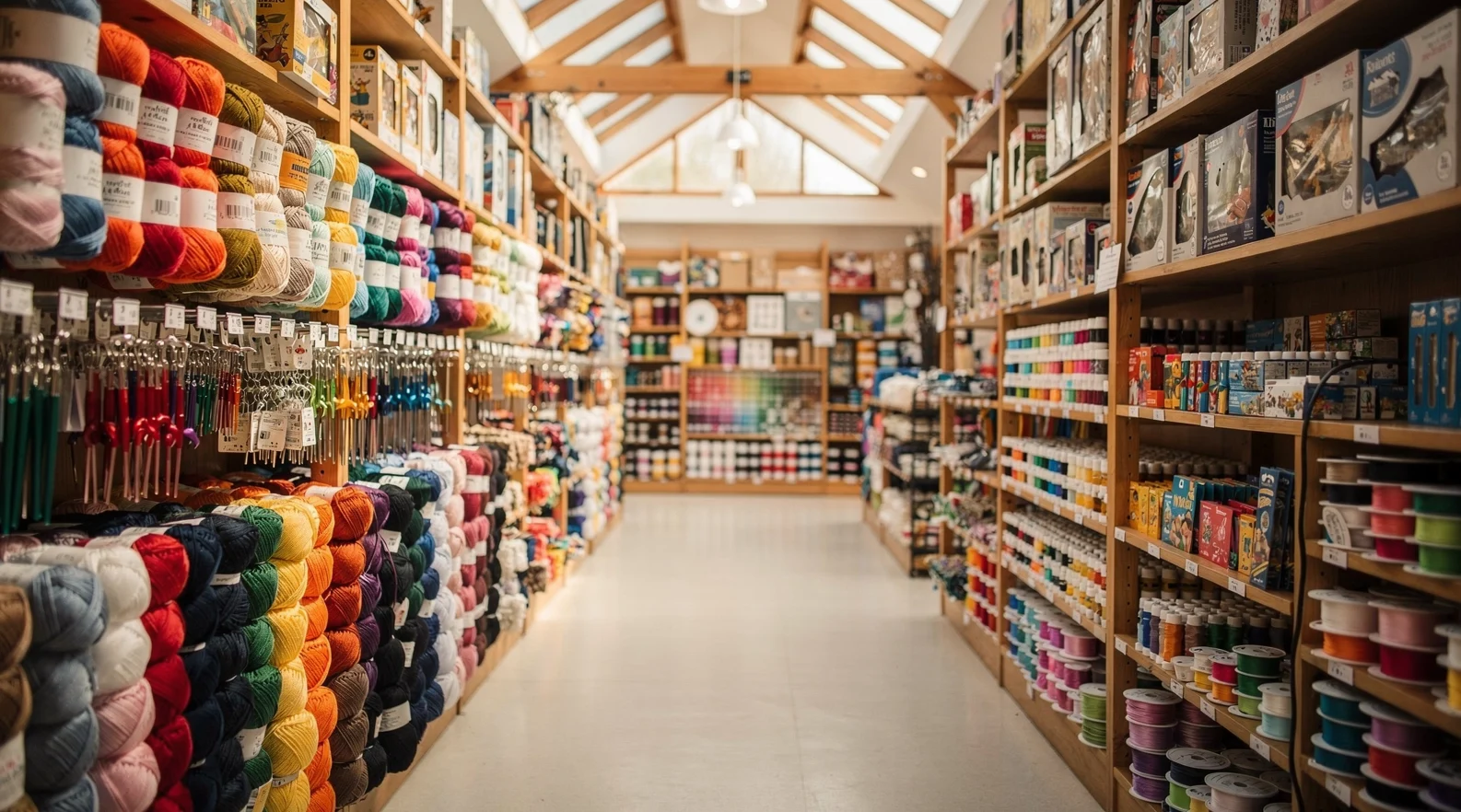
Hobbycraft, the UK’s largest arts and crafts chain, has swung back into the black. The retailer reported a statutory profit of £8.7m for the 52 weeks to 15 February 2026, against a £10.1m loss a year earlier, according to the company’s results statement published on Friday 13 November and reported by Retail Times, InternetRetailing and Retail Week. The figures cover the first year after a company voluntary arrangement (CVA) that closed 18 stores and cut the estate from 124 shops to 107.
The headline number matters to more than investors. Hobbycraft is one of the few specialist chains that many UK towns and retail parks still have for wool, paint, sewing machines and model kits, and its 2.8 million loyalty members are a big slice of the country’s crafting public. The results also set out where the business goes next: a TikTok Shop launch, garden centre trials, more concessions such as Post Office counters, and a look at Ireland, Germany and Poland.
In short
- Profit is back: statutory profit of £8.7m in FY26 (to 15 February 2026) after a £10.1m loss in FY25; adjusted trading EBITDA rose from £4.8m to £15.5m.
- Smaller but steadier: revenue slipped to £210.4m from £215.9m as the estate shrank from 124 to 107 stores, while like-for-like sales grew 2%, and 4% in the second half.
- CVA exited early: Hobbycraft left its CVA on 25 June 2026, which the company says is two years ahead of schedule; borrowings on its asset-backed facility fell £5.7m to £17.9m.
- Screen-free demand: model-making sales rose 45% and crochet 24% over the year, and online searches for “Kawaii” craft items jumped 221%.
- What comes next: an “imminent” TikTok Shop launch, three garden centre trials, more concessions and a review of expansion into Ireland, Germany and Poland.
What did Hobbycraft report?
The results cover Hobbycraft’s financial year 2026, the 52 weeks that ended on 15 February 2026. That window opens just before the restructuring was unveiled in April 2025 and closes after the 2025 Christmas peak, so it is the first full year that shows the effect of the CVA, the store closures and the new ownership under Modella Capital.
The company’s statement, as published in full by Retail Times, lists seven headline points. Statutory profit reached £8.7m compared with a £10.1m loss. Adjusted trading EBITDA, the company’s preferred measure of underlying earnings before interest, tax, depreciation and amortisation, more than tripled to £15.5m from £4.8m.
Like-for-like sales, which strip out stores that opened or closed, rose 2.0% after a 4.3% fall the year before. The second half was stronger, with like-for-like growth of 4.0%. Total revenue fell to £210.4m from £215.9m, a decline of about 2.5% (shopappy calculation), which the company puts down to the smaller estate.
Trading gross margin held at 59.0%. Drawn borrowings under its asset-backed revolving credit facility (ABL RCF) fell by £5.7m to £17.9m from £23.6m, and stock on hand was cut by £7.9m. Active Hobbycraft Club membership reached a record 2.8 million, up from 2.7 million.
| Measure | FY26 (to 15 Feb 2026) | FY25 (to 16 Feb 2025) | Change |
|---|---|---|---|
| Statutory profit (loss) | £8.7m profit | £10.1m loss | £18.8m swing |
| Adjusted trading EBITDA | £15.5m | £4.8m | more than tripled |
| Total revenue | £210.4m | £215.9m | about 2.5% lower |
| Like-for-like sales | +2.0% (H2 +4.0%) | -4.3% | back to growth |
| Trading gross margin | 59.0% | 59.0% | flat |
| Stores at year end | 107 | 124 | 17 fewer |
| Drawn ABL RCF borrowings | £17.9m | £23.6m | £5.7m lower |
| Active Club members | 2.8 million | 2.7 million | about 100,000 more |
Source: Hobbycraft FY26 results statement, 13 November 2026, as published by Retail Times. The £18.8m swing and percentage revenue change are shopappy calculations from the company’s figures.
A note on the earnings measure
Readers comparing this year with last should be careful with EBITDA. When Hobbycraft published its FY25 figures in November 2025, Retail Gazette reported that adjusted EBITDA had halved to £5.2m from £10.4m in 2024. The new statement gives FY25 adjusted trading EBITDA as £4.8m. The two figures are close but not identical, which suggests a different definition or a restated base; the company has not explained the gap in the material published so far.
The statutory figure is the cleaner comparison. It moved from a £10.1m loss to an £8.7m profit, and the FY25 loss was, according to Retail Gazette’s report at the time, driven largely by a non-cash impairment charge and one-off costs tied to the sale of the business to its new owner.
How did Hobbycraft get from loss to profit?
The short answer is fewer shops, lower costs and slightly better sales in the shops that remained. The company describes a “comprehensive turnaround plan” covering the store estate, operating costs and stock management, backed by its shareholder.
The adjusted EBITDA gain of roughly £10.7m (shopappy calculation) came while revenue fell. That pattern, profit rising as sales shrink, is typical of a retailer that has closed loss-making branches: the lost revenue from those shops was smaller than the losses they generated. The statement also credits “one off restructuring efficiencies”, which means some of the improvement may not repeat.
The CVA and the closure list
A CVA is a formal insolvency procedure that lets a company keep trading while creditors, usually landlords, agree to new terms such as lower rents or the surrender of leases. Unlike administration, the business does not change hands and customers can usually keep shopping as normal.
Hobbycraft confirmed its restructuring in April 2025. Retail Gazette reported at the time that nine stores would stop trading by mid-July 2025: Bagshot, Basildon, Borehamwood, Bristol Imperial Retail Park, Canterbury, Cirencester, Dunstable, Epping Forest and Lakeside. Up to 126 roles were at risk, including posts at the Bournemouth head office and the distribution centre in Burton-on-Trent, and the plan was meant to secure at least 99 stores and 1,800 jobs.
A second wave followed in August 2025. Retail Gazette reported that Bromborough, Southport and Stratford-upon-Avon would close that month, with Wigan, Maidenhead, Chichester, Stafford, King’s Lynn and Crayford following in September. By Hobbycraft’s own account in November 2025, the restructuring “resulted in the closure of eighteen loss-making stores”.
The FY26 statement says Hobbycraft formally exited the CVA on 25 June 2026. A notice of completion of the voluntary arrangement (form CVA4) appears on the Companies House register for Hobbycraft Trading Limited, filed on 8 July 2026. The company says the exit came two years ahead of schedule, after it met its restructuring milestones early.
The full FY26 accounts have not yet reached the register. Hobbycraft says they will be filed during the week commencing 9 November 2026; when shopappy checked the filing history on the afternoon of 13 November, the most recent accounts listed were those for the year to 16 February 2025, filed in November 2025. The full document should show the going-concern statement, directors’ pay and the detail behind the “one off” items.
Why are screen-free hobbies selling?
Hobbycraft’s own explanation leans heavily on a change in how people spend their free time. The company points to “growing demand for screen-free hobbies, mindful making and creative wellbeing” and cites category growth to back that up: model-making sales rose 45% and crochet 24% over the 52 weeks, compared with the previous 52 weeks.
It also says online searches for Japanese pop-culture “Kawaii” crafting items jumped 221%. InternetRetailing adds social media trends such as “grandma-maxxing” and cottagecore, together with BBC programmes including The Great Pottery Throw Down and The Great British Sewing Bee, as drivers of interest in making things by hand.
The company’s Power of Making report, produced with the mental health charity Mind, found that 8.8 million UK adults use crafting to support their mental health and that 91% agree children should spend less time on digital devices. InternetRetailing also cites a 2026 study commissioned by National Rail which found that 34% of adults would rather relax with a creative hobby than in front of a screen.
What Christmas 2025 told us
The festive figures, released in January 2026, gave an early signal. In the six weeks to Christmas, total revenue grew 6.3% and ecommerce sales rose 13.8%, according to Retail Times and Retail Gazette. Christmas product sales rose 21.6%, model-making kits 61.1% and the wider hobbies and collectables category 52.6%.
Hobbycraft said it sold more than half a million balls of wool in those six weeks, and that its velvet ribbon sales rose 206% on the back of a TikTok garland trend. Sales of Tom Daley’s beginner crochet and embroidery kits, sold exclusively through the chain, rose 32%. Club sign-ups rose 32% and Club-driven revenue 37%. The same screen-free theme shows up across the toy aisle too, where UK toy sales are growing at their fastest rate in more than a decade on the back of building sets and sticker and squishy crazes.
| Category or metric | Growth | Period |
|---|---|---|
| Model-making sales | +45% | 52 weeks, FY26 statement |
| Crochet sales | +24% | 52 weeks, FY26 statement |
| Online searches for “Kawaii” craft items | +221% | FY26 statement |
| Ecommerce sales | +13.8% | six weeks to Christmas 2025 |
| Model-making kits | +61.1% | six weeks to Christmas 2025 |
| Velvet ribbon | +206% | six weeks to Christmas 2025 |
| Christmas gift cards | +37% | six weeks to Christmas 2025 |
| Club sign-ups | +32% | six weeks to Christmas 2025 |
Source: Hobbycraft statements of 12 January 2026 and 13 November 2026, as reported by Retail Times, Retail Gazette and InternetRetailing.
Is the recovery as strong as the headline suggests?
The turnaround is real on the measures the company publishes, but the scale needs context. A 2% like-for-like rise in a year of above-target inflation is modest, and part of it may reflect customers from closed branches moving to nearby stores. Total revenue is still lower than it was two years ago: Retail Gazette reported FY24 sales of £218.3m, so FY26’s £210.4m is about £7.9m below that level (shopappy calculation).
The second half is the more encouraging part. Like-for-like growth of 4.0% in the six months that included the 2025 Christmas peak, set against the January figure of 6.3% total growth over the festive weeks, points to momentum building through the year rather than a one-off bounce.
Retail Week’s headline described Hobbycraft’s profits as having “rocketed”. That is fair on the percentage swing, but in absolute terms an £8.7m profit on £210m of sales is a margin of roughly 4% (shopappy calculation). That leaves limited room for error as the business absorbs higher wage bills and employer National Insurance costs that other chains have flagged in recent results.
How it fits the wider results season
Hobbycraft’s figures land in a crowded week for retail results. On 12 November, WH Smith reported a 30% fall in headline profit as it pulled back from parts of North America and Europe, while B&M said UK like-for-like sales had returned to growth in its second quarter. DFS warned on 13 November that sofa demand had softened further.
Against that backdrop, Hobbycraft’s numbers fit a pattern seen across discretionary retail in 2026: chains that have cut weaker stores and focused on a clear customer need are improving profit, even when total sales are flat or falling. The Works made a similar case in its July results, saying it had “significantly” outperformed a UK non-food market that fell 0.1% on a like-for-like basis over its financial year, according to British Retail Consortium data it cited.
The difference is that Hobbycraft’s figures run only to February 2026. They say nothing about how the business has traded through spring, summer and the run-up to this Christmas, which is when craft retailers make most of their annual profit.
The January trading update was fronted by chief executive Alex Willson. The FY26 statement quotes Graeme Campbell as acting chief executive. The material published on 13 November does not explain the change or say when a permanent appointment will be made, and shopappy has not been able to confirm the timing from a second source. Earlier reporting, including shopappy’s own coverage of TG Jones in September, named Willson as chief executive of TG Jones, Modella’s former WH Smith chain.
Campbell’s comment in the statement is upbeat. “FY26 has been a pivotal, transformative year for Hobbycraft,” he said. “While the retail sector faced continuing inflation and subdued consumer confidence, the decisive actions we took under our turnaround plan have right-sized our cost base, revitalised our core estate and returned the business to robust profitability.”
Who owns Hobbycraft, and why does that matter?
Hobbycraft is owned by Modella Capital, the investment firm led by chief executive Joe Price. Modella has become one of the busiest buyers of struggling UK high street chains. It also owns TG Jones, the former WH Smith high street business. Its record is not all recovery: two other chains it has owned, Claire’s and The Original Factory Shop, have entered administration, according to trade and legal reports.
The firm’s appetite has not slowed. Retail Sector reported in May 2026 that Modella was nearing a takeover of Flying Tiger Copenhagen, and on 2 November 2026 that it was considering a bid for the fashion brand Joseph. The TG Jones estate is itself being reshaped, with shopappy reporting last month on TG Jones plans affecting 70 Post Office counters by 2027.
That matters for Hobbycraft shoppers in two ways. First, Modella’s model is to buy at low prices, cut the estate hard and rebuild profit, which is exactly what has happened here. Second, it means Hobbycraft’s strategy may increasingly be tied to the rest of the group, for example through shared concessions. The FY26 statement mentions “the continued rollout of strategic concessions, such as the Post Office partnership”, a link that also features in the TG Jones estate.
Price’s comment in the statement thanks colleagues and “the many stakeholders across the entire supply chain in supporting us through what has been a very busy last twelve months”. He adds that management has “much more to achieve, both in our home market and overseas”, the clearest signal yet that international expansion is under active review.
How does Hobbycraft compare with The Works?
The obvious comparison is The Works, the listed books, arts, crafts and toys chain that pitches itself on the same screen-free theme. Both have recovered profitability in 2026, but they have taken opposite views on online selling.
The Works reported results for the 52 weeks to 3 May 2026 on 23 July. Revenue rose 3.1% to £260m and like-for-like sales grew 3.3%, while pre-IFRS 16 adjusted EBITDA from continuing operations rose 47% to £14.0m, according to its stock exchange announcement. It ended the year with 508 stores and net cash of £3.6m.
Crucially, on 20 March 2026 The Works stopped taking orders through its website and moved to a non-transactional site. Its announcement says online sales were less than 10% of total sales and that performance had been “impeded by operational issues with two different third-party fulfilment providers in recent years”. The company says the move has already helped push customers into stores.
| Measure | Hobbycraft (FY26) | The Works (FY26) |
|---|---|---|
| Year end | 15 February 2026 | 3 May 2026 |
| Revenue | £210.4m (down from £215.9m) | £260m (up 3.1%) |
| Like-for-like sales | +2.0% | +3.3% |
| Headline earnings measure | Adjusted trading EBITDA £15.5m | Pre-IFRS 16 adjusted EBITDA £14.0m |
| Stores | 107 (down from 124) | 508 (up from 503) |
| Online selling | Continuing; TikTok Shop launch “imminent” | Transactional website closed 20 March 2026 |
| Ownership | Private, Modella Capital | Listed on the London Stock Exchange |
| Restructuring | CVA exited 25 June 2026 | No CVA; cost programme of £2m a year |
Sources: Hobbycraft FY26 statement via Retail Times; The Works preliminary results RNS, 23 July 2026. The two businesses use different year ends and different EBITDA definitions, so the earnings figures are not directly comparable.
The contrast is useful for anyone selling craft supplies in the UK. The Works decided that fulfilling small, low-value baskets online was not worth the cost and concentrated on footfall. Hobbycraft, which carries a deeper and more specialist range (yarn, fabric, frames, sewing machines, model kits), is doubling down on digital discovery, especially short video.
Both strategies rely on the same trend: people want to make things away from screens, yet they discover what to make on screens. Hobbycraft’s January statement said online sales grew 13.8% over Christmas, so for now its digital channel is still growing rather than shrinking.
What is the TikTok Shop plan?
The most concrete e-commerce development in the results is a plan to sell through TikTok Shop. The statement says Hobbycraft is “capitalising on viral TikTok successes for the brand and key learnings from Hobbycraft TV by ambitiously expanding into social commerce, including the imminent launch of TikTok Shop and a focus on high-engagement, short-form vertical video”.
No launch date, product range or pricing has been published. The fit is obvious, though: crafting is a visual, tutorial-led hobby, and Hobbycraft has already seen individual TikTok trends, such as the velvet ribbon garland, move product in volume. TikTok’s own UK data suggests live selling is growing fast, with the platform claiming in its first UK LIVE Shopping Report that a single live session can outsell a typical week for many small sellers.
What changes when you buy on TikTok Shop
For shoppers, buying from Hobbycraft through TikTok Shop would mean a different checkout and returns route from hobbycraft.co.uk. Under the Consumer Contracts Regulations, a distance purchase from a business seller in the UK generally carries a 14-day cancellation period after delivery, plus a further 14 days to return the goods, whichever site the order is placed on.
The practical differences sit in the detail. Payment is taken by TikTok, refunds and disputes run through TikTok’s own process, and it may not be possible to return a TikTok Shop order to a Hobbycraft store. Until Hobbycraft publishes its TikTok Shop terms, shoppers who care about in-store returns or Club points should check before buying, as there is no confirmation yet that Club membership will link to TikTok orders.
What does this mean for Hobbycraft shoppers?
The most important point for customers is stability. A retailer in a CVA can still trade normally, but it is a sign of financial stress. Exiting the arrangement early, with lower debt and a profit, suggests the remaining 107 stores are on a firmer footing than they were 18 months ago.
That said, the estate is unlikely to stay fixed. The company is trialling three garden centre locations and expanding concessions, which could mean smaller Hobbycraft spaces inside other businesses rather than standalone retail park units. Shoppers in towns that lost a branch in 2025 should not expect a full-size store to return soon, but a smaller format or concession is now a stated part of the plan.
- Club membership: the Club now has 2.8 million active members, and the company says member deals and early access to promotions are driving repeat spending. Expect more Club-only pricing in the run-up to Christmas 2026.
- Gift cards: Christmas gift card sales rose 37% last year. With the CVA ended and the business profitable, the risk to unspent balances is lower than during the restructuring, but it is always sensible to spend gift cards promptly.
- Workshops: Hobbycraft runs in-store and online workshops, and said children’s festive workshops rose 38% last Christmas. Booking early for December sessions is wise.
- Online orders: standard UK consumer law applies to Hobbycraft’s own website and will apply to any TikTok Shop sales made by the company as a trader.
The wider high street picture is mixed. Footfall has been weak through the autumn, and our report on UK footfall in October 2026 showed storms and cautious spending keeping visitors away from high streets and shopping centres. A specialist chain that gives people a reason to visit, such as a workshop or a wide yarn wall, is better placed than most to hold on to trips.
What it means for independent craft shops and sellers
Independent wool shops, haberdashers and art suppliers have long competed with Hobbycraft on expertise rather than price. The chain’s recovery, and its plan to sell more through social video, sharpens that competition in two places: local catchments where a Hobbycraft survived the cuts, and online, where TikTok Shop gives the chain a new way to reach younger makers.
There are also openings. In the 18 towns where Hobbycraft closed in 2025, independents may have picked up customers who no longer have a branch nearby. The category growth Hobbycraft reports (model-making, crochet, Kawaii crafts) is demand that any retailer can serve, and smaller shops on Etsy, eBay or their own websites can move faster on niche trends than a 107-store chain.
Three themes stand out for smaller UK retailers. First, Hobbycraft cut £7.9m of stock while growing like-for-like sales, a reminder that tighter ranging does not have to hurt trade. Second, the loyalty base is the asset: a Club of 2.8 million members gives the chain data and a direct marketing channel that most competitors lack.
Third, the contrast with The Works shows there is no single right answer on ecommerce for a low-basket specialist. One chain closed its transactional site because fulfilment costs outweighed the sales; the other is adding a new social channel. The right choice depends on average order value, range depth and whether customers need advice before they buy.
What happens next?
Several dates and documents will show whether the recovery is holding. The first is the full set of FY26 accounts at Companies House, which the company says will be filed this week. Those accounts should include the auditor’s view, the going-concern statement and the detail behind the restructuring credits.
The second is the Christmas 2026 trading update. Hobbycraft published its 2025 festive figures on 12 January 2026, so a similar statement in mid-January 2027 is likely, although the company has not confirmed a date. That update will be the first to show whether second-half like-for-like growth of 4% carried into the new financial year.
| Milestone | What it would show | Timing |
|---|---|---|
| FY26 accounts on Companies House | Auditor’s report, going concern, one-off items | Week commencing 9 November 2026 (company guidance) |
| TikTok Shop launch | Range, pricing, returns route | “Imminent”, no date given |
| Christmas 2026 trading update | Whether growth continued into FY27 | Likely January 2027, unconfirmed |
| Garden centre trials | Whether a smaller format works | Three locations, no dates given |
| Permanent chief executive | Leadership for the growth phase | Not announced |
| International review | Ireland, Germany or Poland entry | Under evaluation, no dates given |
For now, the message from the results is clear enough. Eighteen months after it closed 18 stores and asked landlords for new terms, Hobbycraft is profitable, carrying less debt and planning to grow again, with social commerce at the front of that plan. Whether that growth comes from new shops, concessions or a phone screen is the question the next set of numbers will answer.
Frequently asked questions
Is Hobbycraft closing down?
No. Hobbycraft returned to a statutory profit of £8.7m in the year to 15 February 2026 and exited its CVA on 25 June 2026. It closed 18 loss-making stores in 2025 and now trades from 107 shops, with plans for concessions, garden centre trials and a TikTok Shop launch.
How much profit did Hobbycraft make?
The company reported a statutory profit of £8.7m for FY26, compared with a £10.1m loss in FY25. Adjusted trading EBITDA, its preferred underlying measure, rose to £15.5m from £4.8m.
How many Hobbycraft stores are there?
Hobbycraft ended FY26 with 107 stores, down from 124 a year earlier. Nine stores closed by mid-July 2025 and nine more in August and September 2025 as part of the restructuring.
What is a CVA and did it affect shoppers?
A company voluntary arrangement is an insolvency procedure that lets a business keep trading while creditors, mostly landlords, accept new terms. Hobbycraft kept trading throughout. The main effect on shoppers was the closure of 18 branches.
Who owns Hobbycraft?
Hobbycraft is owned by Modella Capital, the investment firm led by Joe Price. Modella also owns TG Jones, the former WH Smith high street chain, and has been reported as pursuing other deals including Flying Tiger Copenhagen and Joseph.
Will Hobbycraft sell on TikTok Shop?
Yes, according to its FY26 statement, which describes the TikTok Shop launch as imminent. No date, range or returns policy has been published yet, so check the terms before buying if store returns or Club points matter to you.
Why are crafting sales rising in the UK?
Hobbycraft links the growth to demand for screen-free, mindful hobbies, social media trends and TV shows such as The Great British Sewing Bee. It reported model-making sales up 45% and crochet up 24% over the year.
How does Hobbycraft compare with The Works?
Both chains have improved profit in 2026. The Works is larger, with £260m of revenue and 508 stores, but closed its transactional website in March 2026. Hobbycraft has 107 stores and £210.4m of revenue and is expanding online through TikTok Shop.
When will Hobbycraft publish its next update?
The full FY26 accounts are due at Companies House this week. Based on last year’s timing, a Christmas trading update is likely in January 2027, although the company has not confirmed a date.