
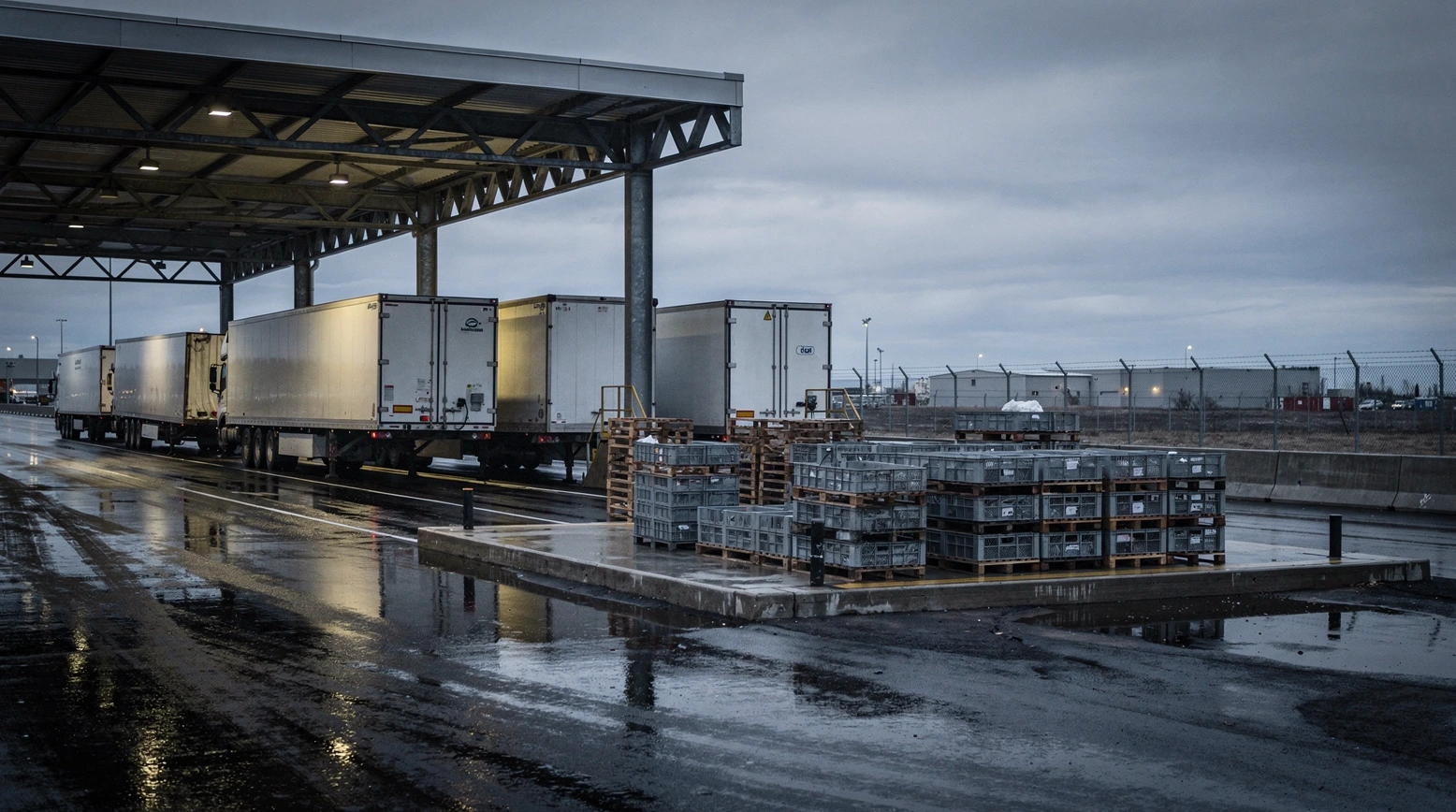
A United States import ban on most Canadian-origin alcohol, several dairy inputs and large motorcycles took effect at 12:01 a.m. EST on September 29, 2026, and the first full week of enforcement has shown importers what a prohibition looks like in practice. Customs entries filed under the affected tariff lines are not being flagged, held or assessed at a higher rate. They are being rejected outright.
According to the logistics platform Flexport, which published an operational note on October 1, U.S. Customs and Border Protection systems are returning the message “HTS Not Allowed for Country of Origin” when a broker attempts to file an entry for a banned Canadian line. There is no duty to pay that makes the shipment admissible. That single change is the reason this escalation behaves differently from every tariff round that preceded it.
In short
- The ban is live. Import prohibitions on specified Canadian alcoholic beverages, dairy products and motorcycles over 800 cc took effect September 29, 2026.
- CBP rejects, it does not assess. Entries under covered tariff lines return “HTS Not Allowed for Country of Origin”, per Flexport’s October 1 operational update.
- The authority is Section 338 of the Tariff Act of 1930, a statute that allows both punitive duties and outright exclusion of goods, and that predates and overrides USMCA.
- Bulk alcohol survives. Alcohol shipped in vats and casks for U.S. bottling remains admissible and is subject to 50% duties instead of exclusion.
- Escalation is scheduled. President Trump has said tariffs on Canadian cars, trucks, auto parts and steel rise to 50% from January 1, 2027.
What actually changed at the border on September 29
The prohibitions trace to five presidential proclamations signed on September 8, 2026. Three of them imposed outright import bans with a September 29 effective date. The other two modified the scope of the existing 50% Section 338 tariff with an earlier September 15 effective date, according to an analysis published by the law firm Troutman Pepper Locke on September 10.
That sequencing matters for anyone reconstructing their landed cost. A product could have moved onto the 50% duty list on September 15 and then onto the prohibited list two weeks later, or moved onto the duty list and stayed there. The two lists are not the same, and a line that appears on one does not appear on the other.
The rejection message brokers are seeing
CBP’s response is a filing-level block rather than a cargo-level one. Flexport reports that entries submitted under the covered Harmonized Tariff Schedule codes are refused at the point of transmission, with the system returning “HTS Not Allowed for Country of Origin”. The company said it had updated its tariff simulation tool so that importers and brokers “can confirm classification before filing rather than finding out at the border”.
For a customs broker, that is a meaningfully different workflow. A duty increase is a pricing problem that resolves at entry summary. A country-of-origin exclusion is a gating problem that resolves before the truck is dispatched, or does not resolve at all.
What still moves: the bulk alcohol carve-out
One commercially significant exception survives. Alcohol imported in large vats and casks for bottling in the United States is not covered by the exclusion and remains subject to 50% duties instead, per Flexport and the Troutman analysis. Packaged product is banned; the same liquid in bulk is expensive but admissible.
The practical effect is to push the value-added step south of the border. A Canadian distiller or winery that ships finished retail packs is locked out. One that ships bulk to a U.S. bottling partner pays a punitive rate but keeps the channel open. Shopappy covered the announcement stage of this action when the proclamations landed, in our report on the U.S. ban on Canadian alcohol from September 29, and the carve-out has survived intact into enforcement.
Why an import ban is not just a bigger tariff
Retail and e-commerce teams have spent two years building muscle for tariff shocks. The standard playbook is well understood: reclassify where legitimate, requalify origin, renegotiate supplier terms, absorb part of the increase, pass through the rest, and model the elasticity. Every one of those moves assumes the goods can still enter.
An exclusion removes that assumption. There is no rate to pay, no bond to post and no brokerage workaround, because admissibility rather than valuation is the binding constraint. The commercial question stops being “what does this cost” and becomes “is there a substitute, and how fast can it be qualified”.
That distinction also changes who inside a retailer owns the problem. Tariff rounds route to finance and merchandising. An admissibility block routes to compliance, legal and supply planning, and it does so with a much shorter fuse, because inventory in transit cannot simply be rerouted to a different cost bucket.
What Section 338 authorizes, and why it bites harder
Section 338 of the Tariff Act of 1930 is an unusual instrument. Where most modern trade authorities permit additional duties, Section 338 permits exclusion. The Troutman analysis sets out the mechanism: subsection (a) supports a punitive duty where a foreign country discriminates against U.S. commerce, and subsection (b) supports excluding articles entirely where that country has “maintained or increased” the discrimination after an initial proclamation.
That two-stage structure explains the shape of 2026. The administration announced the first-stage duties in July, applied them in August, and then moved to second-stage exclusion in September after talks broke down. Shopappy set out the statutory basis when the duties first landed, in our analysis of how Section 338 tariffs on Canada overrode USMCA from August 19.
Why USMCA qualification offers no relief
Importers have repeatedly asked whether USMCA-originating status provides a shield. On the evidence of the published legal analyses, it does not. Troutman points to the USMCA implementing legislation at 19 U.S.C. section 4512(a)(1), which specifies that no provision of the agreement inconsistent with U.S. law takes effect.
Because Section 338 is a standalone statutory authority that predates the agreement, the duties and the exclusions apply regardless of origin-qualification status. A Canadian product that meets every USMCA rule of origin is treated the same as one that does not.
What happens if a court strikes a ban down
The proclamations include a severability provision with a notable consequence. If a court invalidates one of the import bans, the affected goods do not revert to duty-free entry. They snap back to the 50% duty, according to the Troutman reading.
That design narrows the upside of litigation considerably. A successful challenge converts a prohibition into a punitive rate rather than restoring the prior status quo. It is a defensive drafting choice, and importers weighing the cost of a court action should price it accordingly.
The inventory window that has now closed
There was a transitional allowance, and it has expired. Goods that were imported but not entered for consumption before September 29 remained subject to the 50% duties rather than the ban. Anything filed after that date falls under the exclusion.
The proclamations are reported to be silent on drawback eligibility under 19 U.S.C. section 1313. Banned goods cannot generate drawback claims by definition, and the practical advice in the published alerts is to preserve documentation on duty-paid entries pending clarification from customs authorities.
The product scope, line by line
The three exclusion proclamations cover narrower ground than the headline suggests, and the distinction between the banned list and the 50% duty list is where most classification errors are likely to occur. The table below sets out the reported scope.
| Category | Treatment from September 29, 2026 | Reported scope |
|---|---|---|
| Packaged alcoholic beverages | Import ban | Packaged beer (HTSUS 2203.00.00), wine and sparkling wine, whiskey, bourbon, rye, brandy, rum, gin, vodka, tequila, mezcal, liqueurs, other fermented beverages, undenatured ethyl alcohol for beverage use |
| Bulk alcohol for U.S. bottling | 50% duty, still admissible | Alcohol shipped in large vats and casks |
| Dairy and related inputs | Import ban | Whey protein concentrates, modified whey, fluid whey, dried whey, invert molasses, cane molasses, non-alcoholic beer (HTSUS 2202.91.00) |
| Motorcycles and mopeds | Import ban | Engine displacement above 800 cc (HTSUS 8711.50.00) |
| Cheese varieties | 50% duty (added September 15) | Cheddar, Swiss, Emmentaler, Gruyere, Romano, Reggiano, Parmesan, Provolone, blue-veined, Roquefort, Edam, Gouda, sheep’s milk |
| Metals and building products | 50% duty (added September 15) | Iron and steel structures, columns and beams; aluminium profiles, bars, rods, tubes and pipes |
| Furniture and home goods | 50% duty (added September 15) | Seats convertible into beds, seating materials, office and kitchen furniture, mattress supports, electric lamps |
| Removed from duty scope | No Section 338 duty | Salt, Portland cement, pure sugars, tissue stock, refined lead, switchgear, certain fishing rod parts; whiskies and liqueurs above 4 litres |
Two entries on that list deserve a second look from merchandising teams. Non-alcoholic beer sits on the banned list even though it is not an alcoholic beverage in any commercial sense, which catches a fast-growing category that many U.S. grocers have been expanding. Whey protein concentrate sits there too, which reaches into sports nutrition and private-label supplement supply chains that rarely feature in trade-war coverage.
How the September 15 modification reshaped the duty list
The two tariff-modification proclamations were not housekeeping. They added categories that sit squarely in general merchandise and home: furniture, mattress supports, electric lamps, golf carts, writing and printing paper, motorboats, and motor vehicles under 1,000 cc. They also added raw bovine and equine hides, oxidised and dehydrated fats and oils, and tanned furskins.
Removals went the other way and were mostly industrial: salt, Portland cement, pure sugars, tissue stock, refined lead and switchgear came off the list. The net effect was to shift the burden away from construction inputs and toward consumer-facing goods.
Duty stacking is now the default
The most expensive technical change is the least visible one. According to the Troutman analysis, the modifications reversed the original non-stacking rule, so Section 338 duties now apply in addition to Section 232 duties rather than instead of them.
For aluminium and steel products that combination produces 25% under Section 232 plus 50% under Section 338, or 75% in additional duties before any other applicable rate. Any landed-cost model built on the earlier non-stacking assumption understates the number by a wide margin.
What this means for retailers and direct-to-consumer sellers
The direct-to-consumer alcohol channel is the clearest casualty. Canadian wineries, craft breweries and distilleries that built U.S. demand through shipping programmes now face a channel that cannot be filed, not one that has become costly. For those businesses the choice is a U.S. bulk-and-bottle arrangement, a domestic licensing partner, or withdrawal.
Grocery and convenience buyers face a narrower but real gap. Canadian-origin packaged beer and the non-alcoholic beer line both fall under the ban, and substitution in beverages is slow because shelf resets, state licensing and distributor agreements all move on their own calendars.
The compliance overhead is the part most likely to be underestimated. Every Canadian-origin SKU now needs a classification review against three separate lists, and the September 15 and September 29 effective dates mean the correct treatment depends on when the entry was filed. The table below compares what each regime demands.
| Dimension | Section 232 duties | Section 338 duties (50%) | Section 338 import ban |
|---|---|---|---|
| Can the goods enter? | Yes, on payment | Yes, on payment | No |
| CBP system response | Entry accepted, duty assessed | Entry accepted, duty assessed | Entry rejected: “HTS Not Allowed for Country of Origin” |
| USMCA origin relief | Limited | None | None |
| Stacking | Applies alongside Section 338 | Applies in addition to Section 232 | Not applicable |
| Outcome if invalidated in court | Refund claim | Refund claim | Reverts to 50% duty, not duty-free |
| Owning function | Finance, merchandising | Finance, merchandising | Compliance, legal, supply planning |
| Typical response time | Quarterly repricing | Quarterly repricing | Immediate resourcing |
Freight economics add a second layer. Carriers have been adding cost to cross-border lanes through 2026, a pattern Shopappy tracked when FedEx introduced U.S. import demand surcharges covering Canada from September 21. Blocked lines do not generate freight at all, but the surviving Canadian flows carry both the surcharge and, in many cases, the 50% duty.
Travellers, personal imports and the confiscation risk
The consumer-facing edge of this story surfaced on October 2, when the Canadian Snowbird Association issued an advisory to members heading south for the winter. The group urged travellers to leave Canadian-origin alcohol and affected dairy items at home and to check vehicles, recreational vehicles and luggage before crossing.
Reporting by CP24, BNN Bloomberg and National Post set out the exposure plainly: the prohibition applies to the goods, so personal quantities carried across a land border are at risk of seizure rather than simply attracting duty. The association’s list of concern covers packaged beer, sparkling wine, many table wines, cider, sake, rum, vodka, gin and certain whiskies and other spirits, alongside whey protein products, molasses and non-alcoholic beer.
That is a familiar duty-free allowance being overtaken by an admissibility rule, and it is the kind of change travellers rarely learn about before they are at the booth. For U.S. border-town retail, it also removes a small but steady cross-border purchase pattern in both directions.
Canada’s response and the scheduled January escalation
Ottawa has already retaliated once. Canada’s Department of Finance published a counter-tariff list on August 25 applying rates of 15%, 25% and 50% to CA$27.6 billion of U.S. goods, reported at about US$19.9 billion, covering steel, dairy, appliances, agricultural equipment, pulp and paper and electronics, with effect from September 8. Shopappy examined the e-commerce consequences in our coverage of how Canada’s counter-tariffs reached low-value parcels from September 8.
Prime Minister Mark Carney suspended trade negotiations and committed to matching U.S. measures dollar for dollar, telling reporters in August that “you’re at war when you get attacked. We got attacked.” Ontario Premier Doug Ford said the United States had “declared war, economic war against his closest friend and ally”, and both have since pressed for further federal support for tariff-hit steel and auto sectors.
The next scheduled step is larger than anything applied so far. President Trump has said tariffs on Canadian cars, trucks, automotive parts and steel will rise to 50% from January 1, 2027, against a current backdrop of 50% on Canadian steel and 25% on non-USMCA-compliant Canadian vehicles. Canada was the third-largest source of U.S. imports in 2025 at roughly $380 billion of goods, so the scope of a January move is an order of magnitude above the current bans.
The enforcement capacity question
Exclusion regimes are only as effective as the systems policing origin, and CBP has been tightening those systems independently through 2026. We covered one strand of that work when CBP began voiding importer of record numbers tied to inaccurate filings, a change that put cross-border freight at risk of holds for reasons unrelated to tariff rates.
Taken together, the two trends point the same way. Origin accuracy, importer identity and classification discipline now carry consequences that cannot be settled by paying more at the border.
How the dispute escalated from duties to exclusion
The 2026 Canada action did not arrive as a single shock. It ran through a sequence of announcements, effective dates and retaliations across five months, and each step narrowed the room for a negotiated landing. Reconstructing that sequence matters because the treatment of a given shipment depends entirely on which stage was in force when the entry was filed.
The opening move came on July 20, 2026, when President Trump announced 50% tariffs on certain Canadian goods to take effect on August 19, framed as an answer to Canadian discrimination against U.S. commerce in alcoholic beverages, dairy and motor vehicles. Talks failed to produce an agreement, and the duties took effect on August 22 across roughly US$20 billion of trade covering dairy products, alcoholic beverages, cement and hockey equipment.
Ottawa answered three days later. The Department of Finance published a counter-tariff list on August 25 applying 15%, 25% and 50% rates to CA$27.6 billion of U.S. goods, reported at about US$19.9 billion, with an effective date of September 8. Those counter-measures reached steel, dairy, appliances, agricultural equipment, pulp and paper, and electronics.
September 8 then became the pivot date on both sides. As Canada’s retaliation took effect, the White House signed five proclamations: two modifying the scope of the 50% duty from September 15, and three imposing outright exclusions from September 29.
| Date (2026) | Action | Scope as reported |
|---|---|---|
| July 20 | 50% Section 338 tariffs announced | Response to claimed discrimination in alcohol, dairy and motor vehicles |
| August 19 | Original effective date | Deferred while negotiations continued |
| August 22 | 50% tariffs take effect | About US$20bn: dairy, alcoholic beverages, cement, hockey equipment |
| August 25 | Canada publishes counter-tariff list | 15%, 25% and 50% on CA$27.6bn (about US$19.9bn) of U.S. goods |
| September 8 | Canadian counter-tariffs take effect; five U.S. proclamations signed | Steel, dairy, appliances, agricultural equipment, pulp and paper, electronics |
| September 15 | U.S. duty scope modified | Cheese, metals, furniture and lamps added; salt, cement, sugars, lead and switchgear removed |
| September 29 | Import bans take effect | Packaged alcohol, whey and molasses products, non-alcoholic beer, motorcycles above 800 cc |
| October 1 | Entry rejections reported | CBP returns “HTS Not Allowed for Country of Origin” on covered lines |
| January 1, 2027 | Threatened escalation | 50% on Canadian cars, trucks, auto parts and steel |
The categories U.S. buyers should triage first
Not every Canadian-origin line carries the same risk, and the practical task for a buying team this month is triage rather than a full catalogue review. Three groups account for most of the exposure, and they fail in different ways.
Beverage alcohol and the DTC channel
Packaged beer, wine, sparkling wine and the full spirits range are excluded outright, which closes both the wholesale and the direct-to-consumer route for finished Canadian product. Direct shipping programmes are the sharper loss, because they were often the only national route to market for small Canadian producers without a U.S. distributor.
The bulk carve-out offers a partial answer but not a quick one. Moving to a bulk-and-bottle model requires a U.S. bottling partner, label approvals and in many cases new state registrations, and it still carries the 50% duty on the liquid. For producers whose brand proposition rests on provenance and packaging done at source, the economics may not work at all.
Dairy inputs hiding inside finished goods
The dairy exclusions are narrow on paper and broad in effect. Whey protein concentrates, modified whey, fluid whey and dried whey are inputs rather than shelf items, which means the exposure sits inside sports nutrition, bakery, confectionery and private-label supplement supply chains rather than in the dairy aisle.
Invert and cane molasses carry the same characteristic. A U.S. manufacturer may not have a Canadian-origin line in its own catalogue at all, yet still find a contract manufacturer unable to source a bill-of-materials component. Second-tier supplier mapping is the only way to surface that risk before a production run stops.
General merchandise caught by the September 15 additions
The duty-list expansion is the quieter commercial problem. Office and kitchen furniture, seats convertible into beds, mattress supports, electric lamps, golf carts, writing and printing paper and small motor vehicles all moved into 50% duty scope on September 15, well inside the window in which holiday and spring assortments were already committed.
Because these lines remain admissible, they will not trigger a compliance alert. They will simply arrive with a landed cost that no longer matches the plan, and in the case of aluminium and steel components, with the stacked 75% figure rather than the 50% most models assumed.
The wider policy backdrop
The Canada action is unfolding against a U.S. trade agenda under simultaneous legal and diplomatic strain, which is part of why an older statute is carrying this much weight. The Supreme Court ruled in late September that the administration’s sweeping emergency tariffs imposed under the International Emergency Economic Powers Act were unlawful, a decision that triggered a large refund process and removed a central pillar of the 2025 and 2026 tariff architecture.
U.S. Trade Representative Jamieson Greer has said publicly that tariff policy “hasn’t changed” despite that ruling, and the Section 338 route illustrates the point. Where IEEPA proved vulnerable, Section 338 offers an authority with its own statutory findings, a punitive duty tier and an exclusion tier, and no dependence on an emergency declaration.
The diplomatic track has not provided an off-ramp either. The G20 trade ministerial held in Milwaukee from September 29 to October 1 closed without agreement on industrial overcapacity or forced labour, with Greer telling reporters the ministers were deadlocked, according to reporting by Agence France-Presse and Bloomberg. Greer separately indicated, in remarks reported by Nikkei and carried by outlets across Asia, that the United States would unveil measures on excess manufacturing capacity within weeks.
For retail importers that combination is unhelpful in a specific way. It means the Canada exclusions are unlikely to be resolved in isolation, and that further sector actions are being prepared on a timeline that nobody outside the administration can plan against.
What to watch next
Four things will determine how this develops over the fourth quarter. The first is whether CBP publishes further guidance on drawback treatment for the duty-paid entries filed before September 29, which the proclamations left unaddressed.
The second is litigation. Any challenge to the exclusions runs into the severability provision, so the realistic ceiling on a win is a reversion to 50% duties rather than restored free entry, which changes the cost-benefit calculation for trade associations weighing a suit.
The third is substitution speed in beverages and supplements, where Canadian-origin volume has to be replaced by domestic or third-country supply under state licensing rules that do not move quickly. The fourth is January 1, 2027, and whether the threatened automotive and steel escalation is applied, deferred or traded away in a resumed negotiation.
For a working summary of the administration’s stated rationale, the White House published a fact sheet on its response to Canada’s retaliation in September.
Frequently asked questions
When did the U.S. import ban on Canadian alcohol take effect?
It took effect at 12:01 a.m. EST on September 29, 2026, under proclamations signed on September 8, 2026. Goods imported but not entered for consumption before that date remained subject to 50% duties rather than the ban.
Which Canadian products are actually banned?
Three groups: specified packaged alcoholic beverages including beer, wine, sparkling wine and most spirits; dairy inputs including whey products, invert and cane molasses, and non-alcoholic beer; and motorcycles and mopeds with engine displacement above 800 cc.
Can an importer pay a higher duty to bring banned goods in?
No. The measure is an exclusion rather than a tariff, and Flexport reports that CBP systems reject entries under the covered codes with the message “HTS Not Allowed for Country of Origin”. Admissibility, not valuation, is the binding constraint.
Does USMCA-originating status exempt a shipment?
Published legal analyses say it does not. Section 338 is a standalone authority predating the agreement, and the USMCA implementing legislation specifies that no provision inconsistent with U.S. law takes effect, so origin qualification does not change the treatment.
Is any Canadian alcohol still admissible?
Yes. Alcohol shipped in large vats and casks for bottling in the United States is outside the exclusion and is subject to 50% duties instead. Finished packaged product is banned.
What happens if a court strikes down one of the bans?
The proclamations include a severability provision under which invalidated bans revert to the 50% duty rather than to duty-free entry, according to the Troutman Pepper Locke analysis.
Can travellers still carry Canadian beer or wine across the border?
The Canadian Snowbird Association advised on October 2 that members should not pack Canadian-origin alcohol or affected dairy items, and should check vehicles, recreational vehicles and luggage, because the goods are prohibited rather than dutiable and may be seized.
How high can duties go on Canadian metals right now?
Section 338 duties now stack on top of Section 232 duties following the September 15 modification. For aluminium and steel products that is 25% plus 50%, or 75% in additional duties, before any other applicable rate.
What is scheduled next in the dispute?
President Trump has said tariffs on Canadian cars, trucks, automotive parts and steel rise to 50% from January 1, 2027. Canada suspended trade talks and has matched U.S. measures with counter-tariffs of 15%, 25% and 50% on CA$27.6 billion of American goods.
The bottom line
The September 29 prohibitions are narrower in product scope than the headline tariff rounds that preceded them, but they operate on a different axis. A 50% duty is a margin event that retailers can model, finance and pass through. An exclusion is a sourcing event that removes the line from the assortment until a substitute is qualified.
The first week of enforcement has confirmed that CBP is applying the measure at the filing layer rather than the assessment layer, which leaves no commercial workaround for packaged product. With duty stacking now the default and a 50% automotive and steel step scheduled for January 1, the operative question for U.S. retail is no longer what Canadian goods will cost. It is which of them will still be admissible.