
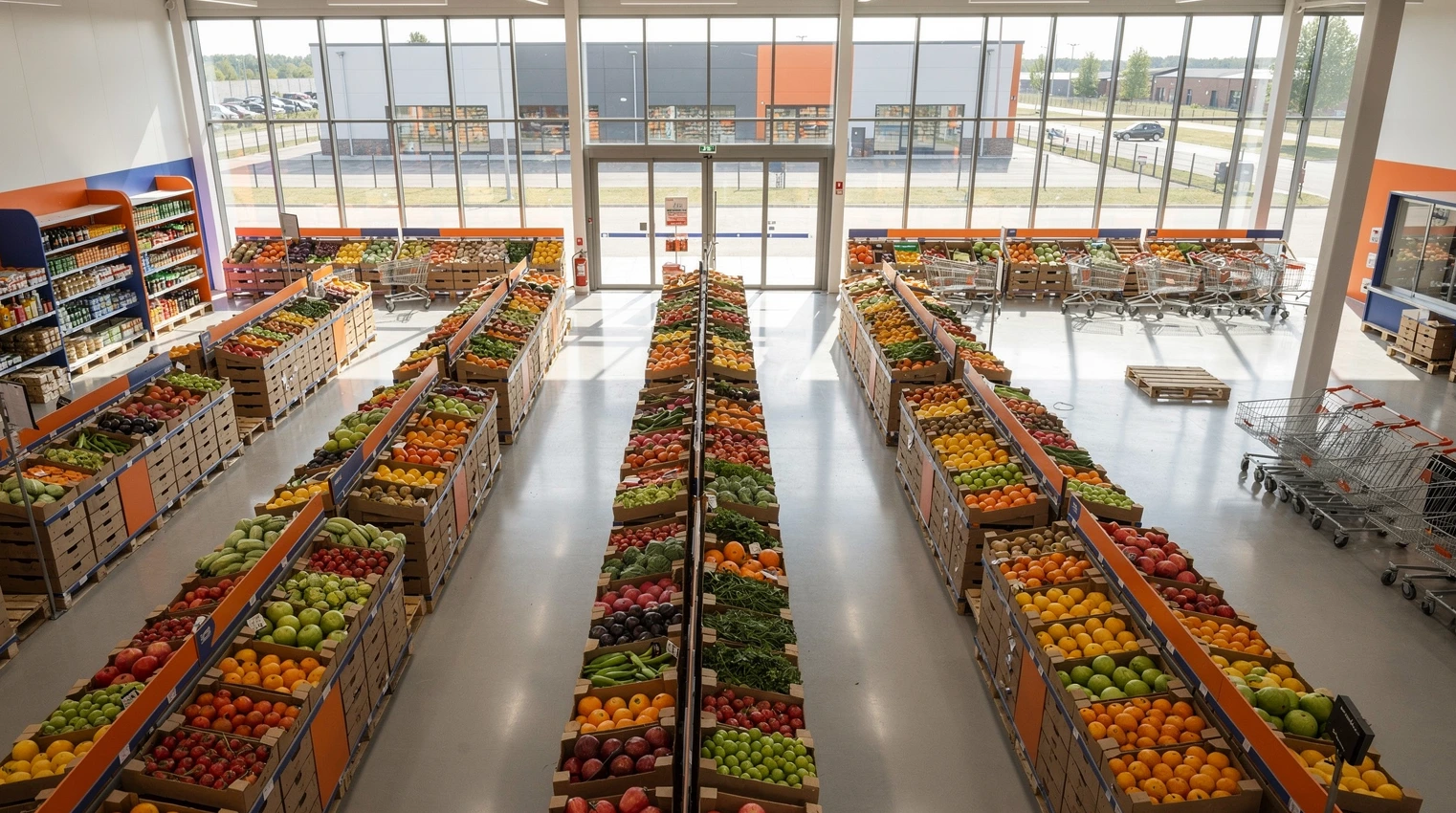
Aldi is opening a new UK supermarket every week this September, and the second half of the programme is still to come: Rayleigh in Essex on Thursday 17 September and Hoxton in east London on Thursday 24 September. The four-store run, confirmed by the discounter in a 7 September statement, is a small slice of a much larger plan: GBP 370 million (about USD 512 million at current rates) earmarked for new stores in 2026, roughly 40 openings pencilled in for the year, and a long-term ambition of 1,500 UK shops. It also lands in a busy fortnight for the chain, with a viral name-change stunt built around its Cuthbert caterpillar cake, a confirmed Boxing Day closure, a pending Competition and Markets Authority ruling on its land deals, and, if the calendar follows last year, a set of annual accounts due around the middle of the month.
In short
- Four September openings: Balsall Common (3 Sep) and Telford (10 Sep) are already trading; Rayleigh Weir Retail Park opens 17 Sep and 21 Hackney Road, Hoxton opens 24 Sep, both at 8am, according to Aldi’s press office and local press.
- Up to 120 jobs, around 30 per store, on Aldi’s advertised national rate of GBP 13.50 an hour (GBP 14.88 inside the M25), as the retailer restated in its Boxing Day announcement on 2 September.
- GBP 370 million on new stores in 2026 sits inside a GBP 1.6 billion two-year expansion plan announced with last year’s results; Aldi is also claiming GBP 300 million of price cuts across more than 1,000 products so far this year.
- Market share is slipping while the estate grows: Worldpanel by Numerator put Aldi at 10.7% of the grocery market in the 12 weeks to 9 August, down from 10.9% a year earlier, while Lidl grew sales 8.5% to reach 8.8%.
- Three dates to watch after the openings: a CMA decision this autumn on whether Aldi is bound by the same land rules as the big supermarkets, Aldi’s annual results (last year’s arrived on 15 September), and the Boxing Day shutdown on 26 December.
Which Aldi stores are opening in September 2026, and when?
Aldi’s press office set out the schedule on 7 September: one new shop each Thursday for four consecutive weeks. The first, on Kenilworth Road in Balsall Common near Solihull, opened on 3 September. The second, at Waterloo Road, Ketley Point in Telford, followed on 10 September. The two still to come are the ones most shoppers will be searching for over the next fortnight.
| Store | Address | Opening date | Doors open | Roles |
|---|---|---|---|---|
| Balsall Common | Kenilworth Road, near Solihull | Thu 3 Sep 2026 | Trading | Up to 30 |
| Telford | Waterloo Road, Ketley Point, Shropshire | Thu 10 Sep 2026 | Trading | Up to 30 |
| Rayleigh | Weir Retail Park, Rayleigh, Essex | Thu 17 Sep 2026 | 8am | 27 colleagues confirmed |
| Hoxton | 21 Hackney Road, London E2 | Thu 24 Sep 2026 | 8am | 14 colleagues confirmed |
Jonathan Neale, Aldi UK’s managing director of national real estate, said in the company statement that “opening a new store every week throughout September demonstrates the pace of our expansion, while creating new jobs and bringing high-quality, affordable food to even more shoppers.” Retail Gazette, Retail Bulletin and Grocery Gazette all carried the same four-store list on 7 September, and Retail Insight Network followed on 8 September with the wider context of 40 planned openings for the year.
Rayleigh Weir: 17 September
The Essex store at Weir Retail Park will be run by manager Amy Fitzgerald with a team of 27 colleagues recruited locally, according to the Essex Gazette’s report on the opening. Team GB rower Hattie Taylor is due to cut the ribbon at 8am, and the first 30 customers in the queue get a free bag of fruit and vegetables from the Super 6 range. Opening hours are 8am to 10pm Monday to Saturday and 10am to 4pm on Sunday, the standard pattern for a large Aldi store.
Rayleigh is not the only discounter opening in south Essex that morning. The same local report notes that Lidl opens on St Chads Road in Tilbury at 8am on 17 September, a GBP 10 million store creating up to 40 jobs, with an in-store bakery and a Middle of Lidl aisle. Between them the two openings add 67 jobs to the area in a single day, a useful illustration of how closely the two German-owned chains now shadow each other’s site selection.
Hoxton, Hackney Road: 24 September
The London store at 21 Hackney Road, E2, opens at 8am on 24 September with Olympic diver Noah Williams doing the honours, the Hackney Gazette reported. Manager Alice Allen leads a team of 14, all recruited from the surrounding area, a smaller headcount that reflects a compact urban footprint rather than the retail-park box at Rayleigh. The store carries the full range, including fresh British meat, the Specially Selected tier, beers, wines and spirits, a food-to-go section and Specialbuys on Thursdays and Sundays. It is also signed up to the Neighbourly platform so local charities and food banks can collect surplus food daily.
Why is Aldi still opening shops when its market share is slipping?
The expansion story and the market-share story point in different directions, and both are true at once. Worldpanel by Numerator’s most recent read, covering the 12 weeks to 9 August 2026, put Aldi’s share of British grocery spending at 10.7%, down from 10.9% a year earlier. In the previous period, the 12 weeks to 12 July, the discounter’s sales grew just 0.7% year on year on a 10.8% share. Lidl, by contrast, grew sales 8.5% in the August period to reach 8.8% of the market, up half a percentage point in a year, and has been the fastest-growing bricks-and-mortar grocer for close to three years according to Worldpanel’s Fraser McKevitt.
Aldi’s answer is capacity. The retailer’s own arithmetic is that every new store brings its prices to a catchment that previously had to travel, and that the 1,500-store target is about geographic reach rather than defending a percentage. That logic is also why the company has spent 2026 pushing price rather than margin. Retail Insight Network’s tally, drawing on Aldi statements, is GBP 300 million of price cuts across more than 1,000 products so far this year, including GBP 122 million in the first quarter and a further GBP 100 million on 330 products in late July aimed at the school holidays.
The Grocer reported, citing Worldpanel data, that Aldi was the only one of the six largest supermarkets where average unit prices actually fell in the second quarter of 2026.
The other reason the openings matter is regulatory. The CMA is deciding this autumn whether Aldi should be bound by the same land rules as Tesco, Sainsbury’s and Asda, a change the watchdog first signalled when it moved to curb Aldi and Lidl land deals in August. A store opened before that ruling is a store opened under the old rules.
How the 2026 plan fits the two-year GBP 1.6 billion commitment
When Aldi published its last annual accounts on 15 September 2025, it paired them with a record GBP 1.6 billion two-year investment plan to open around 80 stores. The GBP 370 million for new stores in 2026 and the roughly 40 openings pencilled in for the year are the first half of that commitment. Grocery Gazette’s report on the 2025 results also noted 21 openings planned in the following 13 weeks, and the September programme of one shop a week is consistent with that cadence carrying into the second year.
How does Aldi compare with Tesco, Lidl and the rest right now?
The Worldpanel figures for the 12 weeks to 9 August 2026, as reported by Reuters and the London Stock Exchange news service, show a market in which the fastest growth is at the two ends: Ocado online and Lidl in the discount channel, with the middle broadly flat and Asda still contracting. Like-for-like grocery inflation eased to 2.1% in the four weeks to 9 August, its lowest in well over a year, from 2.6% in the July read.
| Grocer | Market share, 12 weeks to 9 Aug 2026 | Sales growth, year on year | Direction of share |
|---|---|---|---|
| Tesco | 27.8% | +1.8% | Lower for a third consecutive report |
| Sainsbury’s | n/a in reports | +3.5% | Gaining |
| Asda | n/a in reports | -0.2% | Losing, but best result since March 2024 |
| Aldi | 10.7% | Low single digits (July read: +0.7%) | Down from 10.9% |
| Lidl | 8.8% | +8.5% | Up 0.5 points; fastest-growing physical grocer |
| Ocado | 2.1% | +13.1% | Up from 1.9%; fastest-growing grocer overall |
Two caveats apply. First, market share counts spending, so a retailer that cuts prices harder than rivals can grow volumes and still lose share, which is Aldi’s own explanation for the drift. Second, the Super Grocer 33 price comparison reported by The Grocer in the same window had Lidl edging Aldi on a 33-item basket (GBP 67.43 against GBP 68.02) once Lidl Plus app discounts were applied, so the price gap between the two discounters is now measured in pence rather than pounds. The wider grocery mood is one of retailers competing on quality signals as much as price, which is the backdrop to Tesco’s decision to ban 114 additives from its own-brand food the same week Aldi announced its openings.
The Which? cheapest supermarket title
Aldi’s local-press coverage of the Hoxton opening leans on the fact that Which? named it the UK’s cheapest supermarket for 2025, the fifth consecutive year. That badge is doing more work in the marketing than the Worldpanel share number, and for the shopper arriving at a new store it is the more relevant of the two.
What will the new stores pay, and how many people will they employ?
Aldi’s press office quotes up to 30 roles per store and up to 120 across the four September sites, though the local reports give lower confirmed headcounts (27 at Rayleigh, 14 at Hoxton). The pay rates are the ones Aldi restated on 2 September when it confirmed all UK stores will close on Boxing Day: a national minimum of GBP 13.50 an hour, GBP 14.88 inside the M25, rising with length of service to GBP 14.47 and GBP 15.20 respectively, plus paid breaks the company values at roughly GBP 1,500 a year per colleague. Aldi has described itself as the highest-paying supermarket employer in the sector, a claim that The Grocer and others have reported without contradiction from rivals.
For the towns involved, 30 jobs at a supermarket is not transformational, but the context set out in this month’s Association of Convenience Stores report is that local shops’ business rates bills have nearly doubled in two years, and that independents are cutting investment. A new Aldi anchor tends to pull footfall to a retail park rather than a town centre, which is why the Rayleigh Weir site (a retail park) and the Hoxton site (a high street) will have quite different effects on the shops around them.
What a new discounter does to the local high street
The evidence from previous Aldi and Lidl openings is mixed rather than uniformly negative for independents. A discounter draws a price-sensitive weekly shop that many independents were not winning anyway, and a busy car park next door can lift a butcher or bakery that offers what the discounter does not. The losers tend to be small convenience formats within a short walk that were trading on distress purchases, and any independent whose range overlaps with the Super 6 fruit and vegetable offer. For high street traders near Hackney Road, the practical question is whether Aldi’s food-to-go section takes lunchtime trade from cafés and sandwich shops, because that is the part of a compact urban Aldi that competes most directly with them.
What is the CMA deciding, and why does timing matter for the openings?
On 7 August 2026 the Competition and Markets Authority provisionally decided that Aldi, Lidl GB and Lidl NI should be designated as Large Grocery Retailers and brought under the Groceries Market Investigation (Controlled Land) Order 2010. That order already applies to Tesco, Sainsbury’s, Asda, Morrisons, Co-op, M&S and Waitrose. It stops designated retailers from using restrictive covenants and exclusivity agreements on land to make it harder for a rival supermarket to open nearby. The consultation on the provisional decision closed at 5pm on Monday 7 September, the same day Aldi announced the store-a-week programme, and the CMA has said it expects to reach final decisions in the autumn.
The watchdog’s reasoning rested on three tests: both chains now operate stores above 1,000 square metres across Great Britain, both offer a comprehensive grocery range, and both buy directly from suppliers through their own integrated wholesaling. Juliette Enser, the CMA’s executive director, said the regulator wants “everyone to have the best choice of supermarket and range of prices when buying their groceries,” and that the rules exist “to prevent big supermarket chains blocking rival stores from opening nearby.” Our July analysis of why Aldi and Lidl face a property rules reckoning set out how the designation would change the way both chains negotiate sites.
Does designation slow Aldi down?
Not directly. The Controlled Land Order restricts what a designated retailer can do to block rivals; it does not cap how many stores the retailer itself opens. The practical effect is on the small print of leases and freehold purchases, where an exclusivity clause that would have been legal in 2025 becomes unenforceable once the designation takes effect.
For the 1,500-store target, that means Aldi’s future sites will be more contestable by Lidl and by the big four, not fewer in number. The openings in Rayleigh and Hoxton were agreed under the old regime and are unaffected either way.
What else has Aldi announced this month?
September has been unusually busy for Aldi’s press office, and three of the announcements bear directly on shoppers over the next three months.
Boxing Day closure and Christmas hours
On 2 September Aldi confirmed that every UK store will close on Christmas Day and Boxing Day (Friday 25 and Saturday 26 December 2026), reopening on Sunday 27 December, and will close again on New Year’s Day before reopening on Saturday 2 January 2027. Rachel Geary, Aldi UK’s communications director, said closing on Boxing Day “is one way of saying thank you and giving colleagues a proper chance to rest.” Many stores will run extended hours in the run-up to Christmas, and the company is pointing customers to its store finder for local times. Because Boxing Day 2026 falls on a Saturday, the substitute bank holiday is Monday 28 December, when Aldi stores will be open as normal.
The Cuthbert name-change stunt
On 10 September Aldi launched a campaign, created by McCann, asking members of the public named Colin to change their name to Cuthbert in support of its Cuthbert the Caterpillar cake, Retail Gazette reported on 11 September. Reality television personality Gemma Collins took part by renaming her Instagram account “Gemma Cuthberts.” Aldi’s statement said that “earlier this year we realised that the name Cuthbert’s is dying out, while Colin is still going strong. It’s hard to sell cakes without his name being out there.” The stunt is the latest chapter in a long-running rivalry with Marks & Spencer’s Colin the Caterpillar, which produced a trademark dispute between the two retailers in 2021 that was later settled. It is marketing rather than news, but it explains why “Aldi” has been trending in UK search this week alongside the store openings.
Autumn Specialbuys and range changes
Aldi’s product calendar for the same fortnight includes the return of its sell-out pumpkin serving dish at GBP 12.99 from 13 September, a GBP 34.99 stand mixer in its Home Baker range from the same date, new Jamaican-inspired Flake Bake ready meals at GBP 3.99 from 16 September, and a change to its Mamia baby food range that the company said parents would notice in stores this month. None of these is material on its own, but the density of product news around a store-opening week is deliberate: the new Rayleigh and Hoxton shops open with the autumn Specialbuys already in the middle aisle.
When are Aldi’s annual results, and what should they show?
Aldi UK is privately owned and does not pre-announce a results date, but its recent pattern is to publish annual accounts in mid-September. Last year’s arrived on 15 September 2025 and covered the 12 months to December 2024: sales up 4.8% to GBP 18.1 billion, operating profit down to GBP 435.5 million from GBP 552.9 million the year before, a 2.4% margin, and around GBP 14 billion spent with UK suppliers. Giles Hurley, chief executive for Aldi UK and Ireland, said at the time that “shoppers are still finding things difficult, and that’s why we’re staying laser focused on doing what Aldi does best.” The profit fall was attributed to lower pricing, infrastructure spending and higher staff pay.
If the 2026 accounts follow the same timetable they will cover calendar 2025 and land within a week or two of the Rayleigh opening. The numbers to watch are whether sales growth held above the roughly 2% to 3% grocery inflation of the period, whether operating profit fell again after a second year of price investment, and whether the company restates or raises the 1,500-store target. Aldi has not confirmed a date, and this article will not guess one; the point for readers is that the store-a-week programme is likely to be read against a fresh set of figures very soon.
Why the results and the openings will be read together
Analysts quoted by Retail Week after last year’s results framed Aldi’s strategy as accepting thinner margins to fund a bigger estate. A second consecutive profit decline alongside 40 openings and GBP 300 million of price cuts would confirm that reading. A profit recovery would suggest the price cuts are being funded by volume rather than margin, which would be the more comfortable story for the expansion plan. Either way, the Worldpanel share trend is the number the market will set against whatever Aldi publishes.
What does this mean for shoppers and local businesses in the next 30 days?
For shoppers in south Essex and Hackney the practical detail is simple: Rayleigh Weir opens at 8am on Thursday 17 September and Hackney Road at 8am on Thursday 24 September, with a free Super 6 bag for the first 30 through the door at each. Opening hours at Rayleigh are 8am to 10pm Monday to Saturday and 10am to 4pm Sunday; Hoxton has not published hours in the local press yet and the Aldi store finder is the place to check on the day.
For independent retailers near either site, the first month after a discounter opens is when footfall patterns reset. The sensible moves are the unglamorous ones: check what the new store does not stock, make sure opening hours cover the early-evening trade the supermarket captures, and treat the car park at Rayleigh Weir as an opportunity rather than a threat if you can get a sign in front of it. The larger question for the sector is whether the wider slowdown in non-food spending that the ONS retail sales data due on 18 September is expected to confirm, which we set out in our preview of the August retail sales figures, leaves discount grocery as the one channel still growing volumes into the autumn.
The dates in one place
| Date | Event | Why it matters |
|---|---|---|
| Thu 17 Sep 2026 | Aldi Rayleigh Weir opens, 8am; Lidl Tilbury opens the same morning | 67 new jobs in south Essex in one day |
| Mid-September (date unconfirmed) | Aldi UK annual accounts for calendar 2025, if the 2025 timing repeats | Sales, profit and any update to the 1,500-store target |
| Thu 24 Sep 2026 | Aldi Hoxton, 21 Hackney Road opens, 8am | Compact urban format; food-to-go competes with local cafés |
| Autumn 2026 | CMA final decision on Large Grocery Retailer designation | Ends exclusivity clauses on future Aldi and Lidl sites |
| Fri 25 to Sat 26 Dec 2026 | All Aldi stores closed for Christmas Day and Boxing Day | Reopen Sun 27 Dec; closed again 1 Jan 2027 |
FAQ: Aldi’s September 2026 store openings
When does the new Aldi in Rayleigh open?
Thursday 17 September 2026 at 8am, at Weir Retail Park, Rayleigh, Essex. Store manager Amy Fitzgerald leads a team of 27, and Team GB rower Hattie Taylor is due to open the store. Opening hours are 8am to 10pm Monday to Saturday and 10am to 4pm on Sunday.
When does the new Aldi in Hoxton open?
Thursday 24 September 2026 at 8am, at 21 Hackney Road, London E2. Olympic diver Noah Williams is opening the store and manager Alice Allen leads a team of 14 recruited locally. The first 30 customers receive a free bag of Super 6 fruit and vegetables.
How many Aldi stores are opening in September 2026?
Four, one each Thursday: Balsall Common near Solihull (3 September), Telford (10 September), Rayleigh (17 September) and Hoxton (24 September). Aldi says the programme creates up to 120 jobs and is part of GBP 370 million of new-store investment this year.
How many Aldi stores are there in the UK, and what is the target?
Aldi reported around 1,060 UK stores at the time of its September 2025 results and has a long-term ambition of 1,500. The company said in 2025 it would invest GBP 1.6 billion over two years to open around 80 stores, and Retail Insight Network reported roughly 40 openings planned for 2026.
What does Aldi pay store staff in 2026?
According to Aldi’s 2 September statement, the national rate is GBP 13.50 an hour and GBP 14.88 inside the M25, rising with length of service to GBP 14.47 and GBP 15.20. Aldi also pays for breaks, which it values at about GBP 1,500 a year per colleague.
Is Aldi losing market share to Lidl?
On Worldpanel by Numerator’s figures Aldi’s share fell to 10.7% in the 12 weeks to 9 August 2026 from 10.9% a year earlier, while Lidl grew sales 8.5% to reach 8.8%. Aldi remains the larger of the two by a clear margin; the gap is narrowing rather than closed.
Will Aldi be open on Boxing Day 2026?
No. Aldi confirmed on 2 September that all UK stores will close on Christmas Day and Boxing Day (25 and 26 December 2026) and reopen on Sunday 27 December. Stores also close on New Year’s Day and reopen on 2 January 2027.
What is the CMA deciding about Aldi and Lidl?
The CMA provisionally decided on 7 August 2026 that Aldi, Lidl GB and Lidl NI should be designated Large Grocery Retailers under the Controlled Land Order 2010, which bans land agreements that block rival supermarkets from opening nearby. Consultation closed on 7 September and a final decision is expected in autumn 2026.
What is the Aldi “Cuthbert” name-change campaign?
A marketing stunt launched on 10 September 2026 asking people called Colin to rename themselves Cuthbert in support of Aldi’s caterpillar cake. Gemma Collins took part by changing her Instagram name to Gemma Cuthberts. It references Aldi’s long-running rivalry with Marks & Spencer’s Colin the Caterpillar.