
President Donald Trump said on Saturday that a trade deal with Canada could come “fairly soon,” conditioning the outcome on Ottawa dropping tariffs on US farm products, and said in the same breath that he is not considering pulling the United States out of the Canada-US-Mexico Agreement. The remarks, made to reporters in Dublin alongside Irish Prime Minister Micheál Martin, are the first public signal of a thaw since formal negotiations collapsed on August 21 and set off the most aggressive round of tariffs and import bans in the 19-month dispute. For retailers on both sides of the border, the comments arrive with the September 15 tariff-list changes and the September 29 import bans still on the calendar, and with nothing in Trump’s wording that moves either date.
In short
- The signal: Trump told reporters in Dublin that “you’ll probably see a deal with Canada fairly soon” if Ottawa stops charging tariffs on US farmers, and answered “No, we’re doing great” when asked whether he is weighing withdrawal from the CUSMA/USMCA pact, according to Global News and CTV News.
- The condition: agriculture. Trump repeated the claim that Canada charges US farmers “400 per cent tariffs,” a reference to over-quota rates under Canada’s supply management system for dairy, eggs and poultry. Ralph Goodale, a member of Carney’s trade advisory group, called that characterization “factually wrong” on CTV News.
- Nothing has changed on the ground: 50 per cent US duties on roughly C$28 billion (about US$20 billion at 1.386 CAD per USD) of Canadian goods remain in force, Canada’s counter-tariffs of 15 to 50 per cent on more than 700 US products took effect September 8, and the US import ban on most Canadian alcohol, some dairy inputs and large motorcycles still lands September 29.
- Ottawa’s posture: Prime Minister Mark Carney called the latest US measures “relatively modest” and said Canada is “always ready to strike a fair deal,” while Trade Minister Dominic LeBlanc says he remains “in contact with” US Trade Representative Jamieson Greer with no formal talks scheduled.
- Retail read-through: the Buy Canadian shift is now structural in grocery, with Loblaw reintroducing maple-leaf signage and “T” tariff tags, US share of Canadian vegetable imports down to 62.6 per cent, and US brands such as L.L.Bean describing Canadian sales as “small” but “important.”
What exactly did Trump say in Dublin?
The remarks came during a question-and-answer session with reporters on Saturday, September 12, during Trump’s weekend visit to Ireland. A journalist asked whether the president was considering withdrawing from the Canada-US-Mexico Agreement, known as CUSMA in Canada and USMCA in the United States. Trump’s answer, as reported by Global News with files from The Canadian Press and Reuters, opened with “No, we’re doing great. We’re gonna have a great relationship with Mexico.”
He then turned to Canada. “We actually have a good one with Canada, but the United States has been ripped off for 50 years by Canada,” Trump said. “We don’t need their product and they need our product. They do all of their business almost with us and we do very little with them.”
CTV News, which published its account at 5:04 p.m. EDT after an earlier version at 11:47 a.m., reported the same language.
The operative sentence for trade-watchers followed. “Canada has to treat our farmers better and they can’t charge our farmers tariffs,” Trump said. “When those things go away, and they’re willing to get rid of all of them, you’ll probably see a deal with Canada fairly soon.” He added that “Canada wants to make a deal very badly,” while suggesting he does not believe Ottawa is ready yet.
The Iran comparison
Trump also placed Canada alongside Iran when describing pending negotiations. “Canada wants to make a deal and Iran wants to make a deal. At the right time, both of those things could happen,” he said, adding that he hopes “Canada appreciates being in the same sentence with Iran.” CTV News political commentator Scott Reid, a former communications director to prime minister Paul Martin, said the framing means Canada is “now treated expressly as an enemy” and could “stiffen the spine” of Canadians assessing any prospective deal.
Why does the farm-tariff condition matter more than the “fairly soon” line?
Trump has predicted an imminent deal before. In August he said a “very fair deal for both” had been reached, only for talks to break down days later when, according to Carney, the US introduced new requirements at the 11th hour. The difference on Saturday is that Trump named a specific price: the removal of Canadian tariffs on US agricultural goods.
The “400 per cent” figure refers to Canada’s supply management system, which governs dairy, eggs, chicken and turkey. Under that system a fixed quantity of imports enters at low or zero tariffs, and volumes above the quota face steep over-quota rates. Supply management is politically protected in Canada across party lines, and Parliament passed a law in 2025 barring negotiators from expanding market access under it. That is what makes the condition a hard one rather than a negotiating flourish.
Goodale, speaking on CTV News Channel on Saturday, described the American offer that preceded the August collapse as “one sided” and “fundamentally uneconomic,” and called Trump’s tariff characterization “part of the PR game.” Diamond Isinger, a former special adviser during the NAFTA renegotiation, told CTV that resuming talks “at the same starting point things were severed” would not be realistic, and that Canadians “wouldn’t accept the status quo of what was on the table weeks ago.”
What “not considering withdrawal” changes
The CUSMA review took place over the summer and, per CTV News, the US chose not to renew the pact outright. The agreement stays in force, subject to annual reviews. Trump’s “No” on withdrawal therefore preserves the legal baseline that most cross-border retail supply chains are built on, even as Section 338 duties and import bans operate outside it. For a retailer, that means the origin rules, the duty-free treatment for qualifying goods that are not on a Section 338 list, and the dispute mechanisms remain, at least for now.
Where does the tariff war actually stand this weekend?
The Dublin remarks change none of the measures already in force or scheduled. The table below sets out the sequence of the last four weeks, drawing on CTV News, CBC News, The Canadian Press and prior shopappy coverage.
| Date | Measure | Who | Status |
|---|---|---|---|
| August 21, 2026 | Formal negotiations break down; Carney recalls delegation | Canada | No formal talks since |
| August 22, 2026 | 50 per cent Section 338 duties on about C$28 billion (US$20 billion) of Canadian goods | United States | In force |
| September 8, 2026 | Counter-tariffs of 15, 25 and 50 per cent on more than 700 US products worth about C$27.8 billion (US$20 billion) | Canada | In force |
| September 8, 2026 | Proclamations banning imports of most Canadian alcohol, whey, molasses and motorcycles over 800cc; 50 per cent list widened | United States | Signed |
| September 15, 2026 | List changes take effect: cheese, furniture, mattresses, lamps and golf carts added; toilet paper, cement and road salt removed | United States | Scheduled |
| September 29, 2026 | Import bans take effect | United States | Scheduled |
| January 1, 2027 | Threatened 50 per cent tariffs on Canadian cars, trucks, auto parts and steel | United States | Announced |
The escalation that ended with the import ban on Canadian alcohol from September 29 began the same day Canada’s counter-tariffs took effect. CTV News reports that Trump signed the ban orders later on Tuesday, September 8, and simultaneously added products to the tariff list while removing others, including toilet paper, cement and road salt.
Carney’s first characterization of the bans, delivered Thursday in Banff, was that they are “relatively modest measures” when set against “other things that the U.S. administration has done.” He added that “for individual companies and in individual sectors these are significant, and there’s a response there,” while saying Ottawa is still studying them. CBC’s Aaron Wherry read the phrasing as a signal that Canada does not currently see a need for further retaliation, and that “the recent cycle of escalation may have reached a kind of equilibrium.”
How dependent are the two economies on each other, really?
Trump’s claim that Canada does “all of their business almost with us and we do very little with them” is half right. Canada is far more exposed to the US than the reverse in relative terms, but the absolute flows are large in both directions and they are concentrated in specific US states.
| Metric | Figure | Source |
|---|---|---|
| Canadian goods exports to the US, 2025 | US$382 billion | US Census Bureau, via CTV News |
| Canadian goods imports from the US, 2025 | US$334 billion | US Census Bureau, via CTV News |
| Canada’s rank among US trading partners, 2024 | Second, behind Mexico | TD Economics, via CTV News |
| US states for which Canada is the largest foreign market | 34 | TD Economics, via CTV News |
| US share of Canada’s fresh produce imports | More than 50 per cent | Reuters |
| US share of Canada’s vegetable imports, July 2026 | 62.6 per cent, down from 69 per cent in July 2023 | Reuters |
| Canadian sales as a share of L.L.Bean’s business | “Small” but “important” | NBC News |
The 34-state figure is the one that matters for the political calculus in Washington. Farm-state exporters of dairy, poultry and machinery are the constituency Trump was speaking to when he cited the “400 per cent” number, and they are also the constituency hit by Canada’s September 8 counter-tariffs on farm equipment and food. CBC’s analysis quotes Meredith Lilly of Carleton University identifying the US midterm elections as one of several “trigger moments” that could reopen talks, alongside a US-Mexico agreement and the January 1, 2027 auto and truck tariff threat.
What is Ottawa’s actual negotiating position?
Carney spent Thursday and Friday with his cabinet in Banff, Alberta, in closed-door meetings The Canadian Press described as planning for a fall sitting of Parliament that starts in less than two weeks. Ian Bremmer of Eurasia Group, who presented to ministers, told reporters that tariffs and industrial policy “will remain popular American policy regardless of who is next in the White House,” and that Canada should “differentiate between the broader structural changes in U.S. policy” and the unpredictability of Trump himself.
LeBlanc’s public line has been that conversations with US officials “haven’t stopped.” He has said he is “in contact with” Greer, while giving no indication of formal talks. “When the U.S. is ready to engage, our government will work in good faith and constructively towards a more secure mutually beneficial trading relationship that fully respects Canadian sovereignty,” LeBlanc said, according to CBC News.
The principal negotiators (Greer for the US, LeBlanc and Janice Charette for Canada) have, per CBC, kept a professional tone that “may serve to keep a door open.” Wolfgang Alschner, a professor of business and trade law at the University of Ottawa, gave CBC the most cautious read: “I think it is more likely than not that the current situation remains unchanged until the end of the year. From the latest rounds of talks, we know that there is a potential landing zone but also that positions are currently too far removed to easily reach an agreement.”
The public-opinion constraint
Polling cuts against a quick deal. CBC reports that the Angus Reid Institute found a significant bump in Liberal support after talks collapsed, and that recent polls show high support for a tough approach. Charette reportedly warned her US counterparts before the breakdown that new tariffs would shrink the Canadian side’s room to negotiate, an argument Abacus Data’s David Coletto has since echoed.
Manitoba Premier Wab Kinew has said provinces were told to plan for “two-plus years” of turmoil. In other words, the “fairly soon” timetable Trump described in Dublin is not one that Ottawa’s own advisers recognize.
What does this mean for Canadian grocers and the Buy Canadian shift?
The most concrete retail evidence of the trade war’s second year is on Canadian grocery shelves. Reuters reported on Saturday that a growing consumer push to buy Canadian and avoid US products is forcing grocers to improve country-of-origin labeling and find new sources of supply. The push has intensified since talks collapsed on August 21.
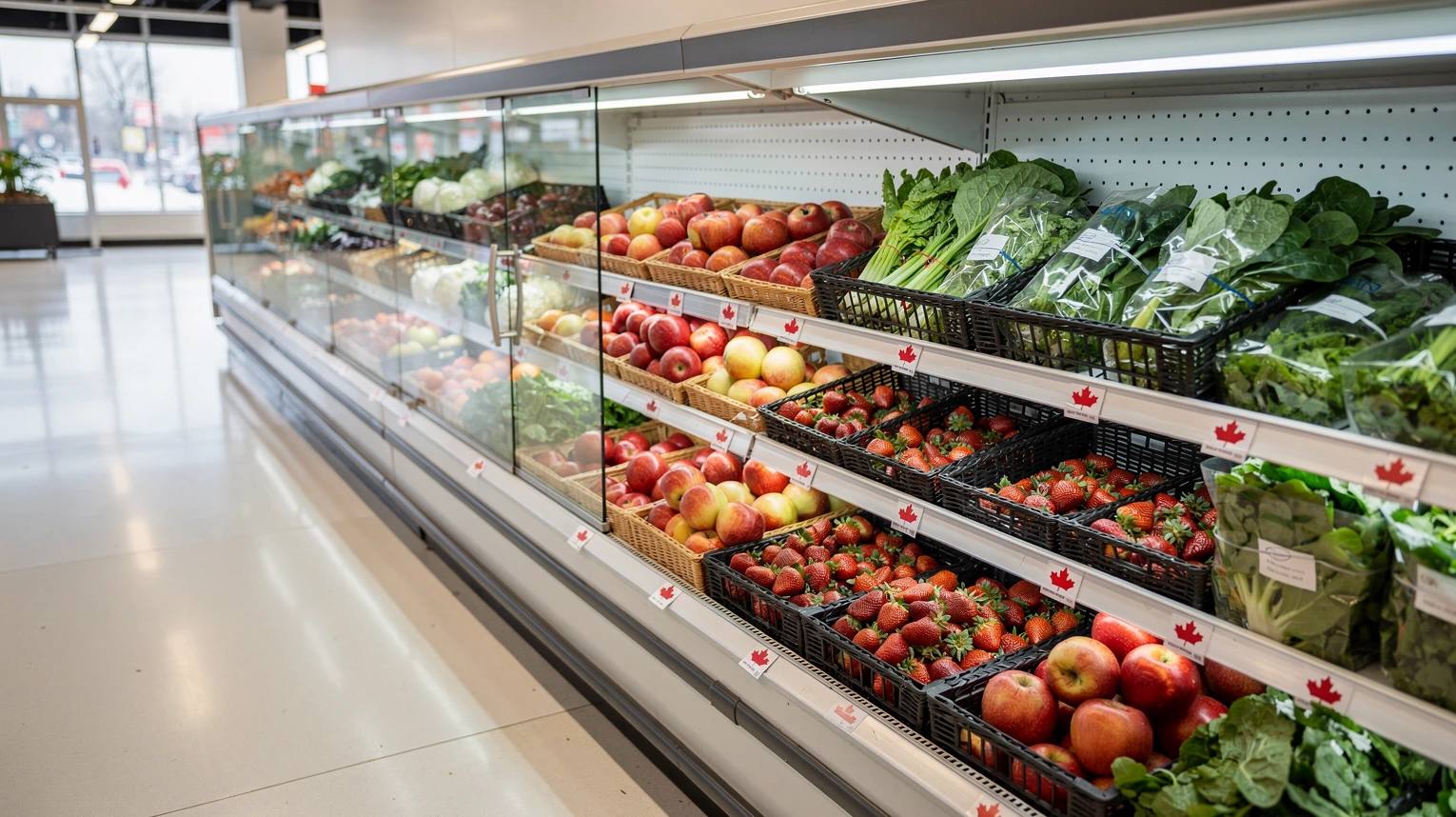
Loblaw Cos, Canada’s largest food retailer, brought back large maple-leaf signs in its produce and fresh-food sections in August after a brief hiatus, and reintroduced a “T” tag flagging products affected by tariffs, according to Reuters. Metro, the third-largest grocer, said it would continue to prioritize local Canadian products in the current context. Giancarlo Trimarchi, president of Ontario independent Vince’s Market, used Facebook to show customers that roughly 90 per cent of his produce is Canadian after receiving angry messages about US produce on shelves; his stores now source strawberries from Quebec rather than the US and have cut advertising spend under cost pressure. “It is a lot more aggressive this time around than last year,” Trimarchi told Reuters.
The sourcing shift is visible in trade data. Reuters cites figures showing the US share of Canada’s vegetable imports fell to 62.6 per cent in July 2026 from 69 per cent in July 2023, even though the US still supplies more than half of Canada’s fresh produce and more than half of its fruit imports. Mike Dean, whose Mike Dean Local Grocer operates in rural Ontario and Quebec, told Reuters he now sells more produce from Spain, Brazil and Honduras and is “in a safer position.” The federal government is putting C$3 billion (about US$2.2 billion) over ten years into greenhouse capacity.
“There has been a permanent change in the Canadian psyche,” Gary Sands, senior vice president of public policy and advocacy at the Canadian Federation of Independent Grocers, told Reuters. That is the line US consumer brands should weigh against Trump’s “they need our product” claim: the substitution is being done by shoppers and merchandisers, not by tariff schedules, and it will not reverse on the day a deal is signed.
What Canada’s counter-tariffs do to US brands at the border
Canada’s September 8 counter-tariffs apply by tariff item regardless of CUSMA origin, and the C$150 courier de minimis threshold offers no shield for direct-to-consumer parcels. The lists cover steel, dairy, appliances, farm equipment, pulp and paper, electronics, furniture and clothing at rates of 15, 25 and 50 per cent. For a US apparel or home brand shipping DTC into Canada, the landed-cost increase is now a function of the tariff item, not of the trade agreement, which is why L.L.Bean chief executive Greg Elder told NBC News on Saturday that “we have long had a tremendous relationship with our neighbors to the north” while the company describes Canadian sales as “small” but “important.”
Which US retail categories are exposed to the September 15 and September 29 dates?
On the US side, the exposures are narrower but sharper. The September 15 list changes add cheese, furniture, mattresses, lamps and golf carts to the 50 per cent list and remove toilet paper, cement and road salt. The September 29 bans are absolute: no duty rate applies because the goods cannot enter.
| Category | US measure | Effective | Retail exposure |
|---|---|---|---|
| Canadian whisky and most packaged alcohol | Import ban | September 29, 2026 | Liquor retailers, grocery beer and wine sets, restaurant supply; Crown Royal (Diageo) is the most prominent brand affected |
| Whey, molasses | Import ban | September 29, 2026 | Private-label bakery, nutrition and confectionery inputs |
| Motorcycles over 800cc | Import ban | September 29, 2026 | Powersports dealers |
| Cheese, furniture, mattresses, lamps, golf carts | 50 per cent duty | September 15, 2026 | Home furnishings chains, specialty grocers, club stores |
| Toilet paper, cement, road salt | Removed from 50 per cent list | September 15, 2026 | Relief for grocery, hardware and municipal buyers before winter |
| Cars, trucks, auto parts, steel | Threatened 50 per cent duty | January 1, 2027 | Auto retail, appliance and hardware input costs |
The pattern of the September 15 changes is instructive. The three removals are household staples and winter-critical inputs whose price effect would land on US consumers before the midterms. The additions are discretionary home goods where Canadian supply competes with US and Asian manufacturing. That mix is consistent with an administration that wants leverage without a visible grocery-aisle price effect, which is also how to read Trump’s willingness to say “fairly soon” on Saturday.
For home furnishings retailers already navigating the furniture and wood tariff schedule, the Canadian 50 per cent rate on furniture and mattresses stacks on top of the Section 232 wood and furniture duties that step up on January 1, 2027. The Canadian share of US upholstered and case-goods imports is small next to Vietnam, Mexico and China, but for retailers with Quebec and Ontario suppliers, the effective duty on those SKUs now exceeds anything in the Asian sourcing base.
How are US retailers with Canadian operations positioned?
US chains with Canadian store fleets face the mirror image of the grocer problem: their Canadian shoppers are the ones boycotting US-origin goods, and their Canadian import costs on US-origin merchandise have risen under the counter-tariffs. When TJX reported its second quarter against a 50 per cent Canada tariff backdrop, the off-price model’s ability to shift buying toward domestic and third-country vendors was the central question, and the same applies to Walmart Canada, Costco Canada and Home Depot Canada.
The operational responses reported across the sector fall into three groups. First, origin-flagging at shelf and online, which Loblaw’s “T” tag and maple-leaf signage formalize. Second, vendor substitution, which the produce data shows moving toward Mexico, Spain, South Africa and Latin America. Third, landed-cost tooling for DTC flows, where guaranteed duties and taxes at checkout have become a competitive feature for US brands that want to keep selling into Canada without surprise invoices at the door.
The cross-border shopper
Canadian cross-border shopping trips into the US, historically a meaningful revenue line for retailers in border states, had already fallen sharply through 2025 as the boycott took hold. Trump’s Iran comparison on Saturday is the kind of remark Canadian consumer sentiment trackers have previously associated with further declines. Retailers in Washington, New York, Michigan and Vermont have no tariff exposure on that traffic; they have a sentiment exposure, and it moved against them this weekend.
What would a deal actually have to contain?
Piecing together the Dublin remarks, the August collapse and the CBC analysis, the shape of a possible landing zone is visible even if the distance to it is not. The US ask is agricultural market access, which in practice means an expansion of tariff-rate quotas under supply management or a change to how over-quota rates apply. The Canadian ask is the removal of Section 338 duties and the import bans, plus predictability on autos and steel ahead of January 1, 2027.
The legal obstacle on the Canadian side is real. Supply management is protected by statute, and the political cost of touching it in Quebec and Ontario during a year in which Alberta votes on separation on October 19 is one no government would take lightly. The obstacle on the US side is that Section 338 of the Tariff Act of 1930 has never been tested in court, as PBS News has noted, and an administration that has already lost its IEEPA tariff authority at the Supreme Court has an incentive to keep the Section 338 measures in place rather than concede them cheaply.
Alschner’s “potential landing zone” therefore most plausibly involves a narrow dairy and poultry quota expansion in exchange for a rollback of the September measures, with autos handled separately. That is roughly the deal both sides were reportedly close to in August before, in Carney’s account, new US demands appeared. Lilly told CBC she wonders whether it would now be harder “to even get back to whatever deal the two sides were broadly in agreement about” then.
What should retailers watch between now and September 29?
Three dates and two signals. The dates are September 15 (list changes take effect), the resumption of Canada’s Parliament in late September, and September 29 (import bans). The signals are whether Greer and LeBlanc announce a formal meeting, and whether Trump repeats or sharpens the farm-tariff condition in the coming week. The August pattern was that an optimistic presidential statement preceded a collapse; the September pattern so far is the reverse, with the harshest measures followed by a softer statement.
Retailers with Canadian-origin alcohol inventory should treat September 29 as firm and clear inbound shipments before then. Those with Canadian furniture and mattress supply should re-price on September 15. Canadian merchants importing US goods should assume the counter-tariffs stay in place through the fall and continue to source around them, since Ottawa has given no indication it would lift them before the US moves first. And DTC brands on either side should keep landed-cost messaging in place, because none of Saturday’s language changes a single duty rate.
The pace of the dispute since the talks collapsed on August 21 has been set by proclamations rather than negotiations. Saturday’s remarks are the first indication in three weeks that the president sees a deal as a near-term outcome. Everything Ottawa has said, and everything the calendar shows, suggests that “fairly soon” should be read as a conditional, not a timeline.
FAQ: Trump’s “fairly soon” Canada deal and what it means for retail
What did Trump say about a Canada trade deal on September 12?
Speaking to reporters in Dublin alongside Irish Prime Minister Micheál Martin, Trump said “you’ll probably see a deal with Canada fairly soon” if Canada stops charging tariffs on US farmers. He said Canada “wants to make a deal very badly,” repeated that the US has been “ripped off for 50 years,” and said “No, we’re doing great” when asked whether he is considering withdrawing from CUSMA/USMCA, according to Global News and CTV News.
Is the United States leaving USMCA/CUSMA?
Not on the basis of Saturday’s remarks. Trump answered “No” to a direct question about withdrawal. The pact was not renewed outright at its summer review and now proceeds through annual reviews, but it remains in force. Section 338 duties and the import bans operate outside the agreement.
Do Trump’s comments change the September 29 import bans or the September 15 tariff changes?
No. The proclamations signed on September 8 stand. Cheese, furniture, mattresses, lamps and golf carts join the 50 per cent list on September 15, with toilet paper, cement and road salt removed. Bans on most Canadian alcohol, whey, molasses and motorcycles over 800cc take effect September 29.
What is the “400 per cent tariff” Trump refers to?
It refers to over-quota tariff rates under Canada’s supply management system for dairy, eggs, chicken and turkey. A fixed quota enters at low or zero tariffs; volumes above it face very high rates. Ralph Goodale, a member of Carney’s trade advisory group, called Trump’s characterization “factually wrong” on CTV News, noting most US exports enter within quota.
How has Canada responded?
Carney called the latest US measures “relatively modest” in the context of other US actions and said Canada is “always ready to strike a fair deal.” Trade Minister Dominic LeBlanc said conversations with US officials have not stopped and that he is in contact with USTR Jamieson Greer, but no formal talks are scheduled. Canada’s counter-tariffs of 15 to 50 per cent on more than 700 US products remain in force.
How big is US-Canada trade?
Per US Census Bureau data cited by CTV News, Canada exported US$382 billion in goods to the US in 2025 and imported US$334 billion. TD Economics ranks Canada as the second-largest US trading partner behind Mexico, and says 34 US states sell more to Canada than to any other foreign economy.
What is the Buy Canadian effect doing to grocery shelves?
Reuters reports Loblaw reintroduced maple-leaf signage and “T” tariff tags in August, Metro is prioritizing Canadian products, and independents are sourcing from Quebec, Mexico, Spain, Brazil and Honduras. The US share of Canada’s vegetable imports fell to 62.6 per cent in July 2026 from 69 per cent in July 2023. The Canadian Federation of Independent Grocers describes “a permanent change in the Canadian psyche.”
What are the possible triggers for talks to resume?
CBC’s analysis, citing Carleton University’s Meredith Lilly, points to a US-Mexico bilateral agreement, the outcome of the US midterm elections, and the January 1, 2027 auto and truck tariff threat as moments that could restart negotiations. A University of Ottawa trade law professor told CBC it is “more likely than not” that the situation stays unchanged through year-end.
What should a US retailer or DTC brand do this month?
Clear Canadian alcohol inbound before September 29, re-price Canadian furniture and mattress SKUs for September 15, keep duties-and-taxes-paid messaging at checkout for Canadian orders, and plan Canadian assortments around the counter-tariff lists rather than around a deal timeline. None of Saturday’s statements change a duty rate.