
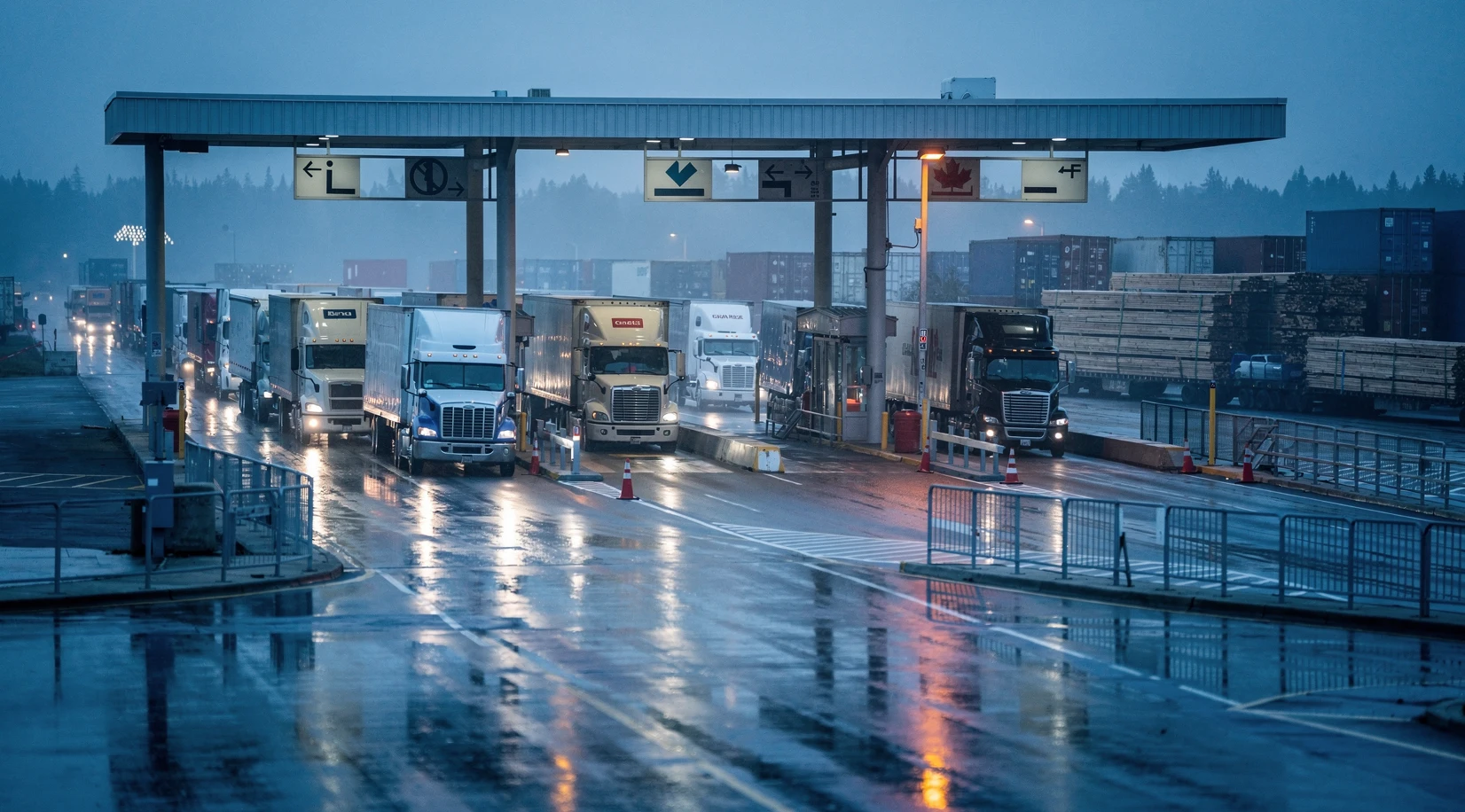
The United States imposed 50% tariffs on roughly $20 billion of Canadian goods at midnight on Saturday, August 22, 2026, after trade negotiations between the two governments collapsed with only minutes left on the clock. Canadian Prime Minister Mark Carney said he had suspended talks and ordered his negotiators home. He then pledged that Canada would match the new duties “dollar for dollar to protect our workers and businesses.”
The measures land under Section 338 of the Tariff Act of 1930, a nearly century-old provision that had sat unused for decades before this year. Three separate proclamations signed in July 2026 cover dairy, alcoholic beverages and motor vehicles, with reporting since the deadline also placing plywood and softwood products, cement, electrical equipment, hockey gear and certain apparel lines inside the affected schedules. The duties were originally set to begin on August 19 before a three-day suspension pushed them to Saturday.
For retailers and importers, the practical question is no longer whether the tariffs happen. It is how quickly the 50% rate flows into landed cost, which entries are already exposed, and what Ottawa’s promised countermeasures do to cross-border assortments in the other direction. This piece sets out what is confirmed, what remains unclear, and what changes for buying and compliance teams over the next two weeks.
In short
- 50% tariffs took effect at midnight on Saturday, August 22, 2026, on roughly $20 billion of Canadian goods, after a three-day suspension expired without a deal.
- Talks collapsed on Friday night. Carney suspended negotiations, citing “last-minute changes in the U.S. proposed terms,” while US Trade Representative Jamieson Greer blamed “new demands and walk backs of other commitments by Canada.”
- The legal instrument is Section 338 of the Tariff Act of 1930, which permits duties of up to 50% where a country is found to discriminate against US commerce. It is a different track from Section 232, Section 301 and IEEPA.
- Canada will retaliate “dollar for dollar,” though Ottawa has not yet published the target list. Existing Canadian counter-tariffs on US autos, steel and aluminum remain in place.
- A near-deal was on the table. Reporting before the collapse indicated terms that would have cut the top-line vehicle tariff to 15% from 25% and halved metals duties to 25%.
What happened at midnight on August 22
Top negotiators from both countries met in Washington for a third consecutive day on Friday, August 21. Canadian minister Dominic LeBlanc had spent more than three hours with Greer on Thursday and told reporters the two sides were “very close,” while cautioning that more work remained. President Donald Trump said publicly that the two countries “should be able” to reach agreement.
That optimism did not survive the evening. Carney issued a statement shortly before the midnight deadline announcing that he had “decided to suspend trade negotiations with the U.S.” and had “directed Canada’s negotiators to return to Ottawa.” The 50% duties took effect on schedule.
Carney’s stated reason was a late shift in the American position. “Last-minute changes in the U.S. proposed terms were unfair, uneconomic, and called into question the reliability of any deal,” he said. That framing matters: it presents the breakdown as a question of process rather than of substance, which leaves a narrow path back to the table.
Greer’s account inverts the sequence. “Despite the U.S. offer to Canada to receive the best treatment of any major exporter to our market, new demands and walk backs of other commitments by Canada have upended the careful balance,” he said. Both statements are consistent with a deal that was drafted but never initialed.
The collapse also carries a signal about sequencing. Negotiations that reach the drafting stage and then fail on final terms typically indicate a domestic political constraint rather than a technical gap. Both leaders face constituencies that would read concession as capitulation, and both statements were written to be read at home.
The three-day pause that bought nothing
The duties were first scheduled for August 19. On the evening of August 18, Trump signed a proclamation suspending the additional ad valorem duties on the covered alcoholic beverages, dairy and motor vehicles for a period of three days, explicitly to give negotiators room to finish. Our earlier coverage of the Section 338 action overriding USMCA treatment set out how the original August 19 date was constructed.
Three days proved insufficient. The suspension changed the effective date without changing the underlying disagreement, and importers who used the window to accelerate arrivals were the only clear beneficiaries. Entries that cleared before midnight avoided the new rate entirely.
One detail deserves emphasis for compliance teams. The suspension proclamation moved the effective date but did not narrow the covered scope, so any preparatory work done against the August 19 schedules remains valid. Teams that paused their readiness work during the pause lost three days rather than gaining them.
Why Section 338 is the instrument, not Section 232 or IEEPA
Section 338 of the Tariff Act of 1930 authorizes the president to impose additional duties of up to 50% on the goods of a country found to be discriminating against United States commerce. It had been effectively dormant for most of its existence. Its revival in 2026 gives the administration a tool with a different procedural shape from the trade statutes retailers have spent the past two years learning.
The distinction is not academic. Each statute carries its own investigation requirements, its own exclusion mechanics, and its own litigation posture. Compliance teams that built playbooks around Section 232 exclusions or Section 301 exclusion rounds cannot assume the same levers exist here.
How Section 338 differs from the tariff tools already in the stack
Section 232 requires a Commerce Department national security investigation and produces a defined product scope that can be expanded through a derivative articles process. That process is active and ongoing: Commerce recently moved to add further derivative lines, and our coverage of the proposed 25% tariffs on 14 additional goods with an August 27 comment deadline tracks how that scope creeps outward.
There is also a practical difference in how scope moves. A Section 232 action grows through a published derivative articles procedure with a comment period, which gives importers advance visibility. A Section 338 proclamation defines its own coverage, so scope changes can appear without the same forewarning.
Section 301 flows from a USTR investigation into a specific foreign practice and has historically included published exclusion processes. IEEPA rests on a declared national emergency and has proven the most legally contested of the three. Section 338 sits apart from all of them, with a finding of discrimination against US commerce as its trigger.
Why the legal exposure profile is different
The IEEPA tariff litigation has produced the largest refund question in modern US customs practice, with hundreds of thousands of importers waiting on class treatment at the Court of International Trade. That fight is documented in our reporting on the pending IEEPA refund class certification affecting roughly 330,000 importers.
The volume of that litigation is itself instructive. When a tariff program of this size is challenged successfully, the refund mechanics become an accounting event across the entire importing base, and the operational burden falls on entry documentation created years earlier. Importers who kept poor records on customs value methodology have found recovery slow even where the legal outcome favored them.
Section 338 duties are a separate matter and should not be assumed to fall within any IEEPA refund outcome. Importers who booked contingent receivables against IEEPA exposure will need a distinct analysis for these Canadian lines. Treating the two as one pool is the most likely accounting error in the next reporting cycle.
The revival of a dormant statute also raises a durability question. Instruments that have not been tested in modern litigation carry unquantified legal risk in both directions: they may prove more robust than newer tools, or they may not survive first contact with judicial review. Neither outcome is predictable from the text alone.
Which goods the 50% rate actually covers
Public reporting on the exact schedules has been inconsistent, and buyers should verify against the proclamation annexes rather than press summaries. The three July proclamations were described at signing as covering motor vehicles, alcoholic beverages and dairy. Coverage since the deadline has added detail on the specific lines inside those and adjacent categories.
Dairy items reported as covered include milk, cream, whey and related ingredient inputs. Other reporting lists plywood and softwood products, cement and building materials, electrical equipment, hockey gear including sticks, liquor, and certain clothing categories. Some outlets have described the affected trade as roughly $28 billion rather than $20 billion, and that discrepancy has not been resolved.
That gap is not trivial for scoping work. A $28 billion base implies roughly 40% more covered trade than a $20 billion base, and the difference determines whether a given category sits inside or outside the schedules. Until the annexes are reconciled line by line, buying teams should treat any category adjacent to the named groups as potentially covered.
The consumer-facing lines retailers will feel first
Alcoholic beverages and sporting goods are the categories where a 50% duty reaches the shelf fastest. Both are finished goods with short domestic value-add chains, so there is little downstream margin to absorb the increase before it becomes a price decision. Canadian whisky and Canadian-made hockey equipment are the clearest examples.
Dairy ingredient inputs behave differently. Whey and milk protein concentrates feed into manufactured food, and the tariff surfaces in a processor’s cost sheet before it reaches a grocery shelf. The lag is real but the pass-through is eventually similar.
Motor vehicles occupy a category of their own. Vehicles already carry a 25% tariff from the earlier action, and the interaction between that rate and a Section 338 layer on covered vehicle lines is the single largest open question in the proclamations. Automotive retail and parts distribution should treat the combined exposure as unresolved rather than additive by assumption.
The building-materials block
Plywood, softwood products and cement matter well beyond home improvement retail. Softwood lumber already carries a reported 45% duty rate from the separate antidumping and countervailing track, so a Section 338 layer on adjacent wood products compounds an existing burden rather than creating a new one.
Cement is unusual because freight economics make it regionally captive. Concrete inputs move short distances by weight-to-value logic, so a border-adjacent market in the northern United States has few practical alternatives to Canadian supply. In those markets the duty behaves less like a cost input and more like a supply constraint.
Home improvement retailers entered this quarter already flagging tariff cost in guidance. Adding a 50% line to plywood and cement in late August, ahead of the fall project season, narrows the window for pricing decisions considerably.
How the near-deal was structured and what it would have delivered
Reporting before the collapse described an agreement that was close to final. The central trade was a reduction in the top-line tariff on Canadian-built vehicles to 15% from 25%, paired with a halving of duties on Canadian steel and aluminum to 25% from 50%. In exchange, Washington sought the rescission of provincial alcohol sales bans that had removed American liquor from Canadian shelves.
That package would have been a meaningful de-escalation. A 10-point cut on vehicles touches the largest single line of bilateral manufactured trade, and halving metals duties would have relieved input costs across construction, appliances and packaging.
The alcohol condition is worth isolating because it was not a tariff demand. Several Canadian provinces removed American spirits and wine from provincial retail systems during the dispute, which functions as a complete market exclusion rather than a price increase. Washington treated restoring that shelf access as a core deliverable, which explains why beverage lines sit inside the Section 338 response.
Its collapse means the pre-existing stack stays in place and a new 50% layer sits on top of it for the covered goods. The negotiating position on both sides is now worse than it was on Thursday.
| Item | Rate before August 22 | Rate under the failed deal | Rate now |
|---|---|---|---|
| Canadian-built vehicles | 25% | 15% | 25%, plus Section 338 where covered |
| Steel and aluminum | Up to 50% | 25% | Unchanged, up to 50% |
| Softwood lumber | Reported 45% | Not addressed publicly | Reported 45%, plus Section 338 on covered wood lines |
| Alcoholic beverages | Standard MFN or USMCA | Bans rescinded, no new duty | 50% Section 338 |
| Dairy inputs | Standard tariff-rate quota treatment | Not addressed publicly | 50% Section 338 |
The table reflects publicly reported figures and negotiating positions rather than published schedules. Rates on individual HTS lines will vary and should be confirmed entry by entry.
There is a second-order cost in the failure itself. Negotiated outcomes give importers a rate they can plan against for a defined period, while unilateral action gives them a rate that can change by proclamation. The loss of a deal removes predictability as well as removing the specific rate reductions on the table.
What Ottawa’s dollar for dollar match means in practice
Carney’s commitment is quantitative rather than product-specific. Matching “dollar for dollar” implies Canadian countermeasures calibrated to the revenue or trade value of the American action, not necessarily mirrored across the same product categories. Ottawa has not published a target list.
That ambiguity is itself a negotiating instrument. It leaves Canadian officials free to select lines with maximum political salience in the United States while preserving room to withdraw the threat if talks resume. It also leaves US exporters to Canada without a concrete planning basis.
History from the earlier phases of this dispute suggests Ottawa will favor goods with concentrated production in politically sensitive states, and goods for which Canadian consumers have ready substitutes. That combination maximizes leverage while minimizing domestic cost. Consumer packaged goods, spirits and agricultural products have all featured in previous Canadian lists.
What is already in force from the Canadian side
Canada’s existing counter-tariffs on US autos, steel and aluminum remain in place. Earlier in the dispute, Ottawa removed retaliatory duties on US goods that qualify as CUSMA-compliant, which narrowed the scope considerably while keeping the headline sectors covered. Any new package will sit on top of that residual structure.
For US brands selling into Canada, the immediate exposure is therefore concentrated in goods that fail CUSMA origin tests. Retailers shipping direct-to-consumer across the border should re-run origin analysis on their top SKUs this week rather than waiting for the list.
The 18-month backdrop
This is the latest turn in a dispute that has run for roughly a year and a half. Both governments have repeatedly escalated and partially withdrawn measures, which has taught importers that headline rates are unstable and that timing of entry matters as much as the rate itself.
Vice President JD Vance characterized the Canadian position dismissively in remarks before the collapse, saying that Carney “presents this as some victory for Canada when fundamentally, like, they climb down on a lot of issues.” Public rhetoric of that kind has generally preceded escalation rather than settlement in this dispute.
Escalation risk runs in both directions from here. Each side has now demonstrated a willingness to let a deadline pass rather than accept the other’s final terms, which lowers the credibility of future deadlines and raises the probability that the next round starts from a harder position.
How the 50% rate flows into landed cost
A 50% ad valorem duty on customs value is not a 50% increase in shelf price, and treating it that way will produce bad pricing decisions. The duty applies to the declared customs value, which typically excludes inbound freight, insurance and any post-import costs. Where customs value represents a fraction of retail price, the shelf impact is proportionally smaller.
The arithmetic still bites. On a product with a customs value equal to 40% of retail and a standard margin structure, a 50% duty adds roughly 20 points of cost against retail before any margin restoration. Retailers who hold price absorb that in gross margin; those who pass it through face volume risk in a category that has substitutes.
| Category | Typical customs value share of retail | Approximate cost added by a 50% duty | Substitution risk |
|---|---|---|---|
| Canadian whisky and spirits | Moderate | Material at shelf | High, broad domestic and third-country supply |
| Hockey equipment | High | Material at shelf | Low, concentrated Canadian production |
| Plywood and softwood products | High | Compounds an existing duty layer | Moderate, alternative origins exist at higher cost |
| Cement and building materials | High, freight-sensitive | Material, regionally concentrated | Low near the border, higher inland |
| Dairy ingredient inputs | Low as share of finished food retail | Diluted, delayed | Moderate, quota constraints apply |
The columns above are directional guidance for scoping, not a substitute for SKU-level modeling. Substitution risk is the variable most retailers underweight, because it determines whether pass-through holds.
Timing compounds the pricing problem. The duty arrives in late August, which is after most fall assortments were bought and priced but before the holiday sell-through period. Retailers therefore face the increase against inventory whose retail price was set under different cost assumptions, with limited room to reset before peak season.
Why refund posture matters even now
Large retailers have already demonstrated that tariff refunds can be material to results. Walmart recorded a substantial IEEPA-related recovery this quarter, and our reporting on how the company directed a $2.9 billion tariff refund into price cuts shows how quickly recovered duty can become a competitive weapon.
The lesson for Section 338 entries is procedural. Preserve protest rights, document customs value methodology, and avoid liquidating entries early where a legal challenge is plausible. Refunds are only available to importers who kept the door open.
What retailers and importers should do in the next ten days
The immediate priority is establishing which entries are exposed. The duty is assessed by the date goods arrive and enter the United States, not the date they shipped from Canada, so in-transit freight that crosses after midnight on August 22 is covered even if it left a Canadian facility days earlier.
The second priority is category triage. Not every Canadian-sourced SKU is covered, and the fastest way to waste a week is to reprice an entire Canadian assortment when only part of it sits inside the schedules. Match HTS codes against the proclamation annexes before touching retail prices.
Entry timing and the arrival-date rule
Buying and logistics teams should reconcile every open Canadian purchase order against actual crossing time rather than ship date. Anything that cleared before the deadline is at the old rate. Anything still on the road is not.
Broker communication matters here more than usual. Entry summaries filed in the days around a rate change are the most common source of misclassification, and a duty applied at the wrong rate is expensive to correct after liquidation. Confirm in writing which rate the broker is applying to each pending entry.
Where goods are in a bonded warehouse or foreign trade zone, entry timing may still be within the importer’s control. That flexibility is worth exercising deliberately rather than by default, since rates in this dispute have moved in both directions.
Cross-border direct-to-consumer exposure
Direct-to-consumer sellers shipping from Canada into the United States face the same duty exposure as commercial importers, without the customs infrastructure to manage it. The removal of the $800 de minimis exemption earlier in 2026 already forced formal or informal entry on parcels that previously moved duty-free, so the Section 338 layer now attaches to shipments that were outside the tariff system a year ago.
Marketplace sellers with Canadian fulfillment should model whether a US-side inventory position now beats cross-border shipping on covered categories. For low-value, high-frequency parcels, brokerage and entry cost can exceed the duty itself. That calculation has moved decisively toward domestic stocking for anything in the affected schedules.
Contract and pricing hygiene
Review Incoterms on Canadian supply. Where terms place duty liability on the seller, the exposure sits with the Canadian exporter, and renegotiation pressure will follow quickly. Where terms are ex-works or FCA, the importer of record carries it.
Retailers should also revisit vendor cost-change clauses. Several large chains have absorbed tariff cost temporarily to hold price, and earnings commentary this season has repeatedly returned to the Canadian exposure, as our coverage of TJX reporting into a 50% Canada tariff backdrop illustrated.
What to watch next
Three signals will determine whether this is a short episode or a durable escalation. The first is whether Ottawa publishes a specific retaliation list or holds the threat in reserve. A published list makes reversal politically harder for both sides.
The second is whether the United States expands Section 338 coverage beyond the current schedules. The statute permits up to 50%, and the covered scope is defined by proclamation rather than by an investigative process with fixed boundaries.
The third is whether negotiations resume. Carney framed the suspension as a response to process failure rather than an end to talks, and Greer’s statement described an American offer still notionally on the table. Neither position forecloses a return within weeks.
A fourth signal sits underneath the other three: whether the dispute spreads into non-tariff measures. Provincial alcohol delistings in Canada were a non-tariff response that removed American products from shelves without a duty, and Washington had made their reversal a condition of the failed deal. Measures of that kind are faster to impose and slower to unwind than tariffs.
For planning purposes, retailers should assume the 50% rate holds through the fall buying season and treat any de-escalation as upside. The three-day suspension in August demonstrated how little a pause is worth when the underlying disagreement is unresolved.
Frequently asked questions
When exactly did the 50% tariffs take effect?
At midnight on Saturday, August 22, 2026, after a three-day suspension of the original August 19 effective date expired without an agreement. Goods that arrived and entered the United States before that moment are not subject to the new rate.
How much Canadian trade is covered?
Most reporting places the figure at roughly $20 billion of Canadian goods, though some outlets have described the affected trade as approximately $28 billion. The discrepancy has not been publicly reconciled, so importers should scope against the proclamation annexes rather than press figures.
Which products are affected?
The three July proclamations were described as covering motor vehicles, alcoholic beverages and dairy. Subsequent reporting has identified plywood and softwood products, cement and building materials, electrical equipment, hockey gear and certain clothing among the affected lines. Verify individual HTS codes before repricing.
What is Section 338 and why does it matter?
Section 338 of the Tariff Act of 1930 permits the president to impose additional duties of up to 50% on goods from a country found to discriminate against United States commerce. It is procedurally distinct from Section 232, Section 301 and IEEPA, so exclusion and refund mechanics familiar from those programs do not automatically apply.
Does USMCA or CUSMA preference protect these goods?
Section 338 duties have been applied in addition to existing treatment rather than being displaced by trade-agreement preference. Importers should not assume that a qualifying origin determination removes the additional duty on covered lines.
What will Canada do in response?
Carney has committed to matching the duties “dollar for dollar” but has not published a target list. Existing Canadian counter-tariffs on US autos, steel and aluminum remain in force, while retaliatory duties on CUSMA-compliant US goods were removed earlier in the dispute.
Are goods already in transit exposed?
Yes, where they arrive and enter after the effective time. The duty is assessed on arrival and entry rather than on the date of shipment from Canada, so freight that left before the deadline but crossed after it is covered.
Could these duties be refunded later?
Any refund would depend on a successful legal or administrative challenge, and none is currently resolved for Section 338. Importers should preserve protest rights and avoid early liquidation of exposed entries, but should not book contingent receivables on the basis of unrelated IEEPA litigation.
How quickly will shelf prices move?
Finished consumer goods such as spirits and sporting equipment transmit fastest, often within one replenishment cycle. Ingredient inputs such as dairy concentrates reach the shelf through processor cost sheets and typically lag by a quarter or more.