
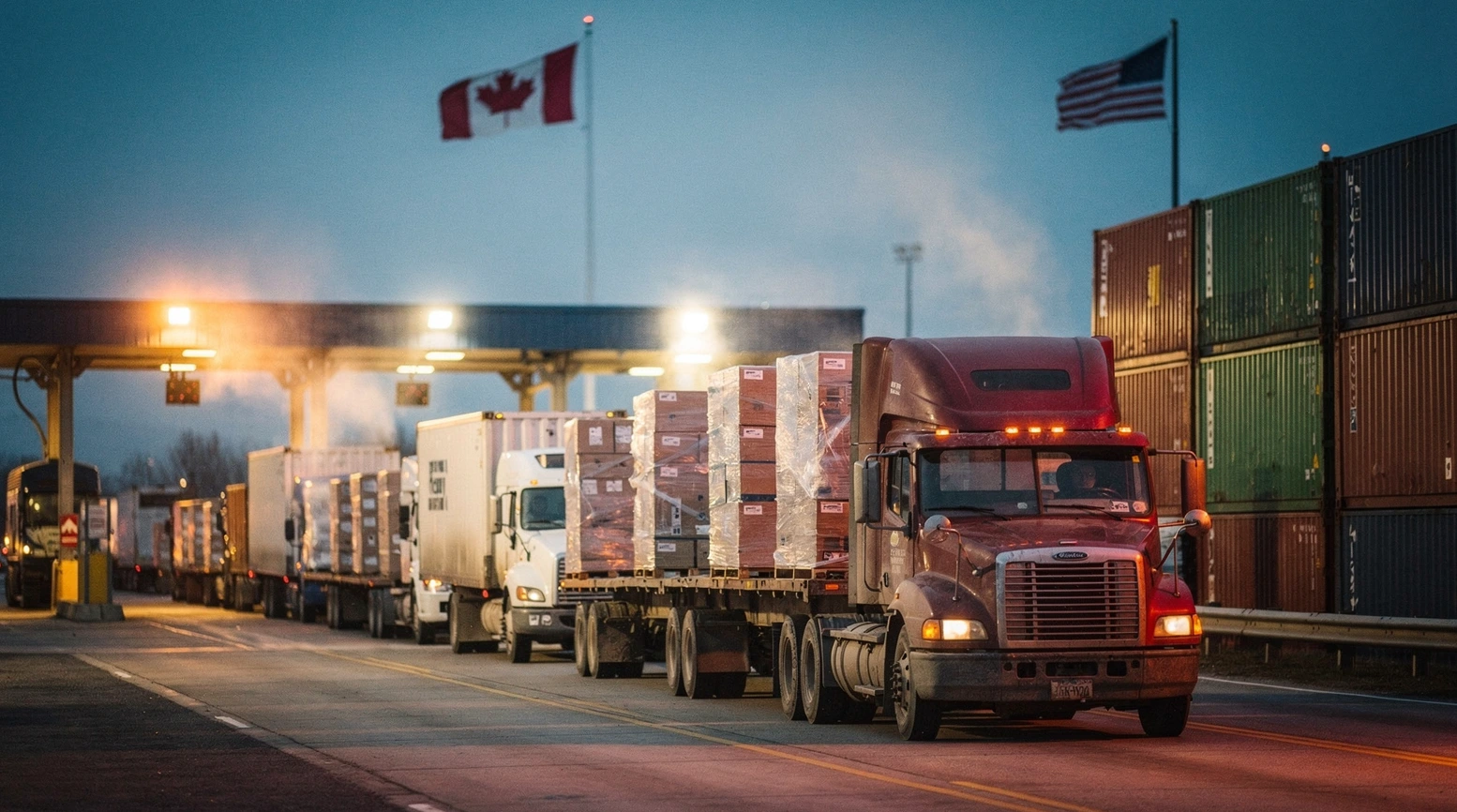
Canada has published the product list for its retaliation against the latest round of United States tariffs, setting a hard start date of 12:01 a.m. on September 8, 2026. The measures cover C$27.6 billion (about USD 19.9 billion at current rates, roughly 1.38 Canadian dollars to the US dollar) of goods imported from the US, and they land squarely on categories that retailers stock: furniture, clothing, appliances, cheese, seafood, electronics and tools.
The announcement came on August 25, 2026, according to the Department of Finance Canada, and was reported the same day by Reuters, Al Jazeera and CNBC. It followed the collapse of trade negotiations and the entry into force of US Section 338 duties of 50% on Canadian goods on August 22, 2026.
In short
- Effective date: 12:01 a.m., September 8, 2026. Goods already in transit to Canada on that day are reported to be exempt.
- Scope: C$27.6 billion (about USD 19.9 billion) of US-origin imports across more than 700 products.
- Rates: three tiers of 15%, 25% and 50%, each product matched to the corresponding US rate on the equivalent Canadian good.
- Retail exposure: the 50% tier includes furniture and clothing; the 25% tier includes appliances, cheese and seafood; the 15% tier includes electronics, tools, pulp and paper.
- Offsetting package: C$7.5 billion (about USD 5.4 billion) in business liquidity, diversification capital and worker supports.
What exactly did Canada announce on August 25?
The Department of Finance Canada published a schedule of US-origin products that become subject to a surtax on September 8. Finance Minister Francois-Philippe Champagne framed the package as symmetrical rather than escalatory, describing it as a set of “dollar-for-dollar, rate for rate counter-tariffs as well as a multi-billion dollar support package” intended to “protect workers, farmers, families, and businesses.”
The design point matters more than the headline number. Canada did not pick a single retaliatory rate. It mirrored the US rate on a product-by-product basis, so a good facing 50% on the way south now faces 50% on the way north.
Champagne also set out the political framing directly, saying that “when the United States asked too much and offered too little, we chose to stand up for Canadians.” US Trade Representative Jamieson Greer countered that Washington had made “meaningful concessions on steel, aluminum, autos, and softwood lumber duties” and that Canada “simply wanted more.”
How the negotiation collapsed
Prime Minister Mark Carney suspended the talks in late August, saying US negotiators had introduced last-minute terms that were “unfair, uneconomic, and called into question the reliability of any deal.” Within days the US Section 338 duties took effect, having already slipped once from an original August 19 start.
That sequence is the reason the September 8 date exists at all. Canada held its list back while negotiations continued, then published it once the US action was live. Our earlier coverage of the moment US tariffs on Canada went to 50% and talks collapsed set out the American side of the same week.
Why the two-week gap before September 8
The delay is not a negotiating window in any formal sense, but it functions as one. It also gives the Canada Border Services Agency time to publish customs notices, and gives importers time to reposition inventory.
Practically, the gap means one thing for commercial teams: any US-origin shipment that can clear Canadian customs before 12:01 a.m. on September 8 avoids the surtax entirely. That is a two-week pull-forward window, and it is short.
Freight capacity on the corridor is the binding constraint on how much of that window can actually be used. Cross-border trucking cannot be scaled meaningfully inside two weeks, and every importer facing the same deadline is chasing the same trailers.
Expect spot rates on southbound-to-northbound lanes to firm through the first week of September, and expect border wait times to lengthen as volumes compress into the final days before the date.
Which products fall into which rate tier?
The three tiers are not arbitrary. Each product’s rate tracks the US rate applied to the comparable Canadian export. Reporting from Reuters and Yahoo Finance, drawing on the published schedule, sets out the following distribution.
| Rate | Main product groups | Retail relevance |
|---|---|---|
| 50% | Steel, aluminum products, furniture, clothing and apparel | Very high: two of the four groups are core general merchandise categories |
| 25% | Appliances, dairy including cheese, fish and seafood, selected steel and aluminum derivatives | High: major grocery and big-box lines |
| 15% | Pulp, paper, electronics, agricultural equipment, tools | Moderate to high: electronics and tools plus packaging inputs |
| Unchanged | Motor vehicles under the existing 2025 auto countermeasures | Low for general retail, high for auto parts and accessories |
The count of affected lines varies slightly by source. Reuters reported approximately 700 products, while customs brokerage summaries of the published schedule have counted 874 tariff items. The difference is almost certainly a question of whether you count product descriptions or eight-digit and ten-digit tariff lines.
The 50% tier is where retail gets hurt
Furniture and clothing sitting in the top tier is the single most consequential detail for merchants. These are high-volume, price-elastic categories with thin landed-cost headroom, and neither has an easy domestic substitute at scale in Canada.
A US-origin sofa that lands at C$600 today lands at C$900 on September 8 before any margin or freight adjustment. At that level, the surtax is not a cost to absorb quietly. It is a pricing decision.
Grocery lines carry the 25% band
Cheese, seafood and appliances at 25% hit a different part of the basket. Dairy is already a supply-managed category in Canada, which limits how much US cheese enters in the first place, but specialty and foodservice channels are more exposed than the retail dairy case.
How does this stack against the US tariffs already in force?
North American retail supply chains now face duty exposure in both directions on the same categories. The table below sets out how the two regimes compare on the mechanics that matter to a customs team.
| Feature | US Section 338 duties on Canadian goods | Canadian counter-tariffs on US goods |
|---|---|---|
| Effective | 12:01 a.m. ET, August 22, 2026 (delayed from August 19) | 12:01 a.m., September 8, 2026 |
| Headline rate | 50% | 15%, 25% or 50%, matched product by product |
| Legal instrument | Section 338, Tariff Act of 1930 | Surtax order under Canadian customs legislation |
| Free-trade agreement relief | USMCA origin does not exempt goods | CUSMA preference does not remove the surtax |
| Basis of assessment | Country of origin, not country of shipment | Country of origin, not country of shipment |
| Goods in transit | Handled through CBP guidance messages | Reported exemption for goods in transit on the effective date |
| Relief mechanism | Exclusion and drawback processes where available | Remission application, claimable at time of entry |
The row that catches most teams out is origin. Duty follows where a good was made, not where the truck loaded. A US distribution centre shipping Chinese-origin goods into Canada is assessed on the Chinese origin, and a Canadian warehouse shipping US-origin goods back south is assessed on the US origin.
The point that the free-trade agreement provides no shelter is equally important, and it was the defining feature of the American action. We covered that mechanic when Section 338 was shown to override USMCA origin preference, and Canada has now mirrored it.
How is the surtax calculated, declared and paid?
A surtax is not a customs duty in the ordinary sense, and the difference shows up in three places: the calculation base, the tax that sits on top, and the account the money moves through.
The surtax is applied to the value for duty of the imported good, the same base used for the most-favoured-nation or preferential rate. It is applied in addition to any customs duty already owing, not instead of it.
The compounding effect on sales tax
Canadian import sales tax is calculated on a duty-inclusive base. Goods and services tax, and the harmonised sales tax in participating provinces, are assessed on the value for duty plus the duties and surtaxes applied at the border.
That means a 50% surtax does not raise the landed cost by 50%. It raises it by the surtax plus the sales tax charged on the surtax. On a C$1,000 value for duty entering Ontario at 13% harmonised sales tax, the surtax adds C$500 and the tax on that surtax adds a further C$65, for a total of C$565 before freight.
For a registrant that recovers input tax credits, the sales tax portion is a timing and working capital issue rather than a permanent cost. For an unregistered importer or a consumer receiving a parcel, it is neither.
What the importer of record has to have in place
Importers bringing commercial goods into Canada operate through the CBSA Assessment and Revenue Management system, which made the importer of record responsible for its own account, its own financial security and its own duty and tax remittance. A surtax of this size changes the arithmetic on how much security an importer needs posted.
Teams that sized their financial security against a pre-tariff duty profile should recalculate before September 8. Insufficient security is a release problem, not just an accounting one, and it shows up at the worst possible moment: at the border, with a loaded trailer.
Where remission fits in the payment flow
Remission is the mechanism that removes the surtax for qualifying goods, and the timing of the application determines whether the money ever leaves the business. Applying at the time of entry means the surtax is not collected. Applying afterwards means paying first and claiming later, with refunds reported to take several months.
Cash-constrained importers should treat this as the single highest-value administrative task in the next two weeks. The difference between the two paths is not the eventual outcome but the size of the hole in the autumn cash flow.
What happens to low-value e-commerce parcels?
This is the question most cross-border merchants get wrong, and the answer is unfavourable.
Under CUSMA, Canada maintains a de minimis threshold of C$40 for taxes and C$150 for customs duties on courier shipments from the US and Mexico. A C$120 order of US apparel shipped by courier normally clears duty-free, with sales tax applied.
Surtaxes do not work that way. According to CBSA guidance issued for the 2025 round of United States surtax orders, the surtax applies to goods imported from the US including those otherwise eligible for relief under the Postal Imports Remission Order or the Courier Imports Remission Order, and it is applicable on shipments that fall below the de minimis thresholds.
What that means at the parcel level
If the same treatment carries into the September 8 order, and the published guidance to date points that way, direct-to-consumer parcels lose their duty-free floor for any product on the list. A C$120 US-origin apparel parcel would carry a 50% surtax of C$60, plus applicable sales tax, on a shipment that cost the buyer nothing in duty a week earlier.
Merchants should confirm the final treatment against the customs notice CBSA publishes for this specific order rather than assume it, because the relief orders are separate instruments and the department has occasionally carved out personal shipments.
The delivered-duty-paid decision
Brands shipping delivered duty paid absorb this directly into contribution margin. Brands shipping delivered at place push it onto the customer at the door, where it converts into refusals and return freight rather than revenue.
Neither option is comfortable at a 50% rate. The realistic responses are Canadian fulfilment, a re-sourced origin, or a category-level decision to stop shipping the affected SKUs into Canada. Teams working through the wider set of moving parts here may find our overview of what changed in cross-border selling during 2026 a useful checklist.
Low-value shipment processing is unaffected
One piece of good news: the low-value shipment threshold of C$3,300, which governs simplified reporting and release, is a processing rule rather than a duty relief. Simplified customs handling continues. Only the money changes.
Which retailers carry the most exposure?
Exposure is a function of two things: the share of Canadian revenue in the mix, and the share of that revenue served from US-origin goods.
Off-price and apparel chains with large Canadian store estates sit at the sharp end, because clothing landed in the 50% band and because their model depends on opportunistic buying rather than long-planned direct sourcing. Home and furniture specialists face the same rate on bulkier, freight-heavy goods.
Grocers and club operators land in the 25% band on cheese and seafood, which is more manageable in isolation but harder to substitute at short notice in fresh and chilled categories.
The less obvious exposure sits with US-headquartered brands that treat Canada as an extension of their domestic market rather than as an export market. These companies typically ship from US distribution centres on US-origin inventory, which is precisely the profile the surtax targets.
Retailers with Canadian distribution and Asian sourcing are, counterintuitively, the least affected. Their goods never carry US origin, so the counter-tariffs pass them by entirely even though their competitors are absorbing a rate increase.
The mitigation levers, ranked by speed
- Pull forward: clear US-origin inventory into Canada before September 8. Fastest lever, and the only one available inside two weeks.
- Re-origin: shift purchase orders to non-US origin where a qualified alternative exists. Effective, but rarely fast in apparel and furniture.
- Remission: apply for relief at entry where the good qualifies. Removes the cash cost upfront when granted, which matters because refunds are reported to take several months.
- Price: pass through selectively on low-elasticity lines. Last resort, and the most visible to consumers.
Retailers with meaningful Canadian exposure have already been telling investors what the American side of this costs. When TJX reported its second quarter against a 50% Canada tariff, the Canadian mix question was the one analysts kept returning to. The September 8 order adds a second, opposite-direction cost to the same footprint.
Can Canadian retailers substitute away from US goods?
Substitution is the variable that decides whether the counter-tariffs are a margin event or a price event, and it differs sharply by category.
The general rule is that the more processed and branded the good, the harder it is to swap at short notice. A commodity input can be re-sourced with a purchase order. A branded appliance line with installed service infrastructure and consumer recognition cannot.
| Category | Rate tier | Substitution difficulty | Likely near-term response |
|---|---|---|---|
| Clothing and apparel | 50% | Low to moderate: Asian and European supply is deep | Re-source over two to three seasons, absorb or price through the holiday quarter |
| Furniture | 50% | Moderate: freight economics favour proximity | Pull forward inventory, then shift to Asian and Mexican origin |
| Appliances | 25% | High: brand, service network and certification lock-in | Selective pass-through, promotional pull-forward before the date |
| Cheese and dairy | 25% | Low: domestic supply management already dominates | Narrow impact, concentrated in specialty and foodservice |
| Fish and seafood | 25% | Moderate: species and season dependent | Origin switching where the species allows |
| Electronics | 15% | Moderate: most product is Asian-origin already | Limited impact, since few consumer electronics carry US origin |
| Tools and agricultural equipment | 15% | High: US brands dominate several segments | Pass-through, deferred replacement cycles |
The electronics line is less severe than it looks
Electronics appearing in the 15% band reads alarming in a headline and matters less in practice. Country of origin governs, and the overwhelming majority of consumer electronics sold in North America originates in Asia rather than the United States.
The goods actually caught are US-origin industrial, networking and specialist equipment, which is a business-to-business problem rather than a shelf-price one. Retail buyers should verify origin at the SKU level before assuming their consumer electronics assortment is exposed.
Apparel is the opposite case
Clothing at 50% looks survivable on paper because global apparel supply is deep and re-sourcing is a well-worn path. The problem is calendar, not capacity.
Autumn and holiday assortments were bought months ago and are either in transit or already committed. A merchant cannot re-source a Christmas order in two weeks, which is why the pull-forward window matters more in apparel than in almost any other category on the list.
Private label changes the exposure profile
Retailers with high private-label penetration control their own origin decisions and can act faster than retailers dependent on national brands. That is an unusual advantage for private label, which normally competes on price rather than on supply chain agility.
National-brand-dependent retailers are in the weaker position here. They cannot re-origin someone else’s product, and they cannot compel a vendor to absorb a surtax that the vendor did not cause.
What is in the C$7.5 billion support package?
Ottawa paired the tariffs with an offsetting package aimed at the businesses and workers most exposed to lost US demand rather than at importers paying the new surtax. That distinction is worth reading carefully, because it means the package does not subsidise the cost of the counter-tariffs themselves.
| Component | Amount (C$) | Approximate USD | Purpose |
|---|---|---|---|
| Rapid-response worker supports | 3.5 billion | 2.5 billion | Employment insurance flexibility, workplace training, Worker Retention and Retraining Program |
| Canada Strong Diversification Fund | 2.0 billion | 1.4 billion | Capital projects that reduce reliance on the US market |
| Regional development agencies | 1.5 billion | 1.1 billion | Small and medium-sized business support |
| Business Development Bank of Canada | 0.5 billion | 0.4 billion | Liquidity and cash flow funding |
| Total | 7.5 billion | 5.4 billion |
USD conversions are calculated at the same approximate 1.38 rate implied by the C$27.6 billion and USD 19.9 billion figures reported alongside the announcement.
Who can realistically access it
The regional development agency and Business Development Bank streams are the ones a mid-sized importer or manufacturer could plausibly reach. The diversification fund is oriented toward capital projects, which puts it out of reach for a merchant simply trying to cover a duty bill in September.
How did business groups react?
Reaction in Canada has been broadly supportive of the principle and uneasy about the cost. The Canadian Chamber of Commerce said businesses would “brace for impact.” The Calgary Chamber of Commerce has estimated that as many as 100,000 jobs nationwide could be affected by the wider trade breakdown, an estimate that covers the whole dispute rather than the September 8 order alone.
One chamber president summarised the mood plainly, saying that “when you’re in a tariff war, there are no winners” and that “costs are going to go up.”
The consumer price question
Analysis of Canada’s previous counter-tariff rounds suggests price effects tend to be concentrated in the targeted categories and largely temporary rather than a broad, permanent shock. That is a reasonable base case, but it assumes substitution is available.
In furniture and apparel at 50%, substitution is available in the medium term through Asian and European sourcing. In the short term, over one holiday quarter, it is not. The categories most likely to show visible shelf-price movement between September and December are exactly the ones in the top tier.
What should retail and trade teams do before September 8?
The window is short enough that the work has to be sequenced, not parallelised.
- Run the origin report first. Pull every Canada-bound SKU with US origin and match it against the published tariff schedule. Country of origin, not vendor location, is the field that matters.
- Quantify the September to December exposure. Multiply forecast landed value by the applicable tier rate. This is the number that goes to finance.
- Decide the pull-forward list. Rank by rate tier, then by margin, then by holding cost. Fifty percent lines with good sell-through justify air freight; 15% lines rarely do.
- Check the parcel channel separately. Direct-to-consumer flows are governed by different relief orders and need their own answer.
- Open the remission question early. Applications made at entry avoid the cash outlay, and cash refunds are reported to take several months.
What to watch after the date passes
Three things will determine whether this order is a two-month event or a two-year one: whether talks restart, whether Washington adds or removes Section 338 lines, and whether the US courts continue reshaping the tariff landscape underneath both governments.
That last factor is not hypothetical. The litigation over refunds of duties collected under the International Emergency Economic Powers Act has already redirected billions of dollars back to importers, and the class question that determines who is entitled to what remains live. Our coverage of the trade court weighing the IEEPA refund class explains why the answer changes the cash position of a large share of US importers.
Does this change the North American sourcing calculus?
For a decade the working assumption in North American retail was that USMCA and its predecessor made continental sourcing the low-risk option. That assumption is now the thing being tested.
Both governments have shown they will apply duties to each other’s goods under authorities that the trade agreement does not neutralise. A supply chain built on the premise of tariff-free continental movement now carries a policy risk premium that a supply chain routed through a third country does not necessarily carry.
The rational response is not to abandon continental sourcing. It is to stop treating it as the default risk-free option and to price it accordingly, alongside the freight, lead time and working capital costs that already sit in the model.
The pattern to expect next
Symmetry cuts both ways. Because Canada matched rates product by product, any change to the US schedule now has a predictable Canadian echo. That makes the Canadian exposure forecastable in a way that a discretionary retaliation list would not be.
For planning purposes, treat the US Section 338 schedule as the leading indicator and assume the Canadian mirror follows within roughly two weeks. It is not a guarantee, but it is the only pattern the two governments have established so far.
Frequently asked questions
When exactly do Canada’s counter-tariffs take effect?
At 12:01 a.m. on September 8, 2026, according to the Department of Finance Canada. Goods reported to be in transit to Canada on that day are exempt.
How much US trade is covered?
C$27.6 billion, or about USD 19.9 billion at the roughly 1.38 rate implied by the figures reported with the announcement. Reuters put the count at approximately 700 products, while brokerage summaries of the schedule have counted 874 tariff lines.
What are the rates?
Three tiers: 15%, 25% and 50%. Each product’s rate matches the US rate on the equivalent Canadian good, which is why Ottawa describes the package as dollar-for-dollar and rate-for-rate.
Does CUSMA or USMCA origin exempt my goods?
No. Neither the US Section 338 duties nor the Canadian counter-tariffs are removed by free-trade agreement origin. Duty is assessed on country of origin regardless of preference status.
Do the counter-tariffs apply to small e-commerce parcels?
CBSA guidance for the 2025 US surtax orders stated that surtaxes apply to shipments falling below the de minimis thresholds, including goods otherwise eligible under the Postal and Courier Imports Remission Orders. Confirm the treatment against the customs notice published for this specific order before relying on it.
Is there any relief available?
Yes. Remission relief can be applied for, and applying at the time of entry avoids paying the surtax upfront. Refund claims made afterwards are reported to take several months to process.
What is in the C$7.5 billion support package?
C$3.5 billion in rapid-response worker supports, C$2 billion for the Canada Strong Diversification Fund, C$1.5 billion through regional development agencies for small and medium-sized businesses, and C$500 million in liquidity via the Business Development Bank of Canada.
Are auto tariffs part of this order?
No. Canada’s existing countermeasures on US motor vehicles, introduced in 2025, remain in force separately and are not modified by the September 8 schedule.
Will Canadian shelf prices rise?
Most likely in the targeted categories, and most visibly in furniture and apparel at the 50% rate, where short-term substitution is limited. Analysis of previous rounds suggests effects tend to be concentrated and temporary rather than broad and permanent.
The bottom line
September 8 turns a one-way tariff problem into a two-way one for anyone moving goods across the Canada-US border. The rates are known, the products are published, and the origin rule is unforgiving.
The two-week gap is the only cheap lever available, and it closes at 12:01 a.m. The full schedule is published by the Department of Finance Canada, and importers should work from that list rather than from press summaries. The official product list is available here.