
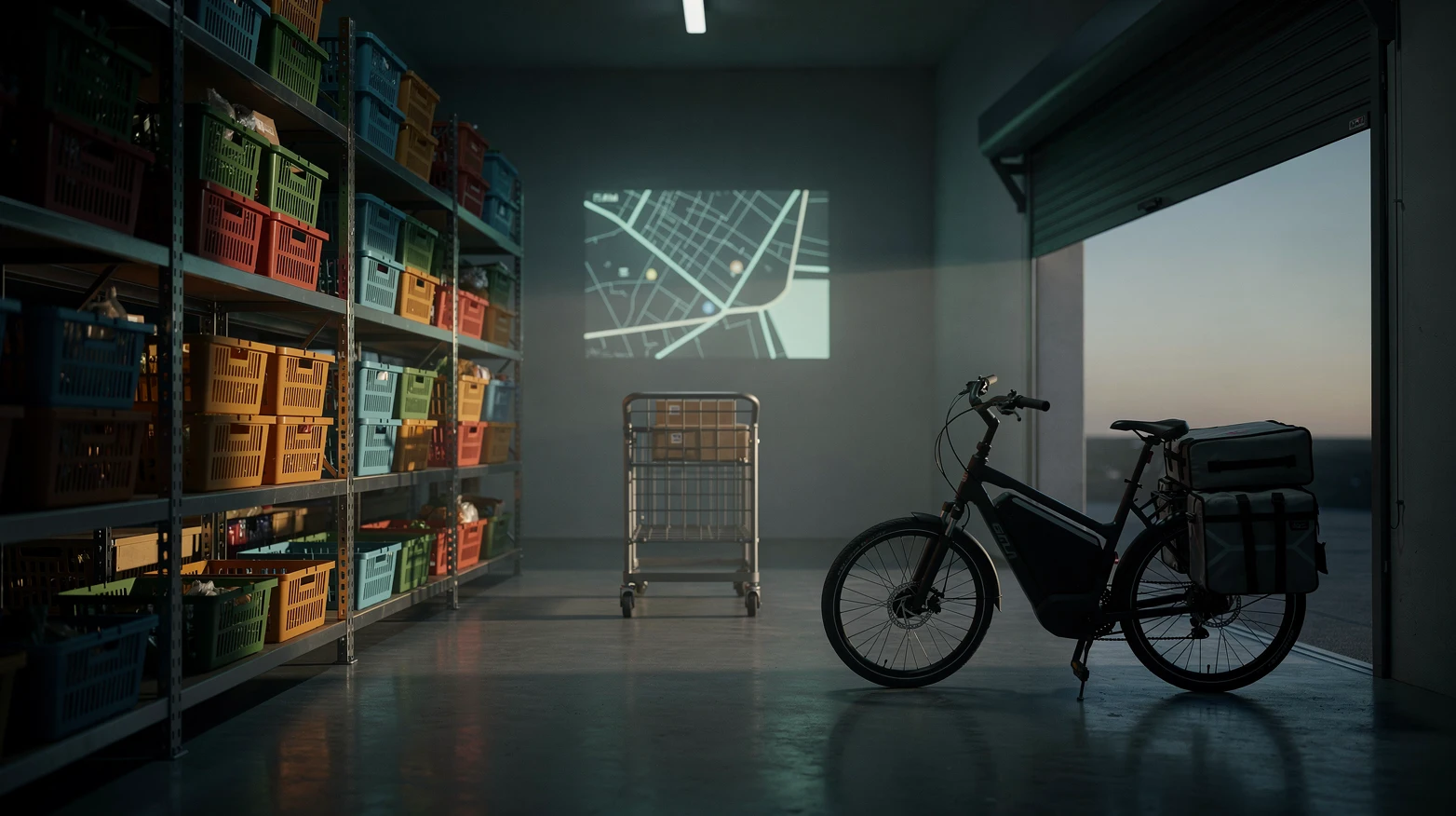
Quick commerce is the business of delivering a small basket of groceries and household items from a local hub to a customer’s door in roughly 10 to 60 minutes. It runs on dark stores: compact, closed-to-the-public warehouses tucked into dense neighborhoods, each stocking a deliberately tiny assortment and staffed by pickers who hand orders to riders within minutes. The model has minted a handful of durable businesses and buried far more of them, and the difference almost always comes down to arithmetic that was visible from day one: order density, basket size and the cost of the last few hundred meters.
This guide explains how the model actually works, what a single order costs, where the break-even line sits, who is winning in 2026 and what a conventional retailer can sensibly do about it. It is written for operators, analysts and founders who want the mechanics rather than the marketing.
In short
- Quick commerce is rapid delivery (10 to 60 minutes) of a narrow assortment from a dark store located inside the delivery radius, not from a distant fulfillment center.
- A dark store typically stocks 1,500 to 4,000 SKUs in 2,000 to 8,000 square feet; the small range is a design choice that keeps pick times under two minutes and inventory turns high.
- The economics hinge on three levers: orders per store per day, average order value and deliveries per rider hour. Rent and packaging matter far less than founders usually assume.
- Most operators need roughly 800 to 1,500 orders per store per day and baskets above $20 to $30 before store-level contribution turns positive; the 2021 to 2023 shakeout hit companies that never got there.
- The survivors in 2026 are grocers with existing supply chains, delivery platforms with shared rider fleets and a few city-dense specialists, particularly in India, Turkey and the Gulf.
What is quick commerce and how does it differ from same-day delivery?
Quick commerce (often shortened to q-commerce) promises delivery measured in minutes, from a facility that sits inside the neighborhood it serves. Same-day delivery, by contrast, usually means a courier van leaves a regional fulfillment center or a full-size supermarket sometime in the next several hours. The two models share a customer but almost nothing else: different real estate, different assortment logic, different labor models and different unit economics.
The defining constraint is distance. A rapid delivery promise of 15 minutes leaves roughly 8 to 10 minutes for the ride once picking and handover are subtracted, which caps the useful radius at about 1.5 to 2.5 kilometers by e-bike in a dense city. Everything else in the model, from the number of SKUs to the shape of the shelving, follows from that radius.
Three delivery models compared
The clearest way to see what makes quick commerce distinct is to line it up against the two models it competes with: same-day delivery from a store or regional hub, and scheduled next-day grocery delivery from a large automated warehouse of the kind that Ocado and its licensees operate.
| Attribute | Quick commerce (dark store) | Same-day from store or hub | Scheduled next-day (central fulfillment) |
|---|---|---|---|
| Promise to customer | 10 to 60 minutes | 2 to 6 hours, or a same-day slot | 1-hour slot, next day or later |
| Fulfillment site | Dark store, 2,000 to 8,000 sq ft, within 2 to 3 km | Supermarket back room or regional depot | Automated warehouse, 100,000+ sq ft, 30 to 80 km out |
| Assortment | 1,500 to 4,000 SKUs | Full store range, 15,000 to 40,000 SKUs | 30,000 to 50,000+ SKUs |
| Typical basket | $15 to $35 | $60 to $120 | $100 to $180 |
| Delivery vehicle | E-bike, scooter, occasionally small van | Van or gig-economy car | Refrigerated van on a planned route |
| Drops per driver hour | 2 to 4 | 3 to 6 | 8 to 14 |
| Primary use case | Top-up, missing item, impulse, convenience | Weekly shop without the trip | Full weekly shop, planned |
The table already hints at the core tension. Quick commerce has the smallest baskets and the fewest drops per hour of the three models, which means it carries the highest delivery cost as a share of each order. It makes up for that with frequency: the customer who orders twice a week is worth more over a year than the one who orders a large basket monthly, provided the operator can serve the small order profitably. That “provided” is the whole story.
Where the model came from
Rapid delivery of convenience goods is not new; Gopuff has been running dark stores in the United States since 2013, and Getir launched in Istanbul in 2015.
What changed in 2020 and 2021 was capital. Pandemic demand plus cheap venture funding produced a wave of start-ups (Gorillas, Flink, Zapp, Jokr, Buyk, Fridge No More, Weezy, Dija and others) that opened hundreds of dark stores in under two years, mostly promising 10 minutes.
By 2023, most of those names had merged, been acquired or closed; Getir announced in April 2024 that it was exiting all of its markets outside Turkey. Meanwhile, in India, Blinkit (acquired by Zomato in 2022), Zepto and Swiggy Instamart grew into some of the largest quick commerce operations in the world. The wider history of how delivery reshaped grocery is covered in our overview of the state of retail across department stores, grocers and experiences, which is worth reading alongside this guide.
How does the dark store model work in plain terms?
A dark store is a small warehouse that looks like a shop but admits no shoppers. The name comes from the fact that it needs no window displays, no checkout lanes and often no signage; it is a fulfillment node wearing a retail unit’s footprint. The typical site is a former convenience store, restaurant or ground-floor commercial unit between 2,000 and 8,000 square feet, chosen for its position at the center of a dense residential catchment rather than for foot traffic.
Inside, the layout is built entirely around picker walking distance. Shelving runs in short, tight aisles; the highest-velocity items (milk, eggs, bread, bananas, soft drinks, snacks, toilet paper) sit closest to the packing bench; frozen and chilled goods sit in reach-in units rather than walk-in cold rooms so a picker never has to open a heavy door. The goal is a pick path that a trained employee can complete in 90 to 150 seconds for a 10-item order.
The order flow, step by step
- Order placement. The customer orders in the app; the platform assigns the order to the dark store whose polygon contains the delivery address and checks live stock before confirming.
- Picking. A picker receives the order on a handheld or wearable device with a route-optimized item sequence, scans each item into a tote and moves to the packing bench. Target: under 2 minutes for most baskets.
- Packing and staging. The order is bagged, chilled items are insulated, and the tote is placed in a numbered staging slot near the door.
- Rider dispatch. A dispatch algorithm assigns the order to a rider who is either waiting at the store or about to return. Where routes allow, two or three orders heading in the same direction are batched.
- Delivery. The rider covers 1 to 3 kilometers, hands over the order, marks it complete and returns or is routed to the next pickup.
- Replenishment. Overnight or in early-morning windows, a truck from a regional hub restocks the store against a forecast that is recalculated daily per SKU.
The whole sequence, from tap to doorstep, is what the customer experiences as a 15-minute promise. Internally, operators track it as three separate clocks (pick time, wait-for-rider time and ride time) because each has a different fix when it slips. The operational detail of pick paths, slotting and staffing rosters is a discipline in its own right (see our guide to dark store operations), and it shares a great deal with the store-floor routines described in the retail store operations playbook on staffing, stock and standards.
Dark stores versus micro-fulfillment centers
A micro-fulfillment center (MFC) is a related but distinct idea: a small automated system, often built into the back of an existing supermarket, that uses robotic shuttles or grid storage to pick orders faster than humans can. MFCs carry more SKUs (often 10,000 to 15,000) and cost several million dollars to install, which only pays off at high daily volume. Dark stores are cheap to open (typically a few hundred thousand dollars of fit-out and stock), quick to close and easy to relocate as demand maps shift. In practice, grocers lean toward MFCs bolted onto stores, while platforms and start-ups lean toward standalone dark stores; the choice reflects who already owns real estate and a supply chain.
Why does the SKU count stay small on purpose?
The single most misunderstood feature of quick commerce is the assortment. Newcomers assume a small range is a limitation to be fixed by growth. Operators who survive know it is the core of the model: a small, ruthlessly curated range is what makes 2-minute picking, high inventory turns and low shrink possible at once.
A typical dark store carries between 1,500 and 4,000 SKUs. Indian operators such as Blinkit and Zepto have reported ranges in the 5,000 to 10,000 region in their largest sites, but even those are a fraction of a supermarket’s 30,000-plus. The range is built from a few clear rules rather than from category-manager instinct, and the full method for building a quick commerce assortment from basket data is covered in its own guide.
The rules that shape the range
- Velocity first. An item earns its slot by selling several units per store per day. Anything slower ties up shelf space that a faster item could turn.
- One or two facings per need. A supermarket carries 12 kinds of ketchup; a dark store carries two (the leading brand and a value option). Choice is deliberately limited so that the picker never has to hunt.
- Mission coverage over category depth. The range is assembled around missions such as “breakfast tomorrow”, “kids’ lunch”, “dinner tonight”, “party in an hour” and “ran out of it”. Each mission must be fully servable or the customer defaults to the corner shop.
- Margin mix is engineered. Fresh produce and dairy drive frequency at thin margins; snacks, drinks, confectionery, personal care and household drive gross margin. Alcohol, where permitted, is a significant margin contributor.
- Local overlays. A 10 to 20 percent overlay of the range varies by neighborhood (halal, kosher, student, family, premium) and is reviewed monthly against sales data.
The consequences run through every line of the cost model. A tight range means a smaller store, which means lower rent and a shorter pick path.
It means fewer suppliers and simpler replenishment. It means less shrink on fresh items because velocity is high and nothing lingers. And it means the app can show every item on a few screens, which matters for a customer who wants the transaction over in 60 seconds.
Expanding the range is the classic way to raise average order value, and it is the classic way to break the model. Every 500 SKUs added lengthens pick paths, raises out-of-stock rates on the tail and increases waste. Operators who expanded range in 2021 to chase basket size often found that the extra items sold rarely while pick times climbed above three minutes.
What does a single order actually cost?
The cost per order (CPO) is the number the whole industry lives and dies by. It aggregates four buckets: picking and packing labor, rider cost, store occupancy and overhead, and packaging and consumables. Marketing, customer support, technology and head office sit above it in contribution accounting, but at the store level these four are what a manager can influence.
The figures below are illustrative ranges for a dense Western European or US city in 2025 to 2026, drawn from operator disclosures, analyst models and industry interviews; actual figures vary widely by labor law, rider employment status and site. Treat them as a structure to reason with, not a benchmark to hit.
| Cost bucket | Low-volume store (300 orders/day) | Mature store (1,200 orders/day) | What moves it |
|---|---|---|---|
| Picking and packing labor | $2.00 to $3.00 | $1.00 to $1.50 | Pick path design, picks per labor hour, roster fit to demand curve |
| Rider cost (per drop) | $5.00 to $8.00 | $2.50 to $4.00 | Drops per rider hour, batching rate, employment model, radius |
| Store rent, utilities, management | $3.00 to $5.00 | $0.75 to $1.25 | Almost entirely order volume; fixed cost spread over drops |
| Packaging, bags, ice packs | $0.40 to $0.70 | $0.30 to $0.50 | Bag standardization, chilled share of basket |
| Shrink and waste | $0.60 to $1.20 | $0.25 to $0.50 | Forecast accuracy, fresh share, range discipline |
| Store-level cost per order | $11.00 to $18.00 | $4.80 to $7.75 | Volume, volume, volume |
Two things stand out. First, the difference between a struggling store and a mature one is not clever cost-cutting; it is order density spreading fixed costs and letting riders and pickers work continuously instead of waiting. Second, rider cost is the largest and most variable line, and it depends mostly on how many drops a rider can complete per hour, which is a function of geography and batching rather than pay rate alone.
Picking labor
A well-run dark store achieves 25 to 40 orders per picker hour at peak. Because demand is spiky (lunch, evening and weekend peaks, quiet mid-mornings), the roster is the real skill: too many pickers in the afternoon and labor cost per order balloons; too few at 7 p.m. and pick times slip past the promise. The best operators cross-train pickers to receive stock and pack, and schedule replenishment into the troughs.
Rider cost
Rider economics depend on three variables: pay per hour or per drop, drops per hour, and idle time. If a rider costs $18 per hour all-in and completes 3 drops per hour, the cost per drop is $6; at 5 drops per hour it falls to $3.60.
Batching (carrying two or three orders on one trip) is the single largest lever because it lifts drops per hour without changing pay, at the price of a slightly longer promise; the full arithmetic of delivery drop density and batching windows is worked through separately. This is why many operators quietly moved from 10-minute to 20- or 30-minute promises between 2022 and 2024: the extra minutes bought batching, and batching bought survival. The trade-off between promise time and drop density is examined in more depth in our analysis of the race to 15-minute grocery delivery in US cities.
Employment status is the other big driver. Where riders are employees (Germany, much of Scandinavia, and Getir’s model in Turkey), the operator carries hourly cost through idle periods but gets reliable coverage. Where riders are independent contractors paid per drop (most US platforms), idle time costs the operator nothing, but supply thins out in bad weather and at unattractive hours. Neither model is free; the choice sets which risk the operator carries.
Occupancy
Rent is the line founders obsess over and the one that matters least at scale. A 4,000-square-foot unit in a secondary location might cost $8,000 to $20,000 a month in a major Western city, which at 1,200 orders a day is well under a dollar per order. The same rent at 300 orders a day is $1 to $2 per order, and the store is still unprofitable for other reasons. The lesson operators drew from the 2022 shakeout was not “find cheaper real estate” but “do not open the store until the catchment can support the volume”.
What basket size and fees does it take to break even?
Set the store-level cost per order beside the revenue an order generates and the break-even condition falls out directly. Revenue per order has four components: product gross margin, the delivery fee, any service fee or small-basket surcharge, and, increasingly, advertising income from brands paying for placement in the app.
A worked example makes the logic concrete. Assume a mature store with a store-level cost per order of $6.00, a product gross margin of 28 percent (reasonable for a mix skewed toward snacks, drinks and household), a $2.49 delivery fee and $0.40 per order of retail media income.
- At a $15 basket: gross margin $4.20 + fee $2.49 + ads $0.40 = $7.09 revenue contribution. Minus $6.00 cost = $1.09 per order before marketing, tech and head office. Thin, and negative once those are allocated.
- At a $25 basket: gross margin $7.00 + fee $2.49 + ads $0.40 = $9.89. Minus $6.00 = $3.89 per order. Enough to carry a modest overhead allocation.
- At a $35 basket: gross margin $9.80 + fee $2.49 + ads $0.40 = $12.69. Minus $6.00 = $6.69 per order. The model works.
Run the same numbers on the low-volume store with a $14 cost per order and every basket size loses money, which is exactly what happened to operators that opened stores ahead of demand in 2021. The break-even order value at a given cost per order can be approximated as (cost per order minus fees minus ad income) divided by gross margin rate. For the mature store above that is ($6.00 minus $2.89) / 0.28, or roughly $11; for the low-volume store it is ($14.00 minus $2.89) / 0.28, or roughly $40, above what most quick commerce customers spend.
Pulling the levers
Operators have four practical ways to move the break-even line, and most survivors used all of them between 2022 and 2025:
- Raise the minimum order or add a small-basket fee. A $10 or $12 minimum, or a $1.99 surcharge under $20, removes the least profitable orders outright. Tesco’s Whoosh service illustrates the mechanics: its free-delivery promotion carries a basket threshold, which our coverage of Tesco making Whoosh delivery free until January walks through in detail.
- Lift gross margin through mix and private label. Nudging the basket toward higher-margin categories and introducing own-brand staples can add 3 to 6 points of margin.
- Sell advertising. Brands pay for search placement, banners and sampling; at scale this has become a meaningful line for Indian operators and for Gopuff and Instacart in the US.
- Extend the promise to enable batching. Going from 10 to 25 minutes can lift drops per rider hour by 30 to 60 percent in a dense area.
The interplay of fees, subscriptions and margin across the wider delivery grocery market, including the large-basket models, is dissected in our earlier piece on grocery delivery economics and who actually makes money; the quick commerce version of the story is the same math at a smaller basket.
Who is winning: grocers, platforms or convenience chains?
By 2026 the field has sorted into four groups, each with a different reason for being in the business. The pure-play start-up funded to build dark stores from scratch is now the exception rather than the rule outside India and a handful of emerging markets.
Incumbent grocers
Supermarket chains entered quick commerce late and cautiously, then discovered they held most of the advantages: buying scale, existing supply chains, established private label, trusted brands and thousands of stores that could double as pick points. Tesco’s Whoosh in the UK, launched in 2021 and now operating from more than a thousand Express stores, is the template: pick from an existing convenience store, deliver via a mix of own and third-party riders, and charge a fee that keeps the smallest baskets out. Carrefour, Albert Heijn, Kroger and others have run equivalents, usually in partnership with a platform for the rider layer; Sainsbury’s went the other way and closed its own Chop Chop service in February 2026 in favor of Deliveroo, Uber Eats and Just Eat.
Delivery platforms
Uber, DoorDash (through DashMart and its grocery partnerships), Deliveroo and Just Eat Takeaway already had rider fleets amortized across restaurant delivery, which solved the idle-rider problem that sank the pure plays. Amazon has been the most consequential recent entrant: its 30-minute Amazon Now service, covered in our report on Amazon Now switching on 30-minute delivery for millions of customers, layers a dark store network on top of Prime membership economics that no start-up can match. Instacart, meanwhile, positioned itself as the technology and rider layer for grocers who did not want to build their own.
Convenience specialists
Gopuff in the US and Getir in Turkey remain the standard bearers for the dark store pure play, and both survived by retreating to the geographies where density was sufficient and by adding advertising and subscription revenue. In the Gulf and parts of Eastern Europe, regional specialists persist where labor costs are low and apartment density is high.
The Indian model
India is where quick commerce has grown fastest and looks most durable. Blinkit, Zepto and Swiggy Instamart operate thousands of dark stores, promise 10 minutes and have expanded assortment well beyond groceries into electronics, apparel and even small appliances. The reasons are structural: dense cities, low rider cost, a fragmented offline retail base that makes the app competitive on price and range, and a consumer habit of frequent small purchases from kirana shops that the model mirrors. Zepto has publicly discussed a public listing, and Blinkit is a significant contributor to Zomato’s reported results.
| Operator type | Examples (2026) | Structural advantage | Structural weakness | Outlook |
|---|---|---|---|---|
| Incumbent grocer | Tesco Whoosh, Sainsbury’s via Deliveroo and Uber Eats, Carrefour Sprint, Kroger via partners | Buying scale, private label, existing store estate as pick points | Store layouts not built for 2-minute picks; rider layer usually outsourced | Durable, if kept as a channel rather than a growth bet |
| Delivery platform | Amazon Now, DoorDash DashMart, Uber, Deliveroo Hop | Shared rider fleet, existing customer base, subscription bundles | Grocery buying and fresh handling are not core skills | Growing share; likely consolidators |
| Convenience pure play | Gopuff (US), Getir (Turkey) | Purpose-built stores, curated range, ad revenue | Own the idle-rider problem; capital dependent | Viable in dense cores; retrenched elsewhere |
| Emerging-market platform | Blinkit, Zepto, Swiggy Instamart, Talabat Mart | Density, low delivery cost, fragmented offline competition | Regulatory scrutiny, price competition, rider welfare debates | Fastest growth; range expansion continues |
The pattern across the table is that the winners all had something to amortize the model against: a supply chain, a rider fleet, a membership base or a favorable cost structure. The losers were trying to build all four at once with venture money, and when funding costs rose in 2022 the clock ran out. Our earlier analysis of the consolidation endgame among scaled delivery players traces how the remaining independents are being absorbed.
Where does quick commerce fail and why do cities differ so much?
The model does not fail randomly. It fails in predictable places for predictable reasons, and the biggest is the shape of the city. A dark store needs roughly 30,000 to 60,000 households within a 2-kilometer radius to reach the 1,000-plus orders a day that make the numbers work at Western cost levels. That population density exists in central London, Paris, Manhattan, Istanbul, Mumbai and a few dozen other cities; it does not exist in most American suburbs, most British towns or most of Germany outside Berlin and Munich.
The failure modes
- Opening ahead of density. Stores launched in secondary cities or outer neighborhoods to show growth never reached break-even volume and were closed within 18 months.
- Promise inflation. Ten-minute promises prevented batching, so rider cost per drop stayed above $5 even in dense areas. The promise was a marketing choice with an operating cost attached.
- Subsidized demand. Deep discounts and free delivery built order counts that vanished the moment fees appeared, leaving stores sized for demand that was never real.
- Range creep. Adding thousands of slow-moving SKUs to raise basket size lengthened picks, raised waste and cluttered the app.
- Labor and regulation. Rider employment rulings in Spain, the Netherlands and elsewhere raised cost per drop overnight; several cities restricted dark stores through zoning or noise complaints from neighbors of 24-hour loading bays.
- Weather and seasonality. Demand spikes in rain and cold while rider supply falls, and the operator eats the mismatch.
Why cities differ
Five variables explain most of the difference between a city where the model prints money and one where it bleeds. Household density sets the addressable orders per store. Vertical housing (apartment blocks versus detached homes) determines how many drops a rider can make per kilometer traveled.
Rider cost, driven by local wages and employment law, sets the floor on cost per drop. Offline competition determines how attractive the app is on price and convenience: where a well-stocked convenience store sits on every corner at low prices, the app has to compete on speed alone. And car dependence shapes habit; a household that drives to a supermarket weekly and stores a full pantry has fewer of the “ran out” moments the model depends on.
Put those together and the map explains itself. Mumbai and Istanbul score well on all five; Phoenix and Leeds score poorly on most. The interesting cases are the in-between cities where the model works in three or four central neighborhoods and nowhere else, which is precisely where the surviving operators have concentrated.
How are surviving operators changing the model in 2026?
The quick commerce of 2026 is a materially different business from the version pitched in 2021, and the changes are all in the direction of the arithmetic laid out above. Understanding them helps a retailer or investor read what an operator is actually doing behind its marketing.
Longer promises, batched routes
Ten minutes has largely given way to 15, 20 or 30 minutes outside India, and even Indian operators treat 10 minutes as a target rather than a guarantee. The extra minutes are spent on batching: a rider leaving with two or three orders heading in the same direction, which lifts drops per hour and cuts cost per drop by a third or more. Customers, it turned out, cared about reliability within a reasonable window far more than about the difference between 10 and 20 minutes.
Advertising and retail media
Apps that own the customer’s grocery search box own a valuable advertising surface. Sponsored placements, sampling and brand-funded promotions have become a material revenue line, especially in India, where Blinkit and Zepto report advertising as a fast-growing segment, and in the US, where Gopuff and Instacart run mature ad platforms. For an operator at a $25 basket, an extra $0.50 to $1.00 per order of ad income is the difference between a marginal store and a profitable one.
Subscriptions and bundles
A monthly membership that waives delivery fees converts occasional users into frequent ones and stabilizes revenue. Amazon’s inclusion of rapid delivery in Prime, and Uber One and DashPass bundling grocery with restaurant delivery, show where this is heading: rapid grocery becomes a feature of a larger membership rather than a standalone product.
Range expansion, carefully
Surviving operators are widening assortment again, but in a disciplined way: through larger “mega” dark stores in the densest catchments (Indian operators have described sites of 8,000 to 12,000 square feet carrying 10,000-plus SKUs), through partnerships that let a third-party retailer’s range be delivered from its own store, and through categories with high margin and low handling cost such as electronics accessories, beauty and pharmacy. The tight core range for the standard store is unchanged.
Automation at the edge
Full automation makes little sense in a 3,000-square-foot dark store, but targeted tools have spread: pick-to-light shelving, wearable scanners with route-optimized pick sequences, demand forecasting per SKU per store per hour, and dynamic dispatch that decides in real time whether to hold an order for a batch. These raise picks per labor hour and drops per rider hour by single-digit percentages each, which compounds into the difference between loss and profit on a mature store.
How should a traditional retailer respond?
For a supermarket chain, a convenience operator or a specialty retailer, the question is rarely “should we build a dark store network” and almost always “which layer of this do we want to own”. The answer depends on what the retailer already has, and the options run from full ownership to doing nothing.
Four strategic options
- Pick from existing stores, outsource the rider. The Whoosh model. Lowest capital, fastest to launch, uses the estate as it stands. The risk is that picking from a shop floor built for shoppers takes 5 to 8 minutes, not 2, and that pickers get in the way of customers at peak.
- Build or convert dedicated dark stores in a few dense catchments. Higher capital, better pick economics, but the retailer now owns the volume risk that sank the pure plays. Sensible only where the retailer already has a strong customer base in the catchment.
- List on a platform’s marketplace. Let Uber, DoorDash, Deliveroo or Instacart handle the app and the rider; the retailer supplies stock and picks. Lowest control, lowest margin, lowest risk. The retailer also hands the customer relationship and the data to the platform.
- Do nothing, deliberately. For retailers in low-density markets or with a customer base that shops weekly by car, rapid delivery may never be more than a small, loss-making channel. Explicitly declining is a legitimate choice, provided it is revisited annually.
What to measure before committing
Retailers who have done this well started with a small number of hard measurements rather than a strategy deck. Households within 2 kilometers of each candidate site. Existing basket data from the store in that catchment, split by mission. Realistic pick times from a timed trial in the actual store.
Rider cost per drop quoted by two platforms. And, most important, a candid estimate of how many of the resulting orders would be incremental rather than shifted from the retailer’s own shop next door. Cannibalization is the quiet cost of the store-pick model: a $22 delivered basket that replaces a $22 in-store visit adds cost and subtracts nothing from anyone but the retailer.
For retailers who do proceed, the operational demands look a lot like the discipline already needed on the shop floor: accurate stock files, tight replenishment, rosters that match the demand curve and standards that hold at 8 p.m. on a Friday. That is not a coincidence. Quick commerce is, at bottom, a convenience store with the customers moved outside the walls, and the retailers who run good convenience stores tend to run good dark stores.
What are the common mistakes in quick commerce economics?
The same errors recur in pitch decks, expansion plans and retailer pilots. Most of them are ways of avoiding the arithmetic in the earlier sections.
- Modeling the mature store on day one. Every store starts at 100 orders a day, not 1,200. The plan has to fund the ramp, and the ramp has to be short.
- Counting subsidized orders as demand. Orders won with $10 off and free delivery tell you almost nothing about willingness to pay a $2.49 fee on a $20 basket.
- Treating rider cost as a pay rate. The relevant number is cost per drop, which depends on drops per hour, batching and idle time far more than on the hourly figure.
- Solving low basket size with more SKUs. Basket size responds to minimum order values, fees, mission coverage and promotions; range expansion mostly adds cost.
- Ignoring cannibalization in store-pick models. A delivered order that replaces an in-store visit is a cost increase, not a sale.
- Underestimating regulation. Rider employment status, zoning for dark stores, alcohol delivery licensing and late-night loading rules vary by city and can change quickly. Operators should verify current rules with local authorities and their own advisors; nothing in this guide is legal advice.
- Forgetting the weather. Demand and rider supply move in opposite directions on a wet evening. Contracted riders and a small buffer of employed ones are how mature operators absorb it.
FAQ on quick commerce and dark stores
What is the difference between quick commerce and e-commerce?
E-commerce in the broad sense covers any online purchase, with delivery in days from a distant warehouse. Quick commerce is a narrow subset: small baskets of groceries and convenience items delivered in 10 to 60 minutes from a dark store inside the neighborhood. The model differs on assortment (a few thousand SKUs rather than millions), on logistics (e-bike riders on short hops rather than parcel networks) and on economics (a delivery cost that is a large share of a small basket). The customer overlap is real, but the operating models share almost nothing.
How big is a typical dark store and how many SKUs does it hold?
A standard dark store runs from about 2,000 to 8,000 square feet and carries between 1,500 and 4,000 SKUs. Larger formats in the densest catchments, particularly in India, reach 8,000 to 12,000 square feet with 10,000 or more SKUs. The range is kept deliberately narrow so that a picker can assemble a 10-item order in under two minutes, inventory turns stay high and waste on fresh items stays low. Every operator that survived the 2022 shakeout kept its core store range small and put wider assortment into a separate larger format or a partner’s store.
How many orders per day does a dark store need to be profitable?
At Western labor and rent levels, most operators and analysts put store-level break-even somewhere between 800 and 1,500 orders per day, depending on basket size, rider model and fees. The number is high because rent, management and a base rider roster are fixed costs that only become cheap per order when spread across a lot of drops. In lower-cost markets such as India or Turkey the threshold is lower, which is one reason the model has scaled faster there. A store stuck at 300 orders a day loses money at any realistic basket size.
Why did so many quick commerce start-ups fail in 2022 and 2023?
Three reasons combined. They opened stores ahead of demand in cities and neighborhoods that lacked the density to reach break-even volume. They held 10-minute promises that prevented batching and kept rider cost per drop high. And they built order counts on subsidies that evaporated once fees were introduced.
When venture funding tightened in 2022, the runway to fix those problems disappeared, and Gorillas, Jokr, Buyk, Fridge No More, Zapp’s expansion plans and eventually Getir’s international business were sold, merged or shut down.
Is 10-minute delivery still the norm?
Outside India, mostly not. Most operators in Europe and North America now promise 15 to 30 minutes, which allows dispatch systems to batch two or three orders per rider trip and cuts cost per drop substantially. Indian operators still market 10 minutes and often achieve it, helped by dense housing, low rider cost and stores placed every couple of kilometers. Customer research across markets suggests reliability within a stated window matters more to retention than shaving the window from 20 minutes to 10.
How do quick commerce companies make money beyond product margin?
Four additional streams matter. Delivery and service fees, often with a small-basket surcharge, cover part of the last-mile cost directly. Advertising income from brands paying for placement in the app has become a large, high-margin line for scaled operators.
Subscriptions that waive fees raise order frequency and smooth revenue. And some operators earn margin from supplier funding, promotions and, where licensed, alcohol and tobacco sales. At a mature store, ad income and fees together can add $3 to $4 per order, which is often the entire profit.
What is a micro-fulfillment center and is it better than a dark store?
A micro-fulfillment center (MFC) is a compact automated system, usually attached to a supermarket, that uses robotic shuttles or a storage grid to pick orders. It holds more SKUs (often 10,000 to 15,000) and picks faster than humans, but costs several million dollars to install and needs high daily volume to pay back.
A dark store is cheap to open and close and suits operators without existing stores. Grocers with large stores in dense areas tend toward MFCs; platforms and start-ups tend toward dark stores. Neither is universally better; the right choice depends on volume, real estate already owned and assortment ambitions.
Should a small or mid-size retailer try quick commerce?
Usually not by building infrastructure. The economics reward density, scale and amortized rider fleets, none of which a single retailer or small chain has. The realistic routes are listing on a delivery platform’s marketplace, where the platform handles the app and riders and the retailer picks from its own shelves, or a store-pick service with an outsourced rider in one or two dense catchments where the retailer already has loyal customers. Before either, a retailer should time actual pick durations in its own store and estimate how many delivered orders would simply replace in-store visits.
Which markets look strongest for quick commerce in 2026?
India is the clear leader by growth and store count, followed by Turkey, the Gulf states and dense Western city cores such as London, Paris, New York and Berlin. The common factors are high household density, apartment living, affordable rider labor relative to basket size and a consumer habit of frequent small purchases. Suburban and car-dependent regions remain difficult, which is why operators there have concentrated on a handful of central neighborhoods and left the rest to same-day and scheduled delivery models.
What to read next
Quick commerce is one corner of a much larger shift in how groceries and convenience goods reach households, and it is best understood next to the models it competes with. Our guide to the state of retail across department stores, grocers and experiences sets the wider context, while the retail store operations playbook covers the staffing, stock and standards discipline that dark stores borrow wholesale from good convenience retailing. Both are worth an hour before any decision about building, partnering or deliberately staying out.