
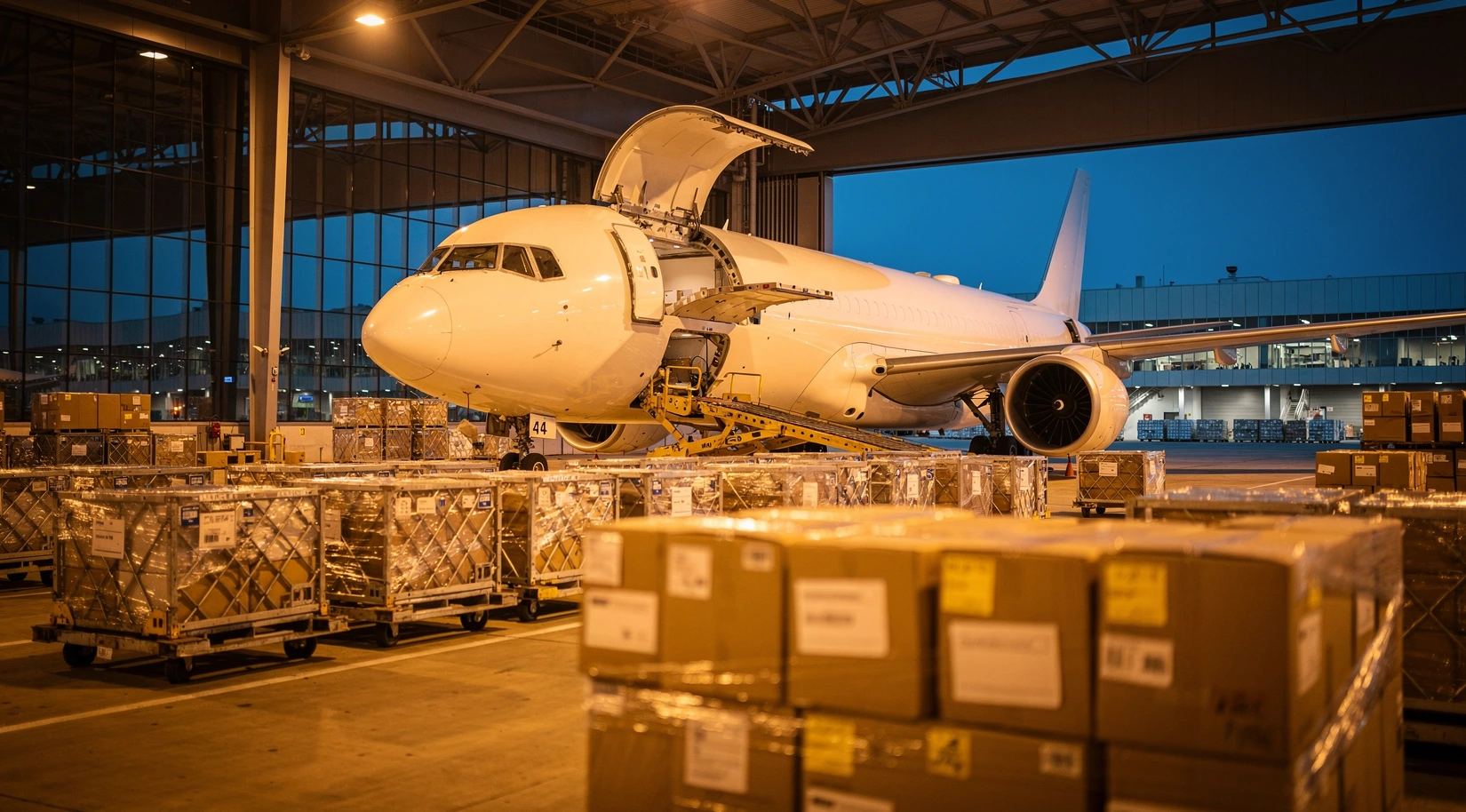
FedEx will begin charging demand surcharges on parcels and freight imported into the United States from Canada, Europe, Latin America and the Caribbean on Monday, September 21, 2026, and will more than double the surcharges it already applies to shipments arriving from China and most of Asia-Pacific. The schedule, published in FedEx’s demand surcharge notice for U.S. international services and first reported by Supply Chain Dive on September 18, runs “until further notice” and lands one week before the carrier’s domestic peak-season fees switch on. For cross-border retailers, marketplace sellers and dropshippers, the practical effect is a new per-pound line on every inbound FedEx invoice just as holiday inventory is moving.
In short
- Effective date: Monday, September 21, 2026, until further notice, according to FedEx’s U.S. import demand surcharge schedule (document updated September 4, 2026).
- New lanes: imports from Canada ($0.14 per lb), Latin America and the Caribbean ($0.12 per lb), Europe and Israel ($0.25 per lb), India ($0.89 per lb) and Sub-Saharan Africa ($0.60 per lb) carry a demand surcharge for the first time under this schedule.
- Existing lanes go up: China, Hong Kong and Macau rise to $0.91 per lb on priority services (from $0.35) and $0.54 on economy (from $0.25); Japan, South Korea, Australia and other Asia-Pacific origins rise to $0.73 / $0.54 from a flat $0.20.
- Minimums: $1 per parcel shipment and $50 per freight shipment, so small parcels pay at least $1 regardless of weight.
- Exports too: US-origin shipments to Canada, Latin America, Europe, Australia and New Zealand move from $0.20 to $0.30 per lb, a 50% increase, on the same date.
What did FedEx announce for September 21?
FedEx’s notice, titled “Demand Surcharge for U.S. international services” and dated September 4, 2026, sets out two tables: one for shipments imported into the United States and one for shipments exported from it. Both carry an “Effective September 21, 2026 until further notice” line for the new rates and list the schedules they replace, most of which expire on September 20. Supply Chain Dive, which broke the story on September 18, reported that the carrier is “levying demand surcharges on various import shipments into the U.S. including those originating from Canada, Europe, Latin America and the Caribbean starting Monday until further notice.”
The carrier’s stated rationale is the same language it has used for domestic peak fees. “During times of elevated volumes, high demand for capacity, and increased operating costs across our network, FedEx will implement Demand surcharges,” the company said in the statement quoted by Supply Chain Dive. FedEx added that regional assessments of shipment volume and network capacity determine where a surcharge applies and at what level.
The surcharge is assessed per pound of billable weight, with a floor of $1 per parcel shipment and $50 per freight shipment. It applies across the FedEx Express international portfolio: FedEx International First, International Priority Express, International Priority, International Connect Plus, International Economy and the corresponding freight products. For the China and Asia-Pacific lanes the rate depends on whether the service is a priority or an economy product; for every other origin a single rate covers “parcel and freight.”
How much are the new US import surcharges by origin?
The table below reproduces the September 21 schedule from FedEx’s notice. Rates are in US dollars per pound of billable weight and apply to shipments into the United States.
| Origin region | Services covered | Surcharge (per lb) | Status vs. prior schedule |
|---|---|---|---|
| Canada | Parcel and freight | $0.14 | New lane |
| Latin America and the Caribbean (LAC) | Parcel and freight | $0.12 | New lane |
| Europe | Parcel and freight | $0.25 | New lane |
| Israel | Parcel and freight | $0.25 | New lane |
| China, Hong Kong SAR, Macau SAR | International First, Priority Express, Priority, Connect Plus, Priority Freight | $0.91 | Up from $0.35 |
| China, Hong Kong SAR, Macau SAR | International Economy, Economy Freight, Deferred Freight | $0.54 | Up from $0.25 |
| Asia-Pacific (Australia, Japan, South Korea, Singapore, Taiwan, Thailand, Malaysia, Philippines, Indonesia, New Zealand, Cambodia, Fiji, Guam) | Priority services (as above) | $0.73 | Up from $0.20 |
| Asia-Pacific (same list) | Economy services (as above) | $0.54 | Up from $0.20 |
| India | Parcel and freight | $0.89 | Up from $0.70 (was inside MEISA) |
| Sub-Saharan Africa | Parcel and freight | $0.60 | Down from $0.70 (was inside MEISA) |
| MEISA, excluding India and Sub-Saharan Africa | Parcel and freight | $0.70 | Unchanged since March 5 |
Minimum charge on every row: $1 per parcel shipment, $50 per freight shipment. Source: FedEx, “Demand Surcharge for U.S. international services,” updated September 4, 2026.
Which countries count as “Europe” and “LAC”?
FedEx’s regional definitions matter because they determine which rate a shipment attracts. For US imports, the “Europe” region in the notice covers the EU member states plus Norway, Switzerland, Turkey and the four UK nations, along with the Channel Islands, the Azores and Madeira. The “Latin America and the Caribbean” region runs from Mexico and Brazil through the Caribbean islands and includes the US Virgin Islands. Israel is listed separately at the same $0.25 rate as Europe.
“MEISA” (Middle East, Indian Subcontinent and Africa) is the broadest bucket, spanning the Gulf states, Pakistan, Bangladesh, Sri Lanka, North Africa and Central Asia. Under the previous schedule India and the Sub-Saharan African economies sat inside MEISA at $0.70 per pound. From September 21 India is carved out at a higher $0.89 and Sub-Saharan Africa (including South Africa, Kenya and Nigeria) at a lower $0.60, while the remainder of MEISA stays at $0.70.
Why does the China lane cost more on priority than on economy?
China, Hong Kong and Macau, and the Asia-Pacific group are the only origins where FedEx splits the rate by service tier. Priority products (International First, Priority Express, Priority, Connect Plus and Priority Freight) carry $0.91 from China and $0.73 from Asia-Pacific, while economy products (International Economy, Economy Freight and Deferred Freight) carry $0.54 from both. That structure reflects where FedEx says capacity is tightest: express air lift on the trans-Pacific lanes that carry direct-to-consumer parcels for Chinese marketplaces and their US sellers.
The China number is also the one with the clearest regulatory backdrop. Since the US closed the de minimis exemption for low-value parcels in 2025, every commercial parcel from China clears customs on a duty-paid basis, and the European Union has since moved in the same direction with a flat EUR 3 duty that has already halved low-value parcel declarations in Belgium and the Netherlands. Carriers that once moved millions of sub-$800 parcels on express air now handle fewer, heavier and more consolidated shipments, and the per-pound surcharge is FedEx’s way of pricing the lift that remains.
How do the new rates compare with the schedules they replace?
The September 21 notice retires three earlier import schedules and one export schedule. Reading them side by side shows the size of the step-up. The China rates that took effect on June 29, 2026 were $0.35 per pound on priority and $0.25 on economy; those become $0.91 and $0.54, increases of 160% and 116% respectively. The Asia-Pacific rate that took effect on May 7 was a single $0.20 per pound on all services; the new priority rate of $0.73 is 265% higher and the economy rate of $0.54 is 170% higher.
| Lane | Prior rate (per lb) | Prior window | Rate from Sept 21 | Change |
|---|---|---|---|---|
| China / HK / Macau to US, priority | $0.35 | June 29 to Sept 20, 2026 | $0.91 | +160% |
| China / HK / Macau to US, economy | $0.25 | June 29 to Sept 20, 2026 | $0.54 | +116% |
| Asia-Pacific to US, priority | $0.20 | May 7 to Sept 20, 2026 | $0.73 | +265% |
| Asia-Pacific to US, economy | $0.20 | May 7 to Sept 20, 2026 | $0.54 | +170% |
| MEISA to US (all) | $0.70 | March 5 to Sept 20, 2026 | $0.70 (ex India, SSA) | 0% |
| India to US | $0.70 (as MEISA) | March 5 to Sept 20, 2026 | $0.89 | +27% |
| Sub-Saharan Africa to US | $0.70 (as MEISA) | March 5 to Sept 20, 2026 | $0.60 | -14% |
| Canada, LAC, Europe, Israel to US | None | n/a | $0.12 to $0.25 | New |
| US to Canada, LAC, Europe, Australia, NZ | $0.20 | May 7 to Sept 20, 2026 | $0.30 | +50% |
Source: FedEx U.S. import and export demand surcharge notices, September 4, 2026. Percentage changes are shopappy calculations.
Two points stand out. First, the Canada, Europe and Latin America rates are low in absolute terms (a 5 lb parcel from Germany attracts $1.25; a 3 lb parcel from Toronto hits the $1 minimum), but they are new, and they apply to trade lanes that until now carried no demand surcharge at all. Second, the trans-Pacific rates are now high enough to change landed-cost math: a 10 lb express shipment from Shenzhen carries $9.10 in demand surcharge alone, before fuel, duty and the disbursement fee.
Why is FedEx adding the fees now?
The timing is a function of the calendar and of what FedEx sees in its own network. The carrier’s domestic peak-season surcharges, announced on July 22, begin with additional handling, oversize and unauthorized-package fees on September 28 and add residential and express demand surcharges from October 26, with the highest rates between November 23 and December 27. Layering international import surcharges from September 21 aligns the two programs so that inbound and outbound capacity are priced for peak at the same time.
Volume is up on the lanes being surcharged
Supply Chain Dive reported that FedEx’s international export package volume grew an average of 5% year over year in the quarter that ended May 31, 2026, and the carrier said demand for international export services has increased. On the import side, the National Retail Federation’s port tracker has lifted its forecast for September to the busiest month of the year, a picture we covered when the NRF raised its September import forecast to 2.31 million TEU. Ocean freight and express parcel are different modes, but they respond to the same retail order books, and a late-running import peak is exactly the environment in which a carrier prices air capacity at a premium.
The precedent: China-origin fees in 2025
FedEx has done this before. Supply Chain Dive noted that the carrier introduced temporary China-origin fees last year as tariff-driven volatility hit trans-Pacific volumes, and the March, May and June 2026 schedules that the new notice replaces show that surcharges on Asian and Middle Eastern origins have been in place for most of this year. What is different about September 21 is the breadth: this is the first schedule to put a demand surcharge on parcels from Canada and Europe, the two largest US trading partners by two-way goods flow.
Costs, not only volume
FedEx’s statement cites “increased operating costs across our network” alongside volume. The carrier has been repricing international fuel surcharges through 2026 and, since the June 1 separation of FedEx Freight into a standalone company, is running a parcel-focused network with a different cost base. Industry analysts have pointed out that demand surcharges are one of the few levers that can be adjusted “until further notice” without reopening annual contracts, which is why they tend to appear whenever a carrier wants to protect yield during a capacity crunch.
What changes for US exporters?
The export side of the notice is smaller but affects a larger number of US merchants. From September 21, US-origin parcels and freight bound for Canada, Latin America and the Caribbean, Europe, Australia and New Zealand attract $0.30 per pound, up from the $0.20 rate that ran from May 7 through September 20. Shipments to the Middle East and Indian Subcontinent group continue at $0.75 per pound and shipments to Israel at $0.50 under a schedule that has been “until further notice” since April 24, while India and the rest of MEISA remain at $0.50 under the March 5 schedule.
For a US apparel brand shipping a 2 lb parcel to a customer in France, the increase is $0.20 per parcel in surcharge terms, although the $1 minimum means a 2 lb parcel pays $1 under both the old and new schedules. The change bites on heavier shipments: a 40 lb replenishment consignment to a Canadian retail partner moves from $8 to $12 in demand surcharge. Merchants that guarantee delivered duty paid pricing at checkout will need to update their landed-cost tables before Monday if they want the surcharge to be passed through rather than absorbed.
What does this mean for retailers and cross-border sellers?
The surcharge is a cost-of-goods line for any retailer that imports finished product by express, and a shipping-cost line for any marketplace seller who fulfills US orders from abroad. Three groups are most exposed.
Direct-to-consumer sellers shipping from China and Asia
Sellers on Amazon, Temu, Shein, AliExpress and TikTok Shop who ship individual orders from Chinese warehouses on FedEx International Priority or Connect Plus will see the largest absolute increase, because the $0.91 priority rate applies to the lightest, most frequent parcels. A 1 lb phone accessory pays the $1 minimum; a 4 lb small appliance pays $3.64, up from $1.40. For sellers already absorbing duty since the end of de minimis, the surcharge is another argument for the bulk-import pivot that Temu and Shein have pursued, moving inventory into US fulfillment centers in consolidated freight and delivering domestically.
North American and European brands selling into the US
Canadian and European DTC brands are the group facing a fee they have never paid before. At $0.14 and $0.25 per pound the amounts are modest per parcel, but they arrive on top of the tariff environment that has defined 2026: Section 301 duties, the Canada-specific measures and the disbursement and duty-forwarding fees that carriers charge to advance duty at the border. Brands that have adopted duties-and-taxes-guaranteed checkout tools, including the FedEx Duty and Tax app for Shopify that guarantees landed cost at checkout, should confirm with their provider whether demand surcharges are inside the guaranteed figure or billed separately, because the answer determines who eats the $0.25.
US retailers replenishing by express freight
Retailers that top up holiday inventory by express freight from Europe or Asia face the freight minimum of $50 per shipment and, above 200 lb from Europe or 55 lb from China on priority, a per-pound charge that exceeds it. A 500 lb consolidated freight shipment of European cosmetics carries $125 in demand surcharge; the same weight from China on International Priority Freight carries $455. That is small relative to the value of the goods but material relative to freight cost, and it will show up in the cost-per-unit calculations that merchandising teams run during the Q3 earnings round.
| Example shipment | Origin, service | Surcharge before Sept 21 | Surcharge from Sept 21 |
|---|---|---|---|
| 3 lb parcel | Toronto to US, International Priority | $0 | $1.00 (minimum applies) |
| 10 lb parcel | Munich to US, International Priority | $0 | $2.50 |
| 4 lb parcel | Shenzhen to US, International Priority | $1.40 | $3.64 |
| 10 lb parcel | Shenzhen to US, International Economy | $2.50 | $5.40 |
| 20 lb parcel | Mumbai to US, International Priority | $14.00 | $17.80 |
| 8 lb parcel | Tokyo to US, International Priority | $1.60 | $5.84 |
| 500 lb freight | Paris to US, International Priority Freight | $0 | $125.00 |
| 500 lb freight | Shanghai to US, International Priority Freight | $175.00 | $455.00 |
| 40 lb parcel | US to Vancouver, International Priority | $8.00 | $12.00 |
Illustrative calculations from the published per-pound rates and minimums; actual invoices depend on billable (dimensional) weight and on any contractual surcharge waivers.
How do FedEx’s international fees compare with UPS, USPS and Amazon this peak?
FedEx is not alone in raising the price of peak capacity, but it is the only one of the big US carriers to have published an origin-by-origin import surcharge of this breadth for the fall. UPS updated its US demand surcharge schedule on August 26; Supply Chain Dive reported that the fees start as early as September 27 as the carrier prepares for US volume to jump 24% from the third quarter to the fourth. According to parcel audit firms that track the UPS schedule, additional handling, large package and over-maximum surcharges begin September 27, air and ground residential surcharges follow on October 25, the highest tier runs November 22 through December 26, and everything expires January 16, 2027.
The US Postal Service’s holiday pricing on Ground Advantage, Priority Mail and other package services starts October 4, per Supply Chain Dive. Amazon Shipping’s peak fees, which the outlet reported are higher than last year, reach their top rate between November 22 and December 26. None of those programs, on the information published so far, includes a per-pound surcharge on inbound international parcels from Canada or Europe.
| Carrier | Peak program start | Highest-rate window | End | International import surcharge by origin? |
|---|---|---|---|---|
| FedEx (international) | Sept 21, 2026 | Flat, until further notice | Until further notice | Yes: $0.12 to $0.91 per lb by origin |
| FedEx (US domestic) | Sept 28 (handling, oversize), Oct 26 (residential, express) | Nov 23 to Dec 27 | Jan 17, 2027 | n/a |
| UPS (US) | Sept 27 (handling, large package), Oct 25 (residential, air) | Nov 22 to Dec 26 | Jan 16, 2027 | Not published in the Aug 26 schedule |
| USPS | Oct 4 | Holiday season | January 2027 (historical pattern) | No |
| Amazon Shipping | Fall 2026 | Nov 22 to Dec 26 | Not disclosed | No |
Sources: FedEx notices; Supply Chain Dive reporting on FedEx (July 23), USPS (August 25), UPS (August 27) and Amazon Shipping (September 3); UPS schedule as summarized by parcel audit firms.
On the domestic side, FedEx’s residential demand surcharge peaks at $0.80 per Ground Residential or Home Delivery package this year, up 23% from $0.65 in 2025, while its additional handling demand surcharge runs from $8.80 to $11.85 per package and the oversize charge from $95.75 to $117.25. Those numbers are the context in which the international surcharge should be read: FedEx is applying the same yield discipline to every lane it can, and the international schedule is the newest piece of it.
How does the surcharge fit with the trade calendar?
The September 21 date sits in the middle of an unusually dense fortnight for trade policy, and the two overlap in ways that matter for anyone importing consumer goods.
On the Canada lane, the surcharge arrives eight days before the US Section 338 measures take effect on September 29, which we detailed when the US confirmed the ban on Canadian packaged alcohol and widened the 50% duty list from September 15. Canadian shippers already re-routing product to avoid the duty list now also face a per-pound surcharge on what still moves by express, and any relief from a negotiated US-Canada deal, which the President has said could come “fairly soon,” would not touch a carrier surcharge.
On the China lane, the new $0.91 priority rate lands three days before the Trump-Xi summit in Washington on September 24, where an extension of the tariff truce and a delayed Section 301 excess-capacity tariff are on the agenda. A truce extension would stabilize duty rates on Chinese goods; it would do nothing to the FedEx surcharge, which is set by network capacity rather than by tariff policy. That distinction is worth making to finance teams who might assume that a calmer tariff outlook means calmer landed costs.
On the India lane, the carve-out to $0.89 per pound coincides with the sharpest tariff uncertainty of any major sourcing market. The Russia-Iran sanctions law signed this week opens the door to secondary tariffs of up to 100% on the largest buyers of Russian energy, a group that includes India, according to the Economic Times and other outlets, even as a bilateral tariff framework remains unfinished. Retailers that shifted apparel, home textile and jewelry sourcing to India after the 2025 China tariffs now face higher express costs on top of duty risk.
Finally, US importers still waiting on IEEPA tariff refunds through CBP’s CAPE system, whose Phase 3 opens on October 6, will find that demand surcharges are not refundable and are not part of any duty calculation. They are a carrier charge and appear as such on the invoice.
What should shippers do before Monday?
There is no opt-out, but there is a short list of actions that reduce the cost or at least make it predictable.
- Check the contract. Many enterprise FedEx agreements include waivers or caps on demand surcharges for specific lanes. The new schedule introduces lanes that were never surcharged, so existing waiver language may not cover Canada or Europe. Ask the account manager in writing before the first surcharged invoice arrives.
- Re-weigh the box. The charge is per pound of billable weight, which for parcels is the greater of actual and dimensional weight. Right-sizing packaging on the China and Asia-Pacific lanes now saves $0.54 to $0.91 for every pound of air removed.
- Move economy where the service allows. On the China and Asia-Pacific lanes the economy tier is $0.37 (China) and $0.19 (Asia-Pacific) per pound cheaper than priority. For replenishment stock that is not time-critical, the transit-time trade-off may now be worth taking.
- Consolidate above the minimum. A single 1 lb parcel from Europe pays the $1 minimum; four 1 lb parcels pay $4. Where orders can be batched to the same US address, the per-pound structure rewards it.
- Update landed-cost and checkout tools. DDP checkout apps, marketplace shipping templates and ERP freight accruals should all carry the new rates from September 21 so that the surcharge is priced into the sale rather than discovered on the invoice.
- Benchmark the lane. UPS and DHL Express have not published equivalent origin-based US import surcharges for this fall on the information available to date. For high-volume lanes from Canada and Europe, a quote comparison is straightforward and the difference is now quantifiable.
What comes next?
The surcharge is open-ended, and FedEx’s pattern this year has been to revise the international schedule every six to eight weeks (March 5, April 24, May 7, June 29 and now September 21). Shippers should expect another update once the holiday peak passes, and the direction of that update will depend on how the fourth quarter runs. If trans-Pacific express volume softens after the Trump-Xi summit or as more Chinese sellers pivot to bulk import, the China rate is the most likely to come down first; the Canada and Europe rates, being new and low, may prove stickier as a permanent yield tool.
FedEx’s own numbers will provide the read-through. The company’s next quarterly report, its first full quarter without FedEx Freight, will show whether international export and import package volume held the 5% growth rate the carrier reported through May, and whether yield per package rose with it. UPS, which said it expects a 24% jump in US volume from the third quarter to the fourth, is the other data point to watch, since a UPS move to match the international schedule would confirm that the surcharge is a market-wide repricing rather than a FedEx-specific one.
For retailers, the practical horizon is shorter. The surcharge begins Monday, the domestic handling fees follow on September 28, residential and express demand surcharges on October 26, and the highest domestic rates on November 23. Every one of those dates now needs to be in the holiday cost model, and the international line is the one most merchants had not yet written down.
FAQ: FedEx import demand surcharges, September 21, 2026
When does the FedEx import surcharge start and when does it end?
The new US import demand surcharges take effect on Monday, September 21, 2026 and run “until further notice,” according to FedEx’s notice updated September 4, 2026. There is no published end date; the prior schedules they replace expired on September 20.
How much is the surcharge on a parcel from Canada?
$0.14 per pound of billable weight on parcel and freight shipments from Canada to the United States, with a minimum of $1 per parcel shipment and $50 per freight shipment. A 3 lb parcel therefore pays $1, and a 20 lb parcel pays $2.80.
What is the surcharge on shipments from Europe and the UK?
$0.25 per pound on parcel and freight. FedEx’s “Europe” import region includes the EU states, Norway, Switzerland, Turkey and the UK nations. Israel is listed separately at the same $0.25 rate.
Why is the China rate so much higher than the European rate?
FedEx sets demand surcharges by regional capacity assessment. The China, Hong Kong and Macau lane carries $0.91 per pound on priority services and $0.54 on economy, up from $0.35 and $0.25 under the June 29 schedule. The carrier has cited elevated volumes and high demand for capacity on trans-Pacific express services; it does not tie the rate to tariff policy.
Does the surcharge apply to FedEx Ground shipments from Canada?
The notice is titled “Demand Surcharge for U.S. international services” and lists the Canada-to-US rate as applying to “parcel and freight.” FedEx’s separate 2026 fee schedule applies demand-related additional handling and oversize charges to FedEx International Ground from September 28. Shippers using International Ground from Canada should confirm with FedEx which of the two schedules applies to their account.
Is the demand surcharge the same as the fuel surcharge?
No. The fuel surcharge is indexed to published fuel prices and changes weekly. The demand surcharge is a fixed per-pound amount set by FedEx’s assessment of volume and capacity, applied “until further notice.” Both appear as separate lines on the invoice, and both are added on top of base transportation rates and any duty, tax and clearance fees.
Are US export shipments affected?
Yes. From September 21, US-origin shipments to Canada, Latin America and the Caribbean, Europe, Australia and New Zealand carry $0.30 per pound, up from $0.20. Shipments to the Middle East and Indian Subcontinent group remain at $0.75, to Israel at $0.50 and to India and the rest of MEISA at $0.50 under earlier schedules.
Can the surcharge be refunded or waived?
It is a carrier charge, not a customs duty, so it is not covered by tariff refund programs such as CBP’s CAPE process. Some enterprise contracts include negotiated waivers or caps on demand surcharges; whether those extend to newly surcharged lanes such as Canada and Europe depends on the contract wording and should be confirmed with FedEx.
Have UPS or DHL announced similar import surcharges?
UPS updated its US demand surcharge schedule on August 26 with domestic fees starting September 27 and running to January 16, 2027, but the schedule as summarized by parcel audit firms does not include an origin-by-origin US import surcharge of the kind FedEx has published. No equivalent DHL Express US import schedule for this fall had been reported at the time of writing.