
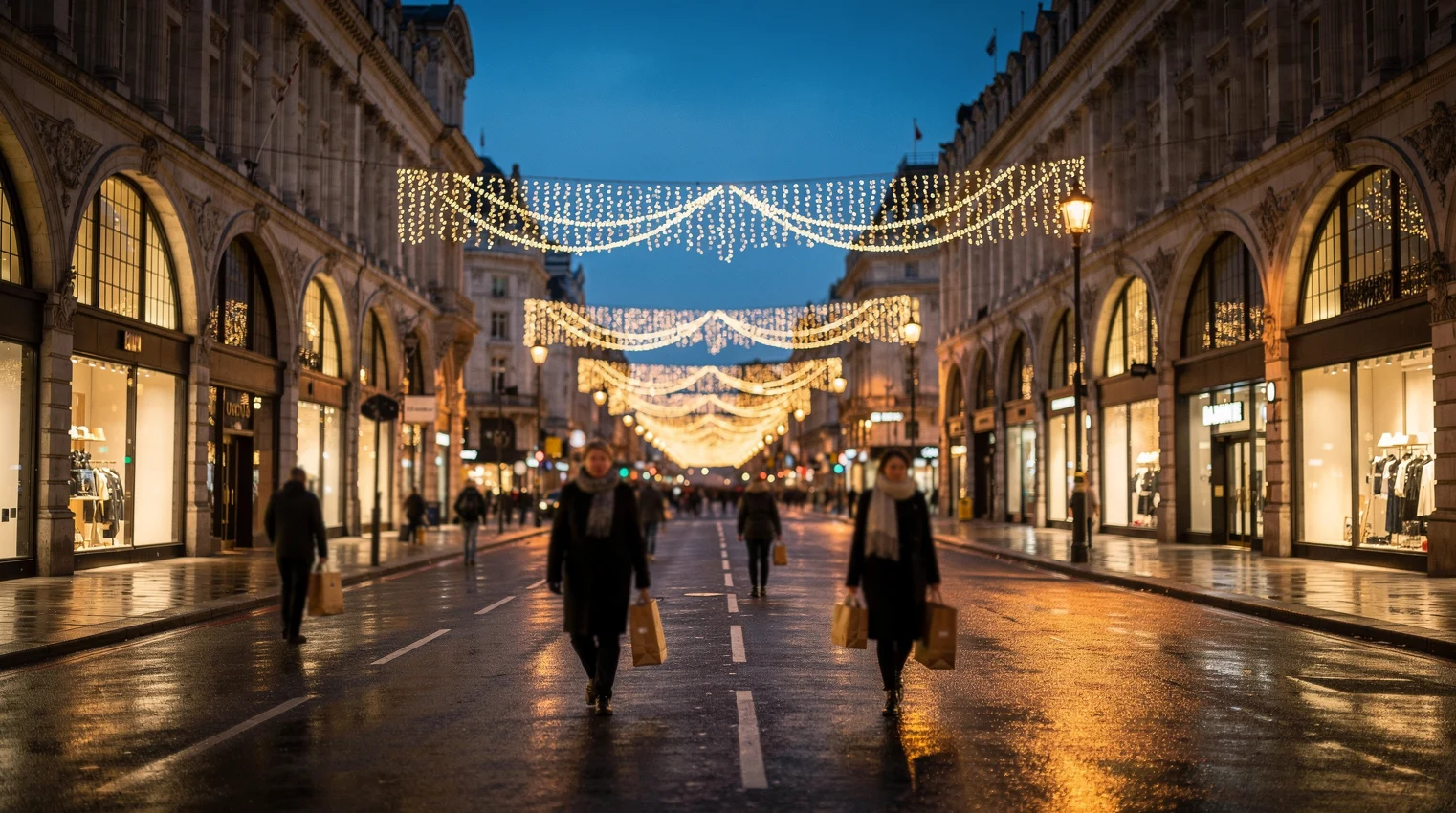
Oxford Street, the busiest shopping street in the UK, closes to traffic on Monday 26 October. Almost a kilometre of road between Orchard Street, by Selfridges, and Great Portland Street, just east of Oxford Circus, becomes a pedestrian zone. Buses stop running along the stretch from the evening of Sunday 25 October, and the change lands days before the Budget on Wednesday 28 October and weeks before the Christmas peak.
This is the first phase of a scheme the Mayor of London, Sadiq Khan, first promised in 2016 and saw blocked in 2018. The Evening Standard reports that he expects the date to “go down in history”. Westminster City Council, which runs the surrounding streets, warns that the traffic will simply move onto narrower roads nearby. Here is what changes for shoppers, workers, retailers and delivery drivers, and what the evidence so far says about whether it will work.
In short
- From Monday 26 October, almost 1km of Oxford Street between Orchard Street and Great Portland Street is closed to cars, buses, taxis, private hire vehicles, bicycles, e-bikes, e-scooters and pedicabs.
- Buses are diverted from the evening of Sunday 25 October onto Wigmore Street, Henrietta Place and Cavendish Place, with replacement stops roughly 100 to 200 metres from the shops.
- Deliveries continue during designated overnight hours, and emergency vehicles, essential services and mobility scooters keep access at all times.
- Little building work happens before Christmas; more than 100 seats, over 50 trees and two new public squares follow in 2027.
- The retail case rests on a single pilot day in September 2025, when footfall rose 45%, while HMV is leaving its flagship over a proposed doubling of rent.
What exactly changes on Oxford Street from 26 October?
The closure covers the western half of the 1.9km street, the part most shoppers know: Selfridges, the big department stores around Bond Street, and the flagship fashion stores either side of Oxford Circus. According to reporting by the Evening Standard and guidance summarised from Transport for London (TfL), the traffic-free section runs from Orchard Street, near Marble Arch, to Great Portland Street. The Oxford Circus junction is inside the closure.
The eastern end, from Great Portland Street towards Tottenham Court Road, is not part of this phase. Nor is the far western stretch around Marble Arch itself. Both are expected to follow in later phases, once City Hall has data from the first section.
Who can still use the street
The rules are simple for anyone on foot: the carriageway becomes walking space. For everyone else, the list of exclusions is long. Ordinary cars, buses, black cabs, private hire vehicles, bicycles, e-bikes, e-scooters and pedicabs are all barred from the pedestrianised section, according to TfL information reported by the Standard and AOL.
Emergency vehicles keep access at all times, as do essential services. Mobility scooters remain permitted, which matters for disabled shoppers who would otherwise face a longer walk from diverted bus stops. Businesses can be serviced by vans and lorries during designated overnight hours.
| Road user | Access to the pedestrianised section from 26 October | What to do instead |
|---|---|---|
| Pedestrians | Full access, including the former carriageway | No change needed |
| Mobility scooter users | Permitted | No change needed |
| Emergency vehicles and essential services | Access at all times | No change needed |
| Delivery vans and lorries | Designated overnight hours only | Check TfL and landlord servicing plans |
| Buses | Barred; diverted from the evening of 25 October | Use new stops on Wigmore Street, Henrietta Place and Cavendish Place |
| Taxis and private hire vehicles | Barred | Book pick-ups on side streets |
| Bicycles, e-bikes and e-scooters | Barred; riders diverted | Use surrounding streets; new cycleways are being developed |
| Private cars | Barred, except at open north-south crossings | Cross at the junctions listed below |
The street is not sealed off from the grid around it. Several north-south crossings stay open to drivers: Orchard Street and North Audley Street, Duke Street, Stratford Place and Davies Street, Vere Street and New Bond Street, Holles Street and Harewood Place, Regent Street at Oxford Circus, and Great Portland Street. Those crossings may close briefly during construction work.
The local news site Brit Brief reports that every crossing except Davies Street and Stratford Place becomes one-way. One report also describes the car restriction as applying from 7am to midnight, while other coverage refers only to designated overnight servicing hours. Drivers and delivery firms should check the final TfL signage rather than rely on secondhand summaries, because the precise windows were not set out in most of the coverage published before launch.
How will buses, taxis and cyclists get around?
The biggest practical change for shoppers who do not walk in from a Tube station is the bus network. Oxford Street has carried bus routes for well over a century, and for many older or less mobile visitors the bus to the door of John Lewis or Selfridges was the main reason to shop there rather than online.
Brit Brief, citing TfL plans, lists routes 7, 94, 98, 139 and 390, plus night routes N7, N98, N113, N137 and N207, as being redirected via Wigmore Street and Henrietta Place, which run behind John Lewis. Most of those routes rejoin Oxford Street at Great Titchfield Street; route 139 instead continues along Regent Street. New stops are being added on Wigmore Street, Henrietta Place and Cavendish Place.
TfL has said the alternative stops will generally be about 200 metres from the traffic-free section. Brit Brief puts the extra walk at 100 to 200 metres and says staff will be deployed at stops in the first weeks to direct passengers. For a shopper carrying bags in December rain, that is the difference critics keep pointing to.
The Standard’s own analysis lists the concerns plainly: buses turning tighter corners on narrower roads, stops further from stores, taxi ranks that are harder to find, and shoppers with heavy bags or limited mobility who may struggle. None of these problems is fatal to the scheme, but each one will shape how the first Christmas is judged.
Cyclists, e-bike riders and e-scooter users are diverted onto surrounding streets, and TfL has said new cycleways are under development. That puts more two-wheeled traffic on the same Marylebone and Fitzrovia streets that will also absorb displaced buses and delivery vans.
Councillor Tim Barnes, deputy leader of Westminster City Council, told LBC in September that “traffic will be pushed to the small streets nearby causing economic and environmental harm”. He also said there was “a danger that we will have all of the downsides and too little upside”. The council has written to the development corporation running the scheme with what it called “serious concerns” over access, air pollution, street cleaning and public safety.
Why is Oxford Street being pedestrianised now, after a decade of failure?
The idea is not new. Sadiq Khan put pedestrianisation in his 2016 mayoral programme, and detailed plans went out to consultation in 2017. In 2018 Westminster City Council withdrew its support, citing a lack of community backing, and the scheme collapsed. The BBC’s London transport correspondent has noted that the idea “thwarted each London mayor so far”, partly because the street lies across two boroughs and some marginal seats.
What changed was the governance. In September 2024 the Mayor announced a wider transformation of Oxford Street and secured government support to take planning powers away from the borough. City Hall created a Mayoral Development Area and the Oxford Street Development Corporation (OSDC), which now oversees the regeneration rather than Westminster council.
A Greater London Authority consultation ran from 28 February to 2 May 2025 and drew 6,642 submissions. Of those who answered the pedestrianisation question, 66% supported making the street traffic-free, or 67% including organised campaign responses. On the Mayoral Development Area, support was 69%.
A second consultation, on local traffic diversions, received about 2,700 responses, and City Hall said most respondents agreed with the plans. The Mayor formally approved the traffic and highway changes for the first section on 26 February 2026, which left eight months to deliver the closure. The Standard notes that “a solid third” of consultation respondents remained opposed.
Speaking to the Evening Standard this weekend, Sir Sadiq framed the scheme as an answer to years of retail decline. “For too long we’ve had years and years of decline,” he said, adding that “decline is not inevitable, we can reverse it.” He also said he was “looking forward to good quality shops rather than the dross we’ve had”, a pointed reference to the American candy stores, vape shops and souvenir outlets that have filled vacant units.
According to the Standard, the Mayor says store vacancies have fallen since the plans were announced and that “quality shops are moving in”. He has not published a vacancy figure alongside that claim, so it is best treated as City Hall’s position rather than an independently measured trend.
What did the 2025 car-free trial show about footfall and sales?
The strongest evidence City Hall has is a single pilot day. On Sunday 21 September 2025, Oxford Street was closed to traffic from 12pm to 8pm for an event branded “This is Oxford Street”. The GLA’s published results say footfall was 45% higher than the week before, measured by five cameras operated by New West End Company (NWEC), the business improvement district for the area.
Tube station counts told a similar story. Passenger entries and exits at the three stations serving the street rose by about a quarter compared with the previous Sunday, according to the GLA data.
| Station | Event day (21 Sept 2025) | Previous Sunday (14 Sept 2025) | Change on week | Same day 2024 | Change on year |
|---|---|---|---|---|---|
| Marble Arch | 21,278 | 16,853 | +26% | 18,501 | +15% |
| Bond Street | 84,134 | 68,274 | +23% | 63,580 | +32% |
| Oxford Circus | 109,693 | 87,499 | +25% | 89,679 | +22% |
The sales evidence is thin
Footfall is not the same as spending. NWEC surveyed stores after the trial and found that 67% of those on Oxford Street reported similar or higher sales than a typical Sunday, while 83% said they would consider taking part in similar events. The survey drew only 21 responses in total, 12 of them from Oxford Street, so it is a small sample from which to draw conclusions about a 1km closure that runs every day of the year.
A separate on-street survey by Walnut Unlimited, commissioned by City Hall, interviewed 270 people. More than three quarters said the event improved their experience of visiting Oxford Street, and more than half specifically liked the extra space for pedestrians. None of this tells us how a wet Tuesday in January will compare with a dry, promoted Sunday in September.
The Standard cites repeated studies showing that well-executed pedestrian schemes can raise visitor numbers and foot traffic by 10% to 40%. Analysts at Colliers and NWEC have previously projected annual sales growth of between 5% and 10% for the street, which they estimated could be worth about £2.8 billion in additional revenue. That figure is a projection, not a measured result, and it comes from parties with an interest in the scheme succeeding.
The GLA says Oxford Street generates £25 billion a year and attracts more than half a million visitors a day. Even a small percentage gain on that base is a large number, which is why landlords and the Mayor are willing to gamble the Christmas season on it.
Which retailers are coming and going on Oxford Street?
The pedestrianisation arrives at a moment of churn. Some of the street’s most famous names have gone in recent years, and the units they left behind were often filled by short-let candy and souvenir stores. At the same time, landlords are betting that a traffic-free street will command higher rents.
HMV leaves its flagship over a rent rise
The most striking departure is HMV. The music and entertainment retailer announced on 12 October that it will close its flagship at 363 Oxford Street in March 2027, just over three years after reopening it in November 2023. According to HMV, the landlord proposed doubling the rent, and the company also faced a substantial renovation bill.
“It’s frustrating that it has been made commercially unviable,” Phil Halliday, HMV’s managing director, said, as reported by ianVisits. The site was HMV’s first shop, opened in 1921, and it closed once before in 2019 when the company went into administration. Just over 50 staff are affected, and HMV hopes to move them to its two other London stores and its head office while it looks for a new West End flagship.
The closure is not a sign of weak trading. HMV reports like-for-like sales up 15% in the first nine months of 2026, and expects combined shop and online revenue above £240 million this year, up from £212 million in 2025. ianVisits notes that the rent rise comes ahead of pedestrianisation, which the landlord may expect to lift footfall and therefore the value of the unit.
On the other side of the ledger, the sportswear brand New Era is opening a major store at 386 Oxford Street, next to Selfridges, on a 10-year lease, according to the Standard. Savills acted for the landlord. “The momentum on Oxford Street is accelerating,” said Callum White, associate director at Savills.
Selfridges is broadly supportive. Meave Wall, its executive director, told the Standard that “we’re hugely energised by the renewed commitment to make this area more enticing and attractive”. The department store has also been pressing for other changes to how the West End trades, including its call for longer Sunday trading hours under the 1994 law. The Langham Estate, a large landlord in Fitzrovia, expects neighbouring Fitzrovia, Marylebone and Soho to benefit too.
Will pedestrianisation push out the candy shops and vape stores?
The Mayor’s “dross” remark is aimed at a well-known problem. Over several years Oxford Street filled with American-style candy stores, vape shops and discount souvenir outlets, many trading from units that once housed department stores or fashion chains. Westminster City Council has spent years trying to remove them.
Counts vary depending on the date and the stretch measured. Retail Gazette, City AM and Retail Week have reported figures ranging from about 21 to 30 candy stores along the street at different points, with numbers falling after enforcement and later recovering. City AM has reported Westminster council leader Adam Hug saying the stores accounted for more than £9 million of unpaid business rates, and that trading standards seizures passed £1 million in goods over 15 months.
Pedestrianisation does not by itself change who can lease a shop. The candy stores exist because landlords prefer a short-term tenant to an empty unit, and because enforcement against counterfeit goods and unpaid rates is slow. A busier street could push rents up and price these operators out, or it could simply bring them more passing trade.
That is why the Mayor is linking the scheme to Wednesday’s Budget. He told the Standard he wants more support for businesses, including business rate relief and measures to help shops hire young people. Independent retailers have made similar requests: the British Independent Retailers Association set out six business rates asks for the 28 October Budget, and the outcome will matter as much to rents on Oxford Street as the traffic ban.
What does it mean for Christmas shopping in the West End?
The timing is deliberate. In September the Mayor said he wanted the street traffic-free “just in time for the busy Christmas shopping period”, and he has encouraged “everyone to explore and enjoy our newly traffic-free Oxford Street”. The Standard reports that little construction will happen before Christmas, so that shoppers get the space without the hoardings.
For shoppers, the immediate effect is more room on crowded pavements and no need to dodge buses at Oxford Circus. The trade-off is that the bus stop and taxi rank are further away, and that the street’s famous festive lights will now hang over a walking zone rather than a road. The changes come as UK households are cautious: UK retail sales fell 0.4% in September, and consumer confidence weakened sharply in October.
Practical advice for Christmas visitors
- Plan to arrive by Tube or rail: Marble Arch, Bond Street, Oxford Circus and Tottenham Court Road stations are unaffected by the road closure.
- If you use the bus, check TfL’s journey planner for the new stops on Wigmore Street, Henrietta Place and Cavendish Place before you travel.
- Book taxis and private hire pick-ups for a side street; drivers cannot stop on the pedestrianised section.
- If you have limited mobility, mobility scooters remain permitted on the traffic-free stretch.
- For large purchases, ask about delivery or click and collect, since you may face a longer walk to a bus or cab.
The street’s department stores and flagships employ thousands of seasonal staff each December, and many of them commute by bus. Those workers face the same diversions as shoppers, often in the dark at the start and end of shifts. Big employers are already hiring more cautiously this year: John Lewis, whose flagship sits on the closed stretch just west of Oxford Circus, cut its Christmas hiring to 10,400 across the business.
What are the concerns over safety, surveillance and access?
Crime is a recurring worry on the street. The Standard notes a rise in phone snatching, and pedestrian zones can make it easier for thieves on bicycles or on foot to work through dense crowds. The scheme’s backers argue that the closure will make policing easier, not harder.
Live facial recognition
In August, ITV reported that Sadiq Khan had indicated the newly pedestrianised street would be covered by live facial recognition, with the Metropolitan Police working closely with the OSDC. Cameras are expected to be fixed to street furniture such as lampposts rather than mounted on police vans. Several outlets reported on 23 October that permanent cameras would be in place during the festive shopping period, although an exact go-live date had not been confirmed in the coverage we reviewed.
The Met says watchlists are compiled no more than 24 hours before a deployment and deleted afterwards. Civil liberties groups are opposed. Liberty has said the plans would scan the faces of everyone who passes by, whether or not they are suspected of wrongdoing, and Big Brother Watch called them a mistake. Both argue the technology should not expand before the government’s promised legal framework is in place.
Local residents raised concerns during the consultation about disability access, longer walks to bus stops and the loss of door-to-door taxi access. The retention of mobility scooter access and the open north-south crossings partly address those concerns, but the 100 to 200 metre walk to a diverted stop remains.
Westminster council and residents’ groups also worry about noise and air pollution moving onto streets in Marylebone and Fitzrovia. City Hall points to evidence from London’s Ultra Low Emission Zone on the health benefits of cutting traffic, but the first months of monitoring on the side streets will be the real test.
What happens next, and when will the work be finished?
Monday’s closure is described by TfL as a “transition phase”. The changes are deliberately temporary so that the OSDC can collect real-time data on how the space is used before it commits to a permanent design for the rest of the street.
According to LBC and Brit Brief, the plans for the first stretch include two new public squares, more than 100 new seats, dining tables and over 50 new trees, with the road raised to meet the pavement. Two sections, from Orchard Street to Duke Street and from Old Cavendish Street to Holles Street, are targeted for completion by spring 2027. A water feature has been discussed but not confirmed.
| Date | Milestone |
|---|---|
| 2016 | Pedestrianisation included in Sadiq Khan’s mayoral programme |
| 2017–2018 | Detailed plans consulted on, then abandoned after Westminster withdraws support |
| September 2024 | Mayor announces wider transformation and a Mayoral Development Area |
| 28 Feb–2 May 2025 | GLA consultation: 6,642 submissions, 66% support for pedestrianisation |
| 21 September 2025 | Eight-hour car-free pilot day; footfall up 45% on the week before |
| 26 February 2026 | Mayor approves traffic and highway changes for the first section |
| 25 October 2026 (evening) | Buses stop running on the stretch |
| 26 October 2026 | First section becomes traffic-free |
| March 2027 | HMV closes its 363 Oxford Street flagship |
| Spring 2027 | Target for first two finished sections, seating, trees and public squares |
The remaining stretches, east towards Tottenham Court Road and west around Marble Arch, are expected in later phases. No firm dates have been published for them. Their timing will depend on what the first section’s footfall, sales and traffic data show, and on whether Westminster’s objections soften once the closure has run through a Christmas and a January.
What it means for UK high streets beyond London
Oxford Street is unusual: no other UK shopping street has its visitor numbers, its international tourist trade or a Mayor with development corporation powers behind it. But the debate is familiar to councils and town centre managers across the country, many of whom are weighing traffic restrictions against the fear of losing car-borne shoppers.
Several things will be watched closely by other high streets. The first is whether a closure introduced with minimal street furniture can hold footfall through winter before the trees and seats arrive. The second is whether the sales uplift seen on one promoted Sunday survives on ordinary weekdays. The third is what happens to rents, since HMV’s experience suggests landlords will try to capture any footfall gain quickly.
The Oxford Street model depended on a Mayor taking planning powers from a reluctant borough. Other English mayors are gaining new tools of their own, including tourist tax powers that independent shops want shared with the high street. If Oxford Street is judged a success, expect more combined authorities to look at development corporations as a way to push through town centre changes over local objections.
For shoppers in London, the change starts on Monday morning. For retailers on the street, the first real verdict will come from the Christmas trading updates published in January.
Frequently asked questions
When does Oxford Street go traffic-free?
The first section becomes traffic-free on Monday 26 October 2026. Buses stop running along the affected stretch from the evening of Sunday 25 October, and related road and bus changes take place over the weekend of 24 and 25 October.
Which part of Oxford Street is pedestrianised?
Almost one kilometre between Orchard Street, near Selfridges and Marble Arch, and Great Portland Street, just east of Oxford Circus. The Oxford Circus junction is included. The stretch east of Great Portland Street towards Tottenham Court Road is not part of this phase.
Can I still get a bus to Oxford Street?
Yes, but not along the closed section. Routes including the 7, 94, 98, 139 and 390, and several night buses, are diverted via Wigmore Street and Henrietta Place, with new stops on Wigmore Street, Henrietta Place and Cavendish Place. Replacement stops are generally 100 to 200 metres from the traffic-free stretch.
Can taxis drop off on Oxford Street?
No. Black cabs and private hire vehicles are barred from the pedestrianised section. Book pick-ups and drop-offs on side streets or at the north-south crossings that remain open, such as Duke Street or New Bond Street.
Can I cycle or ride an e-scooter on Oxford Street?
No. Bicycles, e-bikes, e-scooters and pedicabs are excluded from the traffic-free section, and riders are diverted onto surrounding streets. TfL says new cycleways are under development.
How will shops get deliveries?
Businesses can be serviced by vans and lorries during designated overnight hours. Emergency vehicles and essential services keep access at all times. Retailers should confirm the exact servicing windows with TfL and their landlords.
Can disabled shoppers still reach the shops?
Mobility scooters remain permitted on the pedestrianised section. However, diverted bus stops and the loss of taxi drop-off at shop doors mean a longer walk for some visitors, a concern local residents raised during the consultation.
Is the pedestrianisation permanent?
The October closure is a temporary “transition phase” designed to gather data. Seating, trees and two public squares are expected during 2027, and that data will inform a permanent design for the rest of the street, including the eastern and western ends.
Why is HMV leaving Oxford Street?
HMV says the landlord of 363 Oxford Street proposed doubling the rent, and the shop also needed substantial renovation, making it commercially unviable. The store closes in March 2027, and HMV says it is looking for a new West End flagship.