
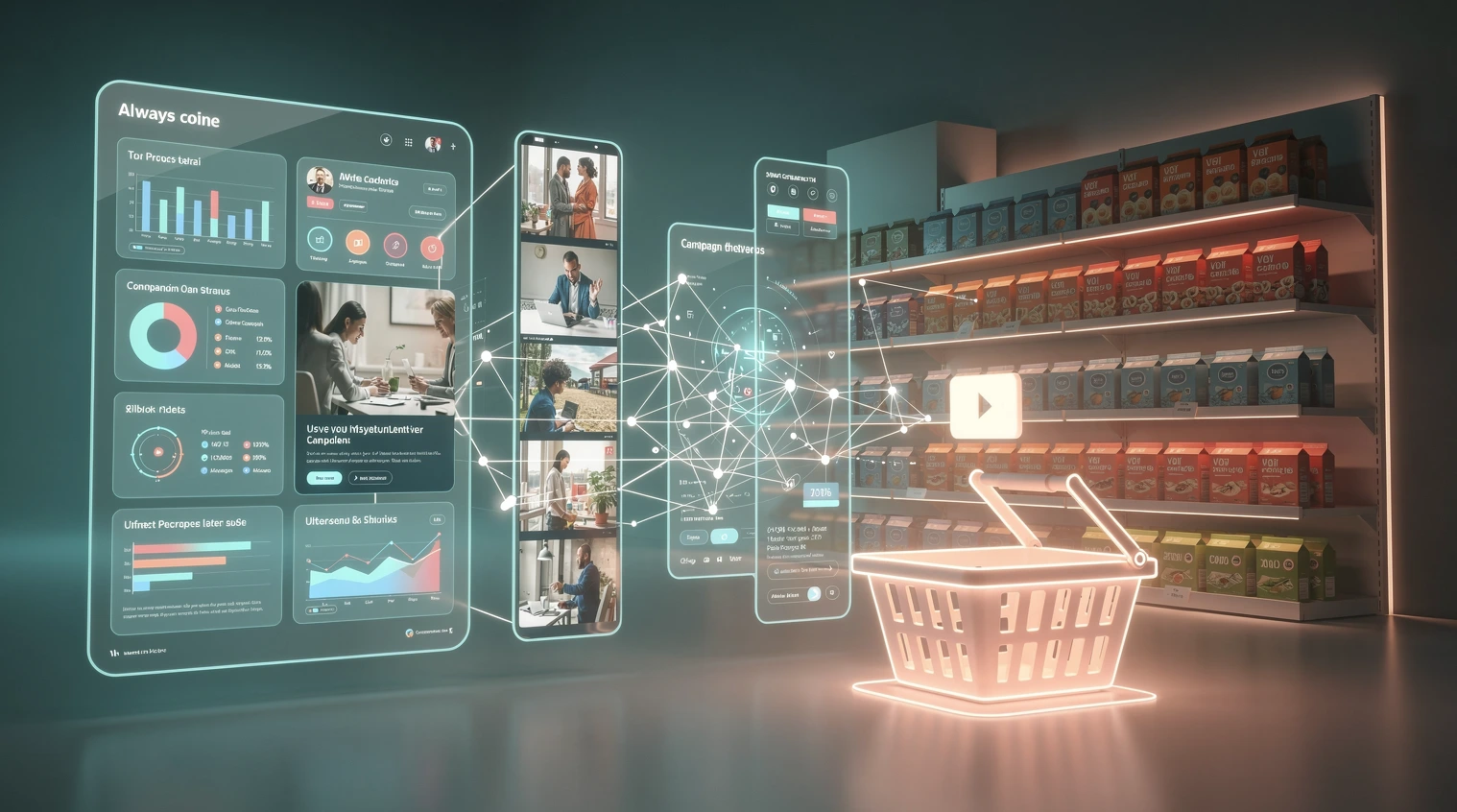
Retail marketing in 2026 looks less like a calendar of seasonal sales and more like an always-on system that blends content, commerce and measurement into a single loop. The campaigns that broke through this year were not the ones with the biggest budgets. They were the ones that borrowed the right mechanics: short creative cycles, retail media placement, creator-led demand, and measurement that ties a video view to a basket. For retail and e-commerce teams planning the back half of the year, the useful question is not what the largest brands spent, but which repeatable tactics actually moved revenue and can be copied with a modest team.
This guide breaks down the retail campaign trends 2026 made mainstream, why each one works, and how to adapt it without a nine-figure media plan. The focus is practical. Every trend below comes with the mechanics, the common failure mode, and a realistic version a mid-market retailer can run inside a quarter.
In short
- Retail media moved from add-on to core channel. Campaigns now plan for on-site and in-store ad placement from day one, not as an afterthought once the creative is locked.
- Creator-led demand replaced the hero ad. Brands that won in 2026 ran many small creator activations in parallel rather than one expensive flagship spot, then scaled the winners with paid budget.
- Short creative cycles beat big productions. The teams that shipped 30 pieces of testable creative a month consistently outperformed those that shipped two polished films a quarter.
- Measurement got honest. Incrementality testing and clean attribution replaced last-click vanity metrics, and budgets shifted toward channels that proved real lift.
- AI moved into the workflow, not just the copy. The practical wins came from AI in briefing, asset variation and feed optimization, where speed compounds, rather than from fully automated campaigns.
Why retail campaign trends matter more in 2026
The cost of getting marketing wrong rose sharply this year. Customer acquisition costs on the major paid social and search platforms have climbed for most retail categories, while consumer attention fragmented across more surfaces than any single team can staff. A campaign that would have carried a brand for a quarter in 2021 now fatigues in weeks. That compression is the single biggest reason the underlying mechanics of campaigns changed.
At the same time, the surfaces where shopping happens multiplied. Discovery now starts on short video, on marketplace search, inside connected TV, and increasingly inside AI assistants that recommend products directly. A campaign built for one channel and ported to the others tends to underperform on all of them. The brands worth borrowing from in 2026 designed for this fragmentation on purpose, building modular campaigns that flex across surfaces rather than monolithic ones that assume a single funnel.
Macro conditions sharpened the pressure further. US retail spending stayed resilient in nominal terms but value-conscious in behavior, with shoppers trading down, waiting for promotions, and concentrating purchases around fewer, larger moments. The official picture from the US Census Bureau retail trade data shows e-commerce holding share gains even as total growth cooled, which means the competition for each conversion intensified. Campaigns had to work harder to justify their cost, and the trends below are largely responses to that reality.
The thread running through every 2026 trend
One pattern connects all the tactics worth copying: the gap between content and checkout kept shrinking. Whether through shoppable video, retail media on the digital shelf, or creator affiliate links, the winning campaigns removed steps between seeing a product and buying it. Every trend in this guide is, at root, a different way of collapsing that distance. That framing is the most useful filter when deciding which idea to borrow first, and it sits at the center of the modern brand playbook that high-performing retail teams now run.
Key terms and definitions
Before the trends, a shared vocabulary helps, because the same words mean different things across teams. The definitions below reflect how practitioners used them in 2026, not how a textbook from 2019 would.
- Retail media: Advertising sold by a retailer on its own properties, on-site search and product pages, in its app, and increasingly on in-store screens and connected TV. The retailer monetizes its first-party shopper data and high purchase intent.
- Creator-led demand: Campaigns where independent creators, not the brand’s own channels, generate the initial reach and trust. The brand supplies product, brief and sometimes commission, then amplifies the content that performs.
- Shoppable content: Any content format, video, live stream, or post, with a native purchase path inside the same surface, so the viewer can buy without leaving the experience.
- Incrementality: The measured lift a campaign causes versus what would have happened anyway. The 2026 standard for proving a channel earns its budget, replacing last-click attribution.
- Always-on creative: A continuous pipeline of small, testable creative variations rather than discrete campaign bursts with long gaps between them.
The 2026 retail campaign trends worth borrowing
The trends below are ranked roughly by how reliably they paid back for mid-market teams, not by how often they appeared in conference keynotes. Each one is copyable on a realistic budget if adapted with discipline.
1. Retail media planned from the first brief
The biggest structural shift in 2026 was treating retail media as a primary channel rather than a bolt-on. Brands stopped building creative and then asking where to run it, and instead reserved budget for on-site search, sponsored product placement and in-store screens at the briefing stage. The logic is simple: retail media reaches shoppers at the moment of highest intent, on the digital shelf where the purchase decision actually happens.
The mechanic worth copying is the split between upper-funnel demand creation and lower-funnel retail media capture. A creator video or connected TV spot generates interest, and retail media ensures the brand owns the shelf when that interest turns into a search. Teams that ran the two in sync, with shared timing and messaging, saw materially better return than teams running them as separate line items. This pattern is the same one driving the prediction that in-store retail media will cross from pilot to scale through the back half of the year.
2. Many small creator activations instead of one hero spot
The flagship brand film did not disappear, but it stopped being the center of gravity. The campaigns that outperformed in 2026 ran portfolios of creator content: dozens of briefs sent to mid-tier and micro creators, each producing native content for their own audience. The brand then identified the handful that performed and put paid budget behind them.
This works because it solves two problems at once. It produces creative variety at a volume no in-house studio can match, and it sources that creative from people who already hold the audience’s trust. The failure mode is treating creators like a media buy and dictating scripts, which strips out the authenticity that makes the format work. The teams that won gave creators a clear product story and tight guardrails, then got out of the way.
3. Short creative cycles and disposable assets
Creative fatigue accelerated to the point that a winning asset now decays in weeks. The response was a production model built for volume and speed: simple, modular shoots that generate many variations, shipped continuously and retired without ceremony. The mindset shifted from making a few perfect assets to running a creative testing engine.
For a mid-market team, the borrowable version is a monthly creative sprint. Pick one product story, shoot a batch of short clips in a single session, vary the hook and the first three seconds aggressively, and let performance pick the winners. The point is not production polish. It is enough volume to find the angle the audience responds to before the window closes.
4. Measurement that proves lift, not clicks
The quietest but most consequential trend was the move to incrementality. As privacy changes and platform walls degraded last-click attribution, teams that kept optimizing to clicks kept funding channels that were not actually driving sales. The brands worth copying ran holdout tests, geo experiments and media mix modeling to find which spend genuinely caused incremental revenue.
This is the trend that pays for all the others, because it tells a team where to put the next dollar. The practical starting point does not require a data science team: a simple geographic holdout, where one region sees a campaign and a matched region does not, reveals real lift faster and more honestly than any dashboard built on last-click. Once a channel proves incremental, scaling it becomes a defensible decision rather than a hopeful one.
5. AI inside the workflow, not on top of it
AI was the most hyped and most misapplied trend of the year. The teams that got value from it did not chase fully automated campaigns. They embedded AI in the slow, repetitive parts of the workflow: generating creative variations, drafting briefs, localizing copy, and optimizing product feeds so listings surface correctly across search and AI assistants. Speed compounded in those places without putting brand safety at risk.
Product feed quality became a sleeper priority as AI-driven shopping grew. When an assistant recommends products, it reads structured feed data, and brands with clean, complete feeds got surfaced while others vanished. That dynamic is why agentic commerce’s bottleneck shifts to product feeds ahead of the holidays, and why feed hygiene quietly became a campaign deliverable rather than a back-office task.
6. Shoppable video and connected TV convergence
Video and commerce kept merging. Short-form shoppable video matured into a reliable channel, and connected TV started to gain native purchase paths, blurring the line between an ad and a storefront. The campaigns worth borrowing treated video as a place to transact, not just to build awareness, with clear product tagging and a frictionless path to checkout.
The convergence is structural rather than a fad, accelerated by deals that put shopping directly into living-room screens, including the way the Fox acquisition of Roku reframed shoppable TV as a serious commerce surface. For most retailers the borrowable move is modest: tag products in the short video they already produce, and treat every view as a potential basket rather than a brand impression.
How modern retail campaigns actually work in practice
The trends above are not standalone tactics. They fit together into a repeatable operating model, and seeing the whole loop makes each piece easier to adopt. The model has four stages that run continuously rather than in sequence.
First, demand creation. Creators and video generate interest at the top, designed for the surfaces where discovery actually starts. Second, shelf capture. Retail media and clean product feeds ensure the brand owns search and recommendation when that interest converts to intent. Third, creative iteration. A continuous testing engine feeds winning angles back into both stages, retiring fatigued assets quickly. Fourth, measurement. Incrementality testing decides where the next dollar goes, closing the loop.
The difference between the brands worth copying and everyone else was not any single stage. It was that they ran all four as one connected system, with shared timing, shared creative and shared measurement, rather than as four teams optimizing in isolation. A campaign in this model is less a launch and more a tuning exercise on an engine that is always running.
The budget reality behind the model
Adopting this does not require reallocating a brand’s entire budget at once. The pattern that worked was a gradual shift: carving out a test budget for retail media and creator activations, proving incremental lift, then moving spend from fatigued channels into the proven ones. The table below shows a representative reallocation pattern observed across mid-market retail teams during 2026.
| Channel | Typical 2023 share | 2026 worth-borrowing share | Why it shifted |
|---|---|---|---|
| Paid social and search | 55% | 35% | Rising acquisition cost, weaker incremental lift |
| Retail media | 10% | 25% | High purchase intent, first-party data, measurable |
| Creator and influencer | 10% | 20% | Trust, creative volume, lower cost per asset |
| Shoppable video and CTV | 5% | 12% | Discovery moved to video, native purchase paths |
| Email, owned and other | 20% | 8% | Still high return, but capacity already maxed |
The exact percentages vary by category and margin structure. The direction of travel does not. Budget moved toward channels closer to the point of purchase and toward formats that produce testable creative at volume, funded by trimming the channels that incrementality testing exposed as overstated.
Common mistakes and how to avoid them
The trends are copyable, but most failed adoptions fail for predictable reasons. The mistakes below came up repeatedly across retail teams that borrowed the tactics without the discipline behind them.
Treating creators like a media buy
The most common failure was over-scripting creators into producing brand ads that happened to feature a different face. That strips out the authenticity that makes creator content work, and audiences detect it instantly. The fix is to brief on the product story and the boundaries, then let the creator own the format and voice. Control the message, not the execution.
Buying retail media without a shelf strategy
Teams that bought sponsored placements without fixing their product pages, pricing and feed quality paid to send high-intent shoppers to listings that did not convert. Retail media amplifies whatever is already on the shelf, including its weaknesses. The fix is to audit and optimize the digital shelf before spending to drive traffic to it.
Chasing reach instead of incrementality
The vanity-metric trap did not disappear; it just got more sophisticated. Teams optimized to views, clicks and last-click conversions that looked impressive and did not reflect real lift. The fix is to run at least one holdout or geo test before scaling any new channel, and to treat any channel that cannot prove incremental lift as unproven, regardless of how good its dashboard looks.
Confusing AI speed with AI strategy
Brands that handed strategy to AI produced fast, generic, off-brand work at scale. The teams that won used AI to accelerate execution while keeping humans on the brief, the brand voice and the creative judgment. The fix is to deploy AI where speed compounds, variation, localization and feed work, and keep human judgment where brand equity is at stake.
Examples from US retail and e-commerce
The clearest proof of these trends is in how US retailers actually behaved in 2026, across both large and mid-market players. The patterns below are composite illustrations drawn from observable campaign behavior rather than confidential internal data.
Big-box and grocery retailers leaned hardest into retail media, building out their own ad networks and turning shopper data into a high-margin revenue line. The borrowable lesson for smaller brands is the buy side of that trend: their retail media inventory is where high-intent shoppers can be reached affordably, often more efficiently than open-web display. The retailer’s monetization is the brand’s opportunity.
Beauty, apparel and consumer packaged goods brands drove the creator-portfolio model, running large rosters of micro and mid-tier creators rather than single celebrity deals. The pattern held across price points: variety and authenticity at volume beat one expensive flagship, and the winners were scaled with paid amplification once performance was clear.
Value and discount retailers showed how campaign timing shifted, concentrating spend around fewer, larger demand moments and pulling promotions earlier in the calendar. The clearest example was how the US summer sales peak is moving to June, forcing campaign calendars to compress and front-load. Borrowing this means planning campaigns around where demand is actually concentrating, not where the traditional retail calendar says it should be.
What the examples have in common
Across categories, the common thread was disciplined adaptation rather than wholesale reinvention. None of these retailers abandoned their existing channels overnight. They reallocated gradually, tested before scaling, and built campaigns as connected systems. The brands that struggled were the ones that adopted a single trend in isolation, a creator program with no measurement, or retail media spend with no shelf strategy, and expected it to work on its own.
Tools, partners and vendors worth knowing
Borrowing these trends is easier with the right stack, and the 2026 tooling landscape matured enough that a mid-market team can assemble a capable system without enterprise budgets. The categories below cover the practical needs of the operating model described above.
On the retail media side, the major retailer ad platforms now offer self-serve buying that smaller brands can access directly, alongside demand-side platforms that aggregate inventory across multiple retail networks. For creator programs, platforms that handle discovery, briefing, contracting and payment at scale removed most of the operational drag that used to make creator portfolios hard to run. For measurement, lightweight incrementality and media-mix-modeling tools brought holdout testing within reach of teams without dedicated data scientists.
Feed and listing optimization deserves its own line, because it became a campaign deliverable in 2026 rather than a technical afterthought. Tools that clean, enrich and syndicate product data across marketplaces, search and AI assistants are now central to whether a campaign’s demand actually converts on the shelf. A fuller breakdown of this category sits in the guide to tools and vendors for AIO for retailers, which covers the feed and visibility stack in depth.
| Need | Tool category | What it does | Best for |
|---|---|---|---|
| Reach high-intent shoppers | Retail media DSP | Buys sponsored placement across retailer networks | Brands selling through major retailers |
| Run creator portfolios | Creator management platform | Discovery, briefing, contracts, payment at scale | Teams scaling beyond a handful of creators |
| Prove real lift | Incrementality and MMM tools | Holdout tests, geo experiments, media mix modeling | Any team reallocating budget |
| Win the digital shelf | Feed and listing optimization | Cleans, enriches and syndicates product data | Brands selling across marketplaces and AI search |
| Ship creative at volume | AI asset and variation tools | Generates and localizes creative variations fast | Teams running short creative cycles |
No single vendor delivers all of this, and the teams worth copying resisted the temptation to buy one suite that promises everything. They assembled a focused stack around their biggest bottleneck first, usually measurement or feed quality, then added capability as each layer proved its return.
A 90-day playbook to borrow these trends
The fastest way to adopt the 2026 playbook is to sequence it rather than attempt everything at once. The plan below is a realistic quarter for a mid-market retail team with a modest budget and no specialized agency.
In the first 30 days, fix the shelf. Audit product pages, pricing and feed quality across every surface where the brand sells, including marketplaces and AI assistant visibility. This is unglamorous and it is the highest-return work, because every later campaign dollar depends on it converting. In parallel, set up one geographic holdout structure so measurement is ready before any new spend begins.
In the next 30 days, run two small tests: a creator portfolio of 10 to 20 micro and mid-tier creators with a tight product brief, and a retail media test on the network where the brand’s best shoppers buy. Keep both deliberately small, and measure incremental lift against the holdout rather than against clicks. The goal is signal, not scale.
In the final 30 days, scale the winners and retire the losers. Put paid budget behind the creator content that performed, expand the retail media line that proved incremental, and start a monthly creative sprint to keep the testing engine fed. By the end of the quarter the team has a running version of the operating model, sized to its own budget, and the evidence to defend the next reallocation. For the strategic context that ties this quarter into a longer brand position, the modern brand playbook is the natural next read.
Frequently asked questions
What are the most important retail campaign trends in 2026?
The trends with the most reliable payback are retail media planned from the first brief, creator-led demand run as portfolios rather than single hero spots, short creative cycles built for volume, measurement based on incrementality rather than last-click, and AI embedded in the workflow rather than running campaigns end to end. The common thread is shrinking the distance between content and checkout.
Can a small or mid-market retailer actually use these trends?
Yes. Every trend here has a copyable version sized for a modest budget. A creator portfolio can start with 10 to 20 micro creators, retail media can begin as a small self-serve test, and incrementality can be measured with a simple geographic holdout. The key is to test small, prove lift, then scale, rather than committing a full budget upfront.
What is retail media and why does it matter so much now?
Retail media is advertising sold by a retailer on its own properties, on-site search, product pages, apps, in-store screens and connected TV, using its first-party shopper data. It matters because it reaches shoppers at the moment of highest purchase intent, on the shelf where the decision happens, and it is measurable in a way open-web display is not. That combination made it the fastest-growing channel in the mix.
How should brands work with creators in 2026?
Run portfolios, not single deals. Brief many micro and mid-tier creators on the product story and clear boundaries, then let them own the format and voice. Identify the content that performs and amplify it with paid budget. The biggest mistake is over-scripting creators into brand ads, which removes the authenticity that makes the format work.
What does incrementality testing mean and why replace last-click?
Incrementality is the measured lift a campaign causes versus what would have happened anyway. Last-click attribution credits whichever channel touched the customer last, which systematically overstates lower-funnel channels and funds spend that is not actually driving sales. A holdout or geo test, where one group sees a campaign and a matched group does not, reveals real lift and is the 2026 standard for deciding where budget goes.
How is AI actually useful in retail campaigns?
The practical wins come from embedding AI in repetitive workflow steps: generating creative variations, drafting briefs, localizing copy, and optimizing product feeds so listings surface correctly across search and AI assistants. Fully automated campaigns tend to produce generic, off-brand work. The pattern that works is AI for speed in execution, human judgment for strategy, brand voice and creative direction.
Why is product feed quality suddenly a campaign priority?
As shopping moves into AI assistants and marketplace search, recommendations are driven by structured product feed data. Brands with clean, complete, enriched feeds get surfaced; those with poor feeds disappear regardless of how good their campaign creative is. Feed quality became a campaign deliverable because it determines whether the demand a campaign creates actually converts on the shelf.
What is the first trend a team should borrow if it can only pick one?
Start with measurement. Setting up a simple incrementality test first means every subsequent decision, which channel to fund, which creator content to scale, whether retail media is working, rests on real lift rather than vanity metrics. Measurement is the trend that makes all the others defensible, and it costs the least to begin.
How quickly can a retailer adopt the 2026 campaign model?
A focused team can run a working version inside 90 days: 30 days to fix the digital shelf and set up measurement, 30 days to run small creator and retail media tests against a holdout, and 30 days to scale the winners and start a monthly creative sprint. The model is meant to be adopted gradually and sized to the budget, not switched on all at once.