
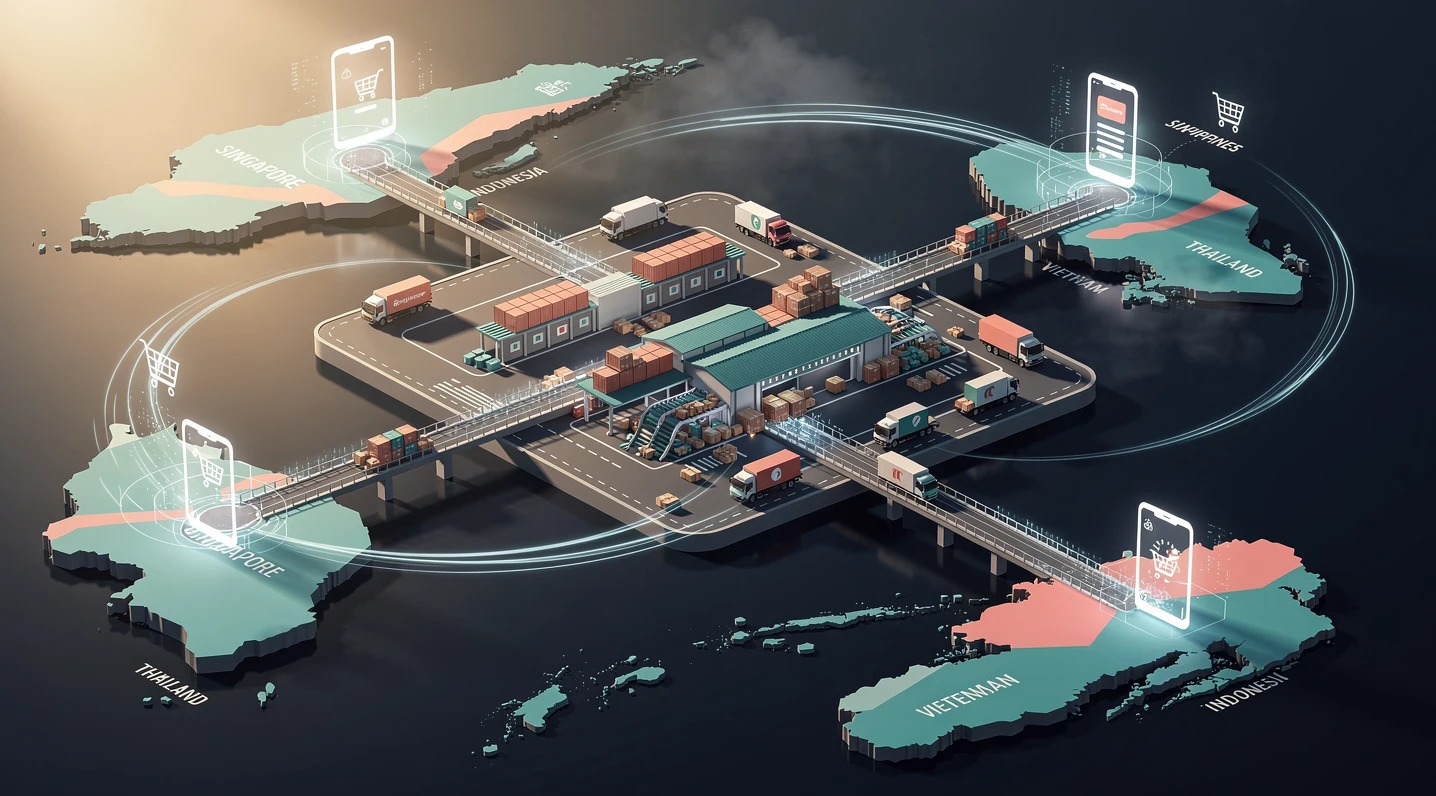
Shopee is the marketplace most Western sellers underestimate and most Southeast Asian shoppers open first. Operated by Singapore-listed Sea Limited, it has spent the past decade turning mobile-first, price-sensitive consumers across six core markets into a single addressable audience of hundreds of millions. For a brand or reseller planning a 2026 entry, the platform is no longer a growth experiment. It is the default distribution channel for the fastest-growing consumer region on the planet, and the operational rules for winning on it are specific, unforgiving and very different from selling on Amazon.
In short
- Shopee is the dominant e-commerce marketplace in Southeast Asia, leading in Indonesia, Vietnam, Thailand, the Philippines, Malaysia and Singapore, with a mobile-first, discovery-driven shopping model closer to TikTok than to Amazon.
- Seller economics hinge on three levers: commission and transaction fees, the free-shipping programme, and in-app advertising through Shopee Ads. Misjudging any one of them quietly erases margin.
- Each country is a separate operation, with its own storefront, currency, logistics network, tax rules and consumer behaviour. A single regional strategy that ignores local nuance is the most common way new sellers stall.
- Shopee Mall is the trust tier that matters for brands, unlocking verified status, better placement and buyer confidence, at the cost of stricter authenticity and service requirements.
- The winning 2026 playbook is content plus price plus fulfillment speed: livestream and short video drive discovery, competitive landed pricing drives conversion, and local or bonded-warehouse fulfillment drives repeat purchase.
Why Shopee matters for sellers in 2026
Southeast Asia is the demographic story that Western retail spent the 2010s missing. The region holds more than 675 million people, a median age under 30, and one of the highest rates of mobile-only internet usage anywhere. Digital commerce here did not migrate from desktop the way it did in the United States. It was born on smartphones, inside social apps, paid for with wallets and cash on delivery rather than credit cards.
Shopee is the marketplace that industrialized that behaviour. It reached scale by subsidizing shipping, gamifying the app with coins and daily check-ins, and localizing aggressively down to the level of individual provinces. For a seller, the practical consequence is reach: a well-run Shopee store can put products in front of buyers in Jakarta, Ho Chi Minh City, Manila and Bangkok from a single seller account structure, without building six separate direct-to-consumer sites.
The commercial gravity is worth stating plainly. Southeast Asia’s online retail economy has grown into a market measured in the hundreds of billions of dollars, and Shopee captures a leading share of that spend in most of its core countries. For a US or European seller staring at saturated home markets and rising customer-acquisition costs, that is a rare combination: a large, still-growing audience where incumbency is far from settled and a well-executed entry can still compound quickly.
The pillar context matters here. Shopee is one node in a much larger decision about where and how to sell internationally, which we lay out in our complete guide to selling on global e-commerce marketplaces. Treating Shopee in isolation, rather than as part of a marketplace portfolio, is exactly how sellers over-commit to one geography and under-invest in fulfillment.
The timing is also specific to 2026. Regional platforms are consolidating their advantage as cross-border players face tighter import rules, and the shift from pure price competition toward content-led discovery is reshaping which sellers win. For context on how Shopee sits against its neighbours, our comparison of Southeast Asia marketplaces for Western brands maps the trade-offs across the major platforms.
What Shopee is and how the marketplace actually works
Shopee is a mobile-first marketplace where discovery happens through the feed, search, livestreams and short video rather than through a shopper arriving with a specific product in mind. The homepage is a scroll of recommendations, flash sales, category tiles and creator content. Search exists, but a large share of transactions begin with browsing, not querying.
The transaction model is straightforward on the surface. A buyer adds items to a cart, applies platform and shop vouchers, selects a shipping option and pays through ShopeePay, a linked bank, a card, or cash on delivery depending on the market. Behind that simplicity sits an operational stack that a seller has to master: catalog management, the Seller Centre dashboard, an integrated logistics network, and an advertising auction.
The three pillars of the Shopee model
Every serious Shopee operation rests on discovery, price and fulfillment working together. Discovery is earned through content and advertising. Price is judged on the landed total, including shipping, after vouchers. Fulfillment is measured in days to delivery and in the seller’s on-time dispatch rate, which directly affects search visibility.
Sellers who treat these as separate departments tend to lose. A cheap product that ships slowly gets buried. A fast-shipping product with weak content never gets discovered. The platform’s ranking logic rewards the combination, not any single strength.
How Shopee differs from Amazon
The instinct to run a Shopee store like an Amazon store is the most expensive mistake a Western seller makes. Amazon is a search-and-buy utility where the buy box, reviews and Prime logistics dominate. Shopee is a social-commerce feed where vouchers, livestreams, chat and shop-level branding drive behaviour.
On Amazon, price competition happens inside a listing. On Shopee, it happens across shops, with buyers comparing landed totals after free-shipping thresholds and stacked vouchers. Customer service is also more direct: buyers expect to chat with a seller inside the app before purchase, and response rate is a measured, ranked metric.
Key terms and definitions every Shopee seller needs
Shopee has its own vocabulary, and misreading it is how sellers agree to costs they did not model. The terms below are the ones that show up in fee statements, dashboards and buyer expectations across markets.
- Seller Centre: the back-office dashboard for listings, orders, finances, ads and performance metrics. Everything operational runs through it.
- ShopeePay: the in-app wallet and payment rail. In several markets it also carries promotions that influence buyer choice at checkout.
- Shopee Xpress and SLS: the platform’s first-party last-mile network (Shopee Xpress) and its cross-border shipping programme (Shopee Logistics Service), which routes overseas seller parcels into local delivery.
- Free Shipping Programme: the platform-subsidized and seller-supported shipping discount that most buyers now treat as a baseline expectation, not a perk.
- Shopee Ads: the pay-per-click auction covering search ads, discovery ads and shop ads, and increasingly the main lever for new-listing visibility.
- Shopee Mall: the verified tier for official brands and authorized distributors, carrying authenticity guarantees and stronger placement.
- Preferred Seller: a performance badge for high-rated non-Mall shops, unlocking better visibility and buyer trust without brand ownership.
How selling on Shopee works in practice
The path from registration to first sale is well defined, but each step carries decisions that shape long-term economics. Rushing setup is how sellers lock themselves into the wrong fulfillment model or the wrong market entry order.
Choosing local, cross-border or a hybrid entry
There are three ways onto the platform. A local business entity registers directly in a market and holds inventory there. A cross-border seller lists from abroad and ships in through Shopee Logistics Service. A hybrid seller tests demand cross-border, then localizes stock into the markets that prove out.
Cross-border is the fastest way to validate demand without a local company or warehouse. It also carries the longest delivery times and the most exposure to import rules and returns friction. The hybrid path, cross-border first and local fulfillment second, is the pattern most disciplined 2026 entrants follow.
Listing, pricing and the landed-cost trap
Listings need local-language titles, mobile-optimized images and pricing that accounts for the full landed cost. The trap is pricing against the sticker and forgetting commission, transaction fees, ad spend and the seller’s share of free shipping. A product that looks profitable at the shelf price can be underwater once every deduction lands.
Successful sellers build a per-market margin model before listing a single SKU. They price to the landed total the buyer sees after vouchers, then work backward to confirm the SKU still clears its target margin. This discipline is what separates a store that scales from one that grows revenue while losing money.
Fulfillment, dispatch time and ranking
Fulfillment speed is not just a service metric on Shopee. On-time dispatch feeds directly into search ranking and shop performance scores, which feed into visibility, which feeds into sales. A slow-shipping shop is a low-visibility shop.
Sellers with genuine ambition move stock into local or bonded warehouses as soon as a market proves out. The economics of infrastructure matter as much as the marketplace choice, which is why the same discipline applies whether you sell on a marketplace or run your own store, as we cover in hosting WooCommerce properly for direct-to-consumer operations. Speed and reliability are the shared currency.
Shopee fees and cost structure compared
Fee structures vary by market and category, and Shopee revises them regularly, so any specific percentage should be confirmed in the current Seller Centre schedule for each country. The categories of cost, however, are stable, and modeling them correctly is the single highest-leverage thing a new seller can do.
| Cost category | What it covers | How it behaves | Seller lever |
|---|---|---|---|
| Commission fee | Percentage of item price on each sale | Varies by market, category and seller tier | Category mix and Mall status |
| Transaction fee | Payment processing on order value | Applied per order, relatively fixed | Average order value |
| Free shipping share | Seller contribution to subsidized delivery | Scales with order volume | Packaging weight and origin |
| Shopee Ads | Pay-per-click search and discovery placement | Auction-based, fully variable | Bid discipline and creative |
| Vouchers and campaigns | Shop-funded discounts and mega-sale entries | Discretionary but competitive | Promotion calendar planning |
The two lines that most often surprise new sellers are the free-shipping share and ad spend. Both feel optional at signup and both become effectively mandatory once buyer expectations and competitive visibility are factored in. A margin model that omits them is not conservative, it is wrong.
Modeling contribution margin per market
The right unit of analysis is contribution margin per SKU per market, not blended store margin. A product can be profitable in Malaysia and loss-making in Indonesia because of shipping weight, local pricing pressure and category commission differences. Blended numbers hide these divergences until they compound.
Disciplined sellers rebuild the model quarterly as fees, ad costs and shipping subsidies shift. The platform changes the rules often enough that a static spreadsheet from launch is dangerous by month six.
Common mistakes and how to avoid them
Most Shopee failures are not exotic. They are the same handful of avoidable errors, repeated by sellers who treated the platform like a Western marketplace with a different logo.
Treating six markets as one
The most common error is running a single regional strategy across markets that behave nothing alike. Indonesian buyers, Vietnamese buyers and Singaporean buyers differ in price sensitivity, payment preference, delivery expectation and even the categories that trend. A campaign calendar and pricing sheet that ignores this underperforms everywhere at once.
The fix is a per-market playbook: local language, local pricing, local promotion timing and a country-specific fulfillment plan. Sellers who cannot resource all six should sequence entry, starting with one or two markets and expanding only after the model is proven. Our guide to picking a regional marketplace for 2026 expansion lays out how to choose that first market deliberately rather than by default.
Underpricing discovery and content
Sellers steeped in search-driven marketplaces assume a good listing will be found. On Shopee, discovery is bought and earned through ads, livestreams and short video. A store that publishes listings and waits is invisible.
The correction is to budget content and advertising as a launch cost, not an afterthought. Livestream cadence, creator partnerships and a disciplined Shopee Ads bid strategy are the difference between listings that surface and listings that sit.
Ignoring service and response metrics
Chat response rate, on-time dispatch and rating are ranked, visible metrics that buyers and the algorithm both watch. Western sellers used to hands-off marketplaces routinely neglect the in-app chat expectation and watch their visibility decay.
The remedy is operational: staff the chat during local peak hours, hit dispatch windows, and treat the performance dashboard as a daily instrument, not a monthly report.
Which Southeast Asian markets to prioritize
Shopee operates as six distinct storefronts across its core region, and the right entry order depends on a seller’s category, price point and fulfillment capacity. The table below sketches the strategic character of each core market rather than precise, fast-moving figures.
| Market | Scale and character | Buyer profile | Best-fit seller |
|---|---|---|---|
| Indonesia | Largest population and volume | Highly price-sensitive, mobile-only, COD common | Value products with local fulfillment |
| Vietnam | Fast-growing, livestream-heavy | Young, content-driven, deal-seeking | Content-led brands and trend goods |
| Thailand | Mature, high engagement | Social-commerce fluent, brand-aware | Lifestyle and beauty categories |
| Philippines | Large, COD-reliant | Value-focused, logistics-sensitive | Sellers with strong last-mile plans |
| Malaysia | Higher average order value | Card and wallet adoption, quality-conscious | Mid-market and premium goods |
| Singapore | Smallest by volume, highest spend | Affluent, fast-delivery expectation | Premium and cross-border testing |
Singapore is often the smart cross-border test market because of higher spending power and simpler logistics, even though its volume is modest. Indonesia is the prize for scale but demands local fulfillment and genuine price discipline. Sequencing entry against this map beats spreading a thin budget across all six at launch. For a broader view of how these platforms stack up against regional rivals, our look at regional marketplaces that rival Amazon on home turf puts Shopee’s position in context.
Examples from Western brands entering the region
The sellers who succeed on Shopee tend to share a pattern: they localize hard, they lead with content, and they treat fulfillment speed as a growth lever rather than a back-office cost. The ones who struggle tend to port a Western playbook wholesale and expect the audience to adapt.
A beauty brand entering Thailand, for instance, wins by pairing local-language livestreams with a tight SKU set priced to the landed total, not by dropping its full catalog and hoping search does the work. A consumer-electronics reseller in the Philippines lives or dies on its last-mile and COD handling, because a high return-to-sender rate quietly destroys the unit economics.
The consistent lesson is that category fit and market fit have to align. A premium positioning that works in Singapore or Malaysia can misfire in the most price-sensitive corners of Indonesia. We go deeper on this entry pattern in our companion piece on Shopee for Western brands entering Southeast Asia, which walks through the sequencing and localization decisions in more detail.
There is also a timing pattern worth copying. The sellers who compound fastest treat their first ninety days as a controlled experiment rather than a launch: a narrow SKU set, one or two markets, a fixed advertising budget, and a weekly review of contribution margin against dispatch performance. They expand only what clears the bar, and they cut listings that drain ad spend without converting.
What that discipline buys is data the seller actually trusts. By the time a store scales into a third or fourth market, it knows its real landed cost, its true return-to-sender rate and the creative formats that convert in each country. That knowledge, accumulated deliberately, is far more durable than an early revenue spike bought with unsustainable subsidies and undifferentiated pricing.
The Shopee Mall decision for brands
For brand owners, Shopee Mall is usually worth the stricter requirements. Verified status, authenticity guarantees and better placement translate into buyer trust that resellers cannot easily replicate. The cost is tighter service standards and authenticity documentation.
Resellers without brand ownership can still build authority through the Preferred Seller badge, which rewards performance rather than brand status. The choice between the two tiers should follow from whether the seller controls the brand or competes on execution.
Tools, partners and vendors worth knowing
Running Shopee at scale across multiple markets is not a manual job. The seller ecosystem has matured into a stack of tools that handle listing sync, order management, advertising optimization and cross-border logistics.
The categories that matter are multichannel listing and inventory platforms, Shopee-specific ad-optimization tools, regional third-party logistics providers with bonded-warehouse options, and localization partners for language and creative. Choosing these before scaling, rather than bolting them on after, prevents the operational sprawl that stalls multi-market sellers. Our roundup of tools and vendors for regional marketplaces in 2026 covers the specific platform categories worth evaluating.
Sea Limited, Shopee’s parent company, publishes market context and financial disclosures that are useful for sizing the opportunity, and the platform’s own Seller Centre education hub remains the authoritative source for current fees and policies in each market. For a neutral overview of the company and its footprint, the Shopee entry on Wikipedia is a reasonable starting reference before diving into market-specific rules.
Building the right internal capability
Beyond vendors, the internal capability that matters most is a small team that owns the per-market model: pricing, promotion calendar, content cadence and fulfillment. Outsourcing everything to agencies without an internal owner of the numbers is how sellers lose visibility into why margin is slipping.
The most durable Shopee operations treat the platform as a core channel with dedicated ownership, not a side experiment run off the corner of someone’s desk. That commitment, more than any single tool, is what compounds into topical and commercial authority in the region. It also mirrors the wider marketplace-portfolio thinking in our global e-commerce marketplace guide, where Shopee is one deliberate bet among several.
Frequently asked questions
Is Shopee bigger than Lazada in Southeast Asia?
Across the core Southeast Asian markets, Shopee is generally the leading marketplace by traffic and order volume, though the gap varies by country and the two compete closely in several markets. Sellers should check current market-share data for each specific country rather than assume a single regional ranking, because the picture shifts market by market and quarter by quarter.
Can a Western seller list on Shopee without a local company?
Yes, through the cross-border programme, which lets sellers list from abroad and ship in via Shopee Logistics Service. It is the fastest way to validate demand without a local entity or warehouse, but it carries longer delivery times and more exposure to import and returns friction. Most disciplined entrants use it to test, then localize inventory into the markets that prove out.
What does it actually cost to sell on Shopee?
The main cost lines are commission fees, transaction fees, the seller share of free shipping, Shopee Ads spend and shop-funded vouchers. Exact percentages vary by market, category and seller tier and change regularly, so confirm the current Seller Centre schedule for each country. The free-shipping share and advertising are the two costs new sellers most often underestimate.
Do I need Shopee Ads to make sales?
In practice, yes, for new listings. Shopee is a discovery platform where visibility is bought and earned through ads, livestreams and short video rather than won through search alone. A store that publishes listings without an advertising and content plan tends to stay invisible, so most sellers budget ad spend as a launch cost.
What is the difference between Shopee Mall and a regular shop?
Shopee Mall is the verified tier for official brands and authorized distributors, carrying authenticity guarantees, stronger placement and higher buyer trust, in exchange for stricter service and documentation requirements. A regular shop can still build credibility through the Preferred Seller badge, which rewards performance rather than brand ownership. Brand owners usually benefit from Mall status, while resellers often compete on execution instead.
Which Southeast Asian market should I enter first?
It depends on category, price point and fulfillment capacity. Singapore is often a smart cross-border test market thanks to higher spending power and simpler logistics, while Indonesia offers the largest scale but demands local fulfillment and strict price discipline. Sequencing entry against a per-market map beats spreading a thin budget across all six markets at launch.
How important is fulfillment speed on Shopee?
It is critical, because on-time dispatch feeds directly into search ranking and shop performance scores, which drive visibility and sales. A slow-shipping shop becomes a low-visibility shop regardless of price or product. Serious sellers move inventory into local or bonded warehouses as soon as a market proves out.
How is selling on Shopee different from selling on Amazon?
Amazon is a search-and-buy utility dominated by the buy box, reviews and Prime logistics, while Shopee is a social-commerce feed driven by vouchers, livestreams, in-app chat and shop-level branding. Price competition on Shopee happens across shops on landed totals after vouchers, not inside a single listing. Buyers also expect to chat with sellers before purchase, and response rate is a ranked metric.
Can I run Shopee alongside my own direct-to-consumer store?
Yes, and many sellers do, treating Shopee as a discovery and volume channel while their own store captures higher-margin repeat customers. The shared requirement is fulfillment reliability and consistent pricing logic across channels. Marketplace presence and a direct store reinforce each other when inventory, pricing and delivery expectations are coordinated rather than run in silos.