Britain’s side hustles are buying proper kit. Currys says its business division has seen sales of portable card payment terminals rise by 150% so far this year compared with the same period last year, with the growth coming from readers made by SumUp and Square. Sales of Starlink satellite internet terminals are up 93% year on year over the same comparison, according to figures the retailer released through the Press Association at 00:01 on Monday 16 November 2026.
The numbers arrive with a Currys survey of 2,000 UK adults, which found that a quarter of Britons now have an additional income stream, rising to 43% of under-30s. The story has been carried by the Press Association, The Independent, LBC and the Express and Star. It lands three weeks after the Budget promised to treble the tax-free trading allowance, and just as the Christmas market, craft fair and Black Friday reselling season reaches its peak.
This article sets out what Currys actually disclosed and what it did not, what a card reader really costs a small seller in the UK, and where the tax and consumer law lines sit for anyone who starts taking card payments this winter.
In short
- Card reader sales up 150%: Currys’ business division says year-to-date sales of SumUp and Square portable terminals are 150% higher than in the same period of 2025; Starlink terminal sales are up 93%.
- One in four has a side income: Currys’ survey of 2,000 UK adults found 25% have an extra income stream, 43% of under-30s, with online selling and reselling the most common activity.
- Cost of living is the driver: 38% said living costs had pushed them to put more time into their side hustle, an average of seven hours a week.
- Fees are small but real: on the providers’ published UK rates, SumUp charges 1.69% and Square 1.75% per in-person card payment on their no-subscription plans.
- The tax line has not moved yet: the £1,000 trading allowance applies until 5 April 2027; the £3,000 allowance starts on 6 April 2027, and platform reporting to HMRC continues regardless.
What exactly did Currys reveal about side hustles?
The headline figure comes from Currys Business, the retailer’s business-to-business arm, rather than from its consumer stores. Currys said purchases of portable card payment terminals had risen by 150% over the year to date compared with the same period a year earlier, and named SumUp and Square as the brands involved. The release did not give unit numbers, revenue or the start date of the “year to date” period.
The second hard number is for Starlink terminals, the small satellite dishes sold by SpaceX’s internet business. Currys said sales were up 93% year on year. The retailer linked both figures to people “taking their side hustles to the next level and getting kitted out”, in the words of the PA report.
Dean Kramer, chief services officer at Currys, put the change in plain terms. “A side hustle used to mean a bit of extra cash at the weekend,” he said. “What we’re seeing now is people setting up properly, taking payments, getting online in places they couldn’t before and generally making a small operation look professional.”
Alongside the sales data, Currys published results from a survey of 2,000 UK adults. A quarter said they had an additional income stream to give them “more breathing space”. That share rose to 43% among under-30s, and the PA report put the figure for millennials at 30%.
The most popular side hustles named in the survey were online selling and reselling, content creation and social media influencing, and selling crafts and handmade goods. A quarter of respondents said they had started their venture specifically to help cover rising living costs, and a third said they wanted more disposable income. Some 38% said cost-of-living pressures had led them to put more time and effort into the side hustle, averaging seven hours a week.
What the release leaves out
Percentage growth figures without a base are hard to read. A 150% rise could mean a few hundred extra units or tens of thousands; Currys has not said. The release also did not name the polling company, the fieldwork dates or how “side hustle” was defined for respondents, which matters because definitions vary widely between surveys.
It is also worth remembering who is speaking. Currys Business is a growing division with a stated ambition, set out in a July 2026 company announcement, to double its sales over three years. Data showing strong demand for small-business kit fits that commercial story, which does not make it wrong, but it is a reason to treat the figures as a signal of direction rather than a measure of the whole market.
Why are side hustles buying card readers and satellite internet now?
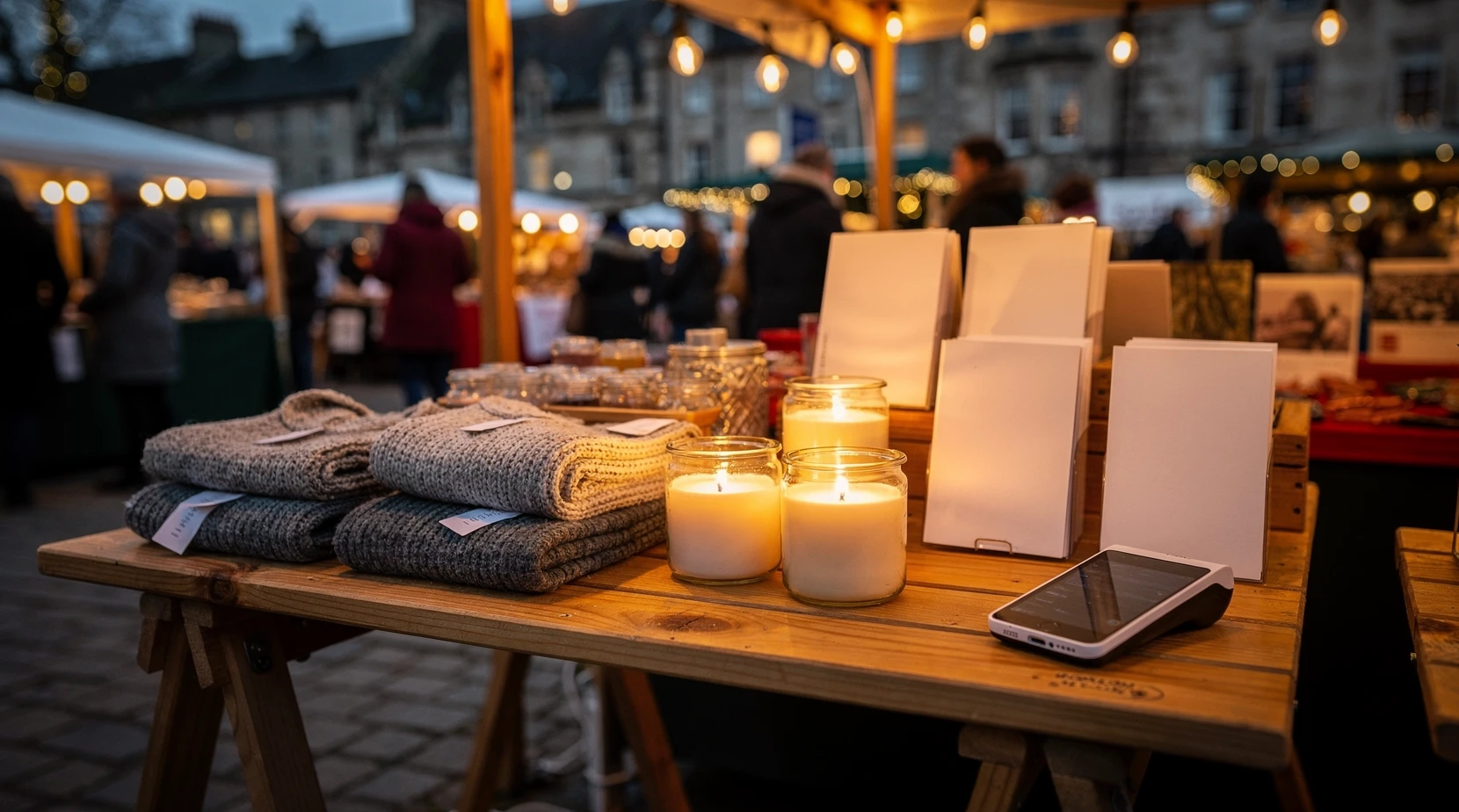
The simplest explanation is that the places where side hustlers sell have changed. Online marketplaces handle payment for the seller, so a Vinted or eBay reseller never needs a terminal. A card reader only becomes necessary when the selling moves into the physical world: a stall at a Christmas market, a table at a craft fair, a pop-up in a café, a mobile service such as hairdressing, bike repairs or dog grooming.
That shift is visible in the survey itself. Crafts and handmade goods are one of the three most common side hustles, and handmade sellers have always relied on in-person events as well as online shops. The winter calendar concentrates that activity: late November and December are when Christmas markets, school fairs and makers’ markets run back to back.
A trader who only takes cash now risks losing sales to the stall next door. Contactless card and phone payments have become the default for many UK shoppers, and a portable reader linked to a smartphone is the cheapest way for a small seller to accept them. Both SumUp and Square publish no-subscription plans, which means a weekend trader pays nothing when the reader sits in a drawer.
Some sellers skip the hardware entirely. Square says on its UK site that it supports Tap to Pay on iPhone, which turns a recent iPhone into a contactless terminal. shopappy has looked at what tap to pay on a phone means for small retailers, and the trade-offs are similar for side hustlers: no hardware cost, but a dependence on the phone’s battery and signal.
The connectivity gap
The Starlink figure points to a practical problem that card readers create. A reader needs a data connection to authorise most payments, and mobile signal at a rural fair, a farm shop, a festival field or a seafront market can be patchy. Kramer’s reference to “getting online in places they couldn’t before” suggests some of the buyers are using satellite internet to keep payments working where 4G drops out.
Currys did not split the Starlink buyers between side hustlers, rural households and other businesses, so the 93% figure cannot all be attributed to traders. It is, however, consistent with the retailer’s broader claim that small operators are now spending on infrastructure rather than just stock.
How does the Currys data compare with other side hustle surveys?
Side hustle surveys are published often in the UK, usually by companies that sell to small sellers, and they rarely measure the same thing. The table below sets the Currys results beside other recent figures that shopappy has been able to source, with the caveats that apply to each.
| Source | Published | Sample | Headline finding | Caveat |
|---|---|---|---|---|
| Currys (via PA) | 16 November 2026 | 2,000 UK adults | 25% have an extra income stream; 43% of under-30s | Pollster and fieldwork dates not stated |
| Currys Business sales data | 16 November 2026 | Currys Business sales | Card readers +150% year to date; Starlink +93% | No unit numbers or base disclosed |
| Poll reported by the Edinburgh Evening News | 16 October 2026 | 2,000 adults | 49% regularly work a “second shift” on personal ambitions, 214 extra hours a year | Measures passion projects as well as paid work |
| UK Budget documents (as reported by shopappy) | 28 October 2026 | Treasury costings | Trading allowance rise costs £225m in 2028-29, falling to £165m in 2029-30 | A cost estimate, not a count of sellers |
The broad pattern is consistent: a large minority of UK adults earn money outside their main job, and younger adults are the most likely to do so. What the surveys do not agree on is scale, because one counts anyone who sold anything and another counts only people who describe themselves as running a venture.
The Treasury’s own costing is arguably the most useful number for sellers. A tax measure worth roughly £165–225 million a year in lost receipts implies a large population of people with small trading incomes, which is the group the Budget chose to help.
What does a card reader actually cost a UK side hustler?
For a small seller, the cost of a card reader has two parts: the hardware, and the fee taken from each payment. Both SumUp and Square publish their UK prices, and both offer plans with no monthly charge. The figures below are taken from the providers’ UK pricing pages as read on 16 November 2026; prices can change and promotional discounts are common in the run-up to Black Friday.
| Provider and plan | Monthly fee | In-person card fee | Online fee (UK cards) | Notes |
|---|---|---|---|---|
| SumUp, pay as you go | £0 | 1.69% | See SumUp terms | 0% when the customer pays with a SumUp card |
| SumUp, Payments Plus | £19 | 0.99% | See SumUp terms | Aimed at businesses taking £3,000+ a month; 12-month commitment |
| SumUp, higher tier | £49 | 0.69% | See SumUp terms | Aimed at businesses taking £10,000+ a month |
| Square, free plan | £0 | 1.75% (UK cards); 1.75% + 1.5% (non-UK) | 1.4% + 25p; 2.5% + 25p for non-UK cards | Contactless and chip reader from £19 + VAT |
Worked examples for a Christmas season
Take a maker who sells £3,000 of candles and cards at markets between November and January, all by card. On SumUp’s pay-as-you-go rate of 1.69%, the fees come to about £50.70. On Square’s 1.75% in-person rate, the same takings would cost about £52.50. The difference is small; the bigger decision is which app and reader the seller finds easier to use on a busy stall.
Subscription plans only make sense at higher volumes. SumUp’s £19 a month plan cuts the rate from 1.69% to 0.99%, a saving of 0.7 percentage points. On shopappy’s arithmetic, a seller needs to take roughly £2,700 a month by card before that saving covers the £19 fee, and the 12-month commitment means quiet months still cost money. That is why the provider itself pitches the plan at businesses taking more than £3,000 a month.
Square’s online rate includes a fixed 25p, which bites on low-value sales. A £10 payment through a Square online checkout costs 39p in fees, or 3.9% of the sale; a £50 order costs 95p, or 1.9%. Sellers who take deposits or pre-orders through payment links should price that in, especially on low-cost handmade goods where margins are thin.
None of these fees include the cost of a phone data plan, card stock, insurance or the pitch itself. Pitch fees can dwarf payment costs: shopappy reported earlier this month that Liverpool’s Christmas market pitches cost around £12,000, a level that prices out many local traders long before card fees are considered.
When does a side hustle need to be declared to HMRC?
Buying a card reader does not, by itself, change anyone’s tax position. What matters to HMRC is whether the activity counts as trading and how much income it brings in during the tax year, which runs from 6 April to 5 April. HMRC’s online guidance draws a firm line between selling personal possessions and trading.
Selling your own unwanted belongings is generally not trading, and HMRC says it is unlikely you will need to tell it about that income or pay tax, however many items you sell. The exception is a single item, or a set, sold for more than £6,000, which may bring Capital Gains Tax into play. Buying items to resell at a profit, or making items to sell, is likely to be trading, and so are paid services such as dog walking, tutoring, gardening and repairs.
The £1,000 limit still applies this Christmas
Under current rules, if your total trading income from all side activities is more than the £1,000 trading allowance in a tax year, you need to tell HMRC. The allowance is measured on income, not profit, and it is one allowance per person, so stall takings, Etsy sales and dog walking all count towards the same total.
The Budget on 28 October 2026 confirmed that the allowance will treble to £3,000 from 6 April 2027, and that the Self Assessment reporting threshold for trading income will rise to the same level. shopappy set out the detail in its report on how the trading allowance triples to £3,000 for Vinted and eBay sellers. Crucially, anything sold this November and December falls in the 2026/27 tax year and is still judged against the old £1,000 limit.
Since 1 January 2024, UK digital platform operators have been required to collect details about sellers and report their income to HMRC each year by 31 January. HMRC’s guidance says a seller’s details will not be reported if they make fewer than 30 sales of goods in a calendar year and receive less than €2,000 (about £1,700) for them. A platform report does not automatically mean tax is owed.
Those rules are aimed at platforms that connect sellers with buyers, such as marketplaces and booking apps. HMRC’s guidance on digital platform reporting does not describe a card reader used at a market stall as a platform sale, so takings collected that way are not covered by that particular reporting regime. That does not make them invisible or tax-free: the same trading rules apply, and the seller is responsible for declaring income above the allowance.
What the Budget promised young entrepreneurs
The PA report on the Currys data noted that the Chancellor’s Budget pledged both to triple the trading allowance and to bring in a new allowance to cover a year of living costs for young entrepreneurs. The government has said the trading allowance change is meant to make it easier to earn money from a side hustle.
The second measure is less developed. Budget coverage describes a Young Entrepreneurs Allowance that will be piloted in England and is intended to help applicants with living costs during their first year of business. shopappy has not found published eligibility rules, payment amounts or a start date for the pilot, so anyone hoping to use it should wait for official guidance before making plans.
| Date | What happens | Who it affects |
|---|---|---|
| 1 January 2024 | Digital platform reporting rules start | Sellers on marketplaces and apps |
| 6 April 2026 | Making Tax Digital for Income Tax starts for qualifying income over £50,000 (2024/25) | Larger sole traders and landlords |
| 31 January 2027 | Deadline for 2025/26 online Self Assessment returns and payment | Anyone with 2025/26 trading income above £1,000 |
| 5 April 2027 | Last day of the 2026/27 tax year under the £1,000 allowance | Everyone selling this Christmas |
| 6 April 2027 | £3,000 trading allowance and reporting threshold take effect; Making Tax Digital extends to qualifying income over £30,000 (2025/26) | Small sellers; growing sole traders |
| 6 April 2028 | Making Tax Digital extends to qualifying income over £20,000 (2026/27) | Side hustles that have grown into businesses |
The Making Tax Digital dates matter more than many side hustlers realise. According to HMRC, sole traders registered for Self Assessment whose qualifying income from self-employment and property is over the threshold must keep digital records and send quarterly updates. A side hustle that grows from a few markets to a year-round business can cross the £20,000 line sooner than its owner expects.
What changes when a hobby seller becomes a trader?
Taking card payments is often the moment a hobby starts to look like a business, and the legal obligations follow the activity rather than the equipment. Once someone is selling in the course of a business, their customers gain the protections of the Consumer Rights Act 2015. Goods must be of satisfactory quality, fit for purpose and as described, and a buyer can reject faulty goods within 30 days for a full refund.
The rules differ between online and in-person sales. A trader selling at a distance, through a website, social media shop or payment link, must generally give buyers a 14-day right to cancel under the Consumer Contracts Regulations, with exceptions for personalised and perishable goods. A sale made face to face at a market stall does not carry that automatic cooling-off right, although the trader’s own returns policy can be more generous, and faulty goods rights still apply.
The Digital Markets, Competition and Consumers Act 2024 strengthened the rules on unfair commercial practices, including hidden fees and fake reviews, and gave the Competition and Markets Authority power to fine businesses directly. These rules are aimed at traders of every size. A side hustler who adds an unannounced card surcharge at the till, or asks friends to post glowing reviews, is taking a legal risk as well as a reputational one.
Card surcharges are a specific trap. Consumer law in the UK has banned surcharges on most consumer card payments since 2018, so a seller should build card fees into prices rather than add a percentage when the customer taps. If a stall offers a cash discount, it should be displayed clearly in advance.
How are marketplaces and social platforms shaping the trend?
Online selling and reselling remains the most common side hustle in the Currys survey, and marketplaces are where most of that activity happens. The platforms handle payments, so they also hold sellers’ money until it is released. That dependence has its own risks: shopappy reported last week on Vinted Pro sellers who could not withdraw earnings from their wallets after failing business verification checks.
A card reader at a market gives a seller a second, independent channel, with money paid out by the card provider rather than held by a marketplace. For many makers and resellers, the logic is to spread risk: list online for reach, and sell in person for margin and direct customer contact.
Live selling blurs the line
Content creation and influencing, the survey’s other big category, increasingly overlaps with selling. TikTok Shop has pushed live shopping hard in the UK, and its first UK live shopping report claimed that 61% of small businesses surveyed made more in one live session than in a typical week. shopappy examined those claims in its analysis of what the TikTok Shop UK live shopping numbers really show, finding that some headline figures repeated earlier releases.
Currys itself is part of the same shift. The retailer launched on TikTok Shop in October 2026 as a trial run with THG Commerce, according to a company press release, and said it would host live shopping events. A national retailer selling through creator content while also selling payment kit to side hustlers shows how far the boundary between big retail and small sellers has moved.
What does this mean for the high street and Currys?
For Currys, small businesses are a growth market it is actively courting. In July 2026 the retailer said Currys Business had grown 20% year on year and opened 10 new Business Hubs inside its stores, taking the total to 70, alongside a UK-based contact centre. The new hubs opened in Durham, Tunbridge Wells, Doncaster, Huddersfield, Gloucester, Wolverhampton, Derby, Cheetham Hill, Watford and Poole.
The hubs offer dedicated business customer managers, 30-day credit and a leasing service. Side hustlers are at the small end of that customer base, but a card reader or a satellite dish bought through a Currys Business account brings a new customer into a relationship the retailer hopes will grow into laptops, tills and appliances later.
For high streets, the side hustle boom is a mixed picture. Every maker who trades at a Christmas market is a potential future tenant for an empty unit, and many independent shops started life as market stalls. But the cost pressures described by small business owners in the national press this month, from break-ins to rising bills, show why many sellers prefer the low overheads of a weekend pitch to a permanent shop.
Policy may shift that calculation slowly. The Budget also raised the ceiling for small business rate relief, which shopappy covered when the Budget lifted rates relief to £18,000 for high street firms. Together with the higher trading allowance, the measures lower the cost of the first steps from hobby to business, although neither removes the cost of rent.
What should side hustlers do before the Christmas markets?
The practical steps are mostly about records and prices rather than equipment. A seller who keeps clear records from the first sale will find tax returns and any future Making Tax Digital obligations far easier.
- Decide whether you are trading. Use HMRC’s online tool for income from online platforms if you are unsure. Selling your own unwanted things is different from buying or making goods to sell.
- Add up all side income. Stall takings, online sales and paid services count towards one £1,000 allowance in 2026/27.
- Price in the card fee. At 1.69–1.75%, a £20 item costs about 34–35p to take by card on the providers’ standard in-person rates. Do not add a surcharge at the till.
- Test your connection. Check mobile signal at the venue before the day, and know what your reader does if it cannot connect.
- Write a simple returns policy. Display it on the stall and on any online shop, and remember that faulty goods rights apply regardless.
- Keep every receipt. If income goes over the allowance, you can deduct actual allowable expenses instead of the allowance, but only if you can show them.
Most side hustlers will not need to do anything dramatic. The point of the new data is that the line between a casual seller and a small business is now crossed by a lot more people, and it is better to cross it knowingly than by accident.
Frequently asked questions
What did Currys say about card reader sales?
Currys said its business division had seen a 150% increase in sales of portable card payment terminals from SumUp and Square over the year to date, compared with the same period a year earlier. It did not disclose unit numbers or revenue.
How many Britons have a side hustle, according to Currys?
Currys’ survey of 2,000 UK adults found that a quarter have an additional income stream. The figure rises to 43% among under-30s. The polling company and fieldwork dates were not stated in the release.
Do I have to tell HMRC if I sell at a Christmas market?
If the selling counts as trading and your total trading income for the tax year is more than £1,000, you need to tell HMRC. Selling your own unwanted possessions is generally not trading. The limit rises to £3,000 from 6 April 2027, so it does not help with sales made this Christmas.
Are card reader payments reported to HMRC like Vinted or eBay sales?
The digital platform reporting rules cover platforms that connect sellers with buyers, such as marketplaces. HMRC’s guidance on those rules does not describe a card reader used at a stall as a platform sale. That does not change your tax position: trading income above the allowance must be declared however it is paid.
Which is cheaper for a small seller, SumUp or Square?
On their published UK no-subscription plans, SumUp charges 1.69% per in-person card payment and Square 1.75% for UK cards. On £3,000 of takings, that is about £50.70 against £52.50. SumUp also offers a £19 a month plan at 0.99%, which only pays off at roughly £2,700 a month of card sales or more.
Can I charge customers extra for paying by card?
UK rules ban surcharges on most consumer card payments, so you should build the card fee into your prices instead. You can offer a discount for cash if you display it clearly in advance.
Do customers have a right to return items bought at my stall?
If you are trading, buyers have Consumer Rights Act protections, including the right to reject faulty goods within 30 days. The 14-day cooling-off right generally applies to online and distance sales, not face-to-face purchases at a stall, although you can offer a more generous policy.
What is the Young Entrepreneurs Allowance?
The Budget announced a pilot in England to help young founders with living costs during their first year of business. Eligibility rules, payment amounts and a start date had not been published when this article was written.
When does Making Tax Digital affect a side hustle?
HMRC says sole traders with qualifying income over £30,000 in 2025/26 must use Making Tax Digital for Income Tax from 6 April 2027, and those over £20,000 in 2026/27 from 6 April 2028. Most small side hustles are below these thresholds.