
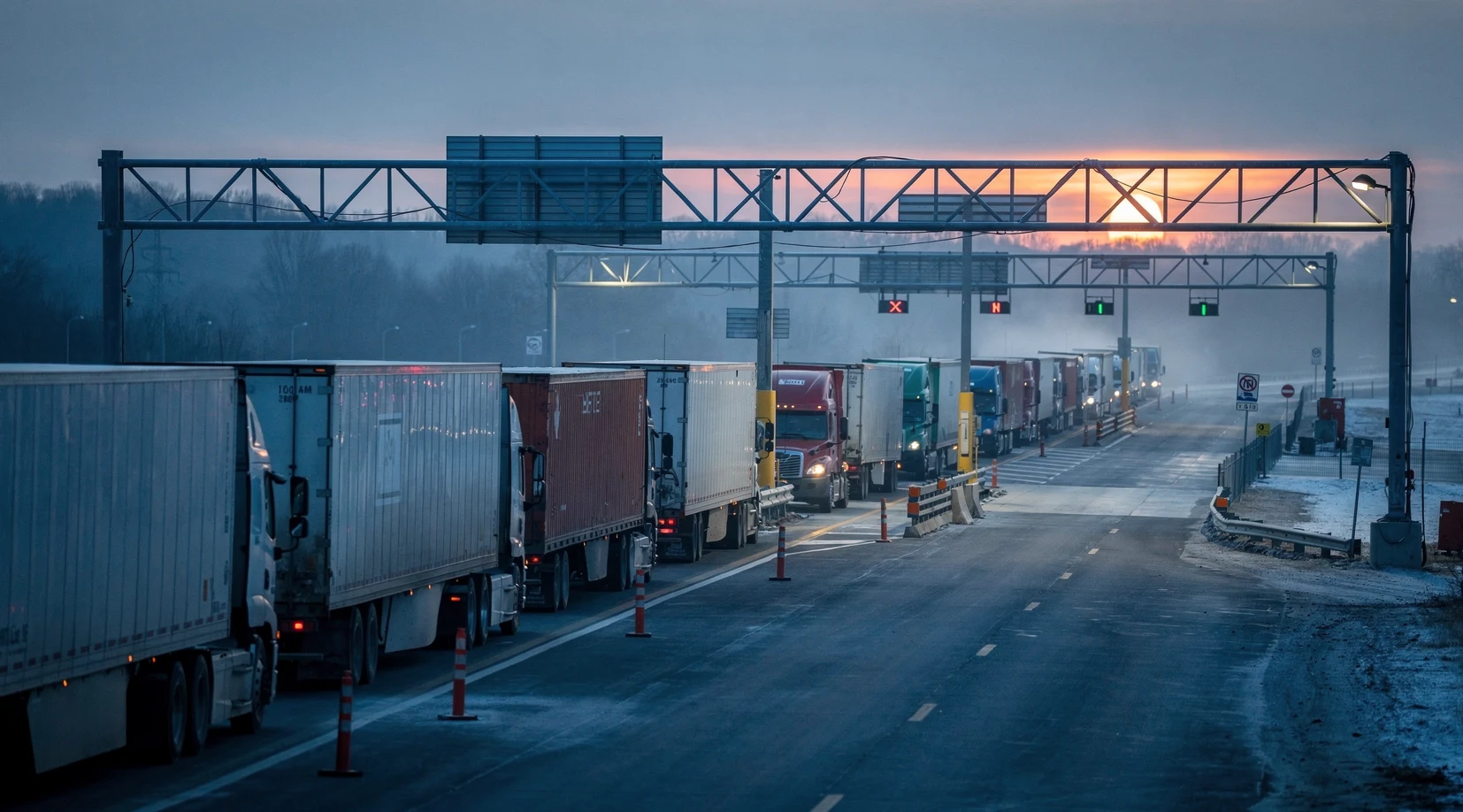
A 50% additional duty on a wide band of Canadian goods takes effect on Wednesday, August 19, 2026, at 12:01 a.m. Eastern time. It arrives through a legal channel that no US president had ever used to set tariffs, and it lands on categories that reach far past the three sectors named in the headlines.
In short
- Effective moment: 12:01 a.m. ET on August 19, 2026, applying to goods entered for consumption or withdrawn from warehouse for consumption on or after that time.
- Legal basis: Section 338 of the Tariff Act of 1930, invoked by three proclamations signed July 20, 2026. Trade counsel describe this as the first presidential use of the provision in US history.
- Rate and scope: an additional 50% ad valorem, the statutory maximum, across annexes that reach well beyond motor vehicles, alcohol and dairy.
- USMCA does not shield you: advisories are consistent that USMCA-qualifying origin does not exempt covered goods, and that the duty stacks on existing obligations.
- Exposure: figures attributed to the US Trade Representative put coverage at nearly $20 billion in Canadian imports, roughly 5% of the approximately $382 billion the US imported from Canada in 2025.
Update: the August 19 start date slipped, and the duties took effect on August 22
The 50% Section 338 duties did not begin on August 19. On August 18 the President signed a proclamation suspending them for three days while talks continued. Those talks broke down late on August 21, and the duties took effect at 12:01 a.m. Eastern time on August 22, 2026. They remain in force.
Everything below about how the duty works still applies, with one substitution: read every reference to August 19 as August 22. The trigger is still entry, not order date and not shipment date. A container entered for consumption before 12:01 a.m. Eastern time on August 22 sits outside the duty. One entered after that moment does not.
The August 18 proclamation suspended the three proclamations signed on July 20, numbered 11046, 11047 and 11048, and moved the effective moment from August 19 to August 22. The stated reason was the state of the negotiations, with Canada signalling it would address the measures Washington had complained about in alcoholic beverages, dairy and motor vehicles. No agreement was reached inside the window.
Anyone filing entries should work from the CBP guidance issued as CSMS # 69606660, “Section 338 Additional Duties on Certain Goods of Canada”. It carries the HTSUS headings for the three annexes: 9903.03.12 for the alcoholic beverages group, 9903.03.13 for dairy, and 9903.03.14 for the motor vehicle group. The three day gap is worth checking in your own records, because entries made on August 19, 20 and 21 were filed while the duty was suspended.
What actually changes at 12:01 a.m. on August 19
The operative trigger is entry, not purchase and not shipment. Advisories from customs brokerages and trade law firms use the same formulation: the duty applies to covered goods entered for consumption, or withdrawn from warehouse for consumption, on or after 12:01 a.m. Eastern time on August 19, 2026.
Entry date, not order date, decides who pays
That distinction decides who pays. A container that cleared customs on August 18 is outside the new duty even if it reaches a distribution center in September. A container sitting at a port on August 19 awaiting an entry filing is inside it.
The practical consequence is that purchase orders signed months ago at pre-tariff landed cost assumptions can still be repriced by 50 points if the goods have not yet been entered. Merchandising teams that model landed cost from the purchase order date will understate exposure.
Warehouse withdrawals deserve the same attention. Goods sitting in a bonded warehouse are not dutied until withdrawal, so inventory that has been in bond since spring becomes newly expensive the moment it is withdrawn for consumption after the effective time.
Platform and systems readiness
Brokerage guidance circulating this week indicated that the new Section 338 classifications were expected to be live on shipping and customs platforms by the evening of Monday, August 17. That timing gives importers a narrow operational window rather than a comfortable one.
Customs and Border Protection has issued entry filing instructions through its CSMS bulletin system, covering the new Chapter 99 headings and foreign trade zone admission requirements. Published advisories cite headings in the 9903.02 and 9903.03 ranges, though the exact subheading cited varies between advisories, so importers should work from the CBP message and the proclamation annexes rather than secondary summaries.
Discrepancies between secondary summaries are themselves a warning. When advisories from reputable firms cite different Chapter 99 headings for the same annex, the risk of a misfiled entry rises, and a misfiled entry at a 50 point rate step is an expensive error to unwind.
Why Section 338 is not Section 232, Section 301 or IEEPA
Most retail importers have spent two years learning the mechanics of Section 232, Section 301 and the International Emergency Economic Powers Act. Section 338 behaves differently in ways that matter operationally, not just academically.
No investigation and no agency process
Section 338 authorizes the president to impose new or additional duties on countries found to have discriminated against US commerce. According to analysis published by Holland & Knight, the provision requires only a presidential finding and proclamation, with no prior investigation by the US International Trade Commission, the Office of the US Trade Representative or the Commerce Department.
That is a sharp departure from Section 232, which runs through a Commerce Department national security investigation, and from Section 301, which runs through a USTR investigation with a notice and comment record. There was no docket here for importers to monitor and no comment period in which to argue product exclusions.
A hard statutory ceiling of 50%
The statute authorizes duties of up to 50% ad valorem. The proclamations went straight to the ceiling. There is no headroom for escalation within Section 338 itself, which is one reason trade lawyers read the action as a negotiating position rather than a permanent settlement.
Why the IEEPA defeat sits behind this
Canada had been subject to a 35% IEEPA tariff on products that did not qualify as USMCA-compliant, until those tariffs were found unlawful by the Supreme Court. The refund machinery from that defeat is still working through the courts, and the pending class certification question on IEEPA refunds continues to determine how hundreds of thousands of importers recover money already paid.
Section 338 arrives into that vacuum. It is a different statute with a different theory, which is precisely the point: it does not inherit the IEEPA reasoning that the courts rejected.
How the four regimes compare
| Feature | Section 338 | Section 232 | Section 301 | IEEPA |
|---|---|---|---|---|
| Statutory source | Tariff Act of 1930 | Trade Expansion Act 1962 | Trade Act 1974 | IEEPA 1977 |
| Prior investigation required | No | Yes (Commerce) | Yes (USTR) | No |
| Rate cap | 50% ad valorem | None specified | None specified | None specified |
| Public comment record | No | Yes | Yes | No |
| USMCA origin exemption | No | Varies by action | Not applicable | Applied to non-qualifying goods |
| Formal exclusion process | None announced | Yes, historically | Yes, historically | None |
| Current legal status | Untested, challenge anticipated | In force | In force | Found unlawful by Supreme Court |
What the three proclamations actually cover
The White House signed three separate proclamations on July 20, 2026, each built on a distinct discrimination finding. The structure matters because the annexes attached to each proclamation are far wider than the sector in the title.
The motor vehicle proclamation
The administration’s stated rationale cites a roughly 22% year over year decline in Canadian purchases of US vehicles, an amount put at approximately $5.6 billion. The annex attached to this proclamation is the broadest of the three. Published summaries describe it reaching agricultural and food products, leather, plywood, textiles, metals, industrial machinery and printed circuit boards alongside motorcycles and vehicle-related lines.
The alcoholic beverages proclamation
This proclamation follows an alleged 81% reduction in US alcohol imports into Canada. The administration states that all but two Canadian provinces and territories halted the purchase, distribution or retailing of US alcoholic beverages beginning in March 2025. The annex covers beer, wine and spirits, and according to one brokerage advisory also reaches certain wood and paper products.
The dairy proclamation
The dairy action addresses tariff-rate quotas on US cheese, which the administration characterizes as more restrictive than the treatment the EU receives. Its annex is described as covering dairy products, caseins, sugar-containing products and nonalcoholic beverages.
The categories retailers did not price for
The gap between the headline sectors and the annex contents is where the retail damage sits. A general merchandise buyer reading “motor vehicles, alcohol and dairy” would reasonably conclude the action does not touch their assortment. That conclusion is wrong.
Analysis published by Thomson Reuters lists goods swept into the annexes that include wine, hockey sticks, cement, plywood, furniture, fishing rods, seeds, clothing, wigs and swimming pools. Other summaries add paper, cosmetics and sporting goods to the same picture.
The explanation offered is structural rather than accidental. The three headline categories received individual proclamations because each tied to a specific documented dispute with a measurable trade effect. The same 50% duty then applies uniformly across the annexed goods regardless of whether they carry headline status.
There is a second-order problem in components. Printed circuit boards and industrial machinery appear in the annex summaries, which means finished goods assembled elsewhere can still carry Canadian-origin inputs whose duty treatment changes. Bills of material, not just finished goods origin, need review.
Retailers with private label programs face this most acutely. Own-brand goods are frequently sourced through multi-country supply chains where the retailer, rather than a vendor, is the importer of record, which puts the duty liability directly on the retailer’s own entry filings.
For a home improvement or seasonal goods retailer, plywood and cement are not peripheral lines. For a softlines merchant, clothing and textiles are the assortment. This is the second tariff action in two weeks to catch categories outside its nominal scope, following the Section 232 action on unmanned aircraft systems effective September 3, which reached consumer drones alongside thermal imaging units.
Why USMCA origin no longer protects a shipment
This is the provision that breaks the most planning assumptions. Under the IEEPA regime, USMCA-qualifying goods were treated differently from non-qualifying goods, and a great deal of supply chain engineering was built on securing and documenting that qualification.
Section 338 does not carry that distinction. Advisories are unambiguous: the duties apply to USMCA-qualifying goods because those goods are not excluded from the annexes. As one summary put it, USMCA origin does not help here.
The second half of the problem is stacking. The 50% is an additional duty layered on top of existing obligations rather than a replacement rate. A line already carrying a most favored nation rate and any other applicable duty adds 50 points on the covered value.
Sourcing teams that spent 2025 and early 2026 qualifying Canadian suppliers under USMCA rules of origin now hold certificates that carry no relief against this specific action. The certificates retain value for other purposes; they simply do not answer Section 338.
What is excluded, and what that tells you
The exclusions are as informative as the inclusions. Advisories consistently list the following as carved out of the Section 338 duties.
- Energy products
- Potash
- Fish
- Critical minerals
- Goods already subject to Section 232 tariffs
- Products covered by the WTO Civil Aircraft Agreement
The pattern is legible. Energy, potash and critical minerals are inputs where a 50% duty would raise US industrial and agricultural costs immediately and visibly. The Section 232 carve-out prevents the two regimes from compounding on steel, aluminum and copper derivative lines. The civil aircraft exclusion respects a standing plurilateral commitment.
What is not carved out is consumer goods. There is no exclusion for finished retail merchandise, no de minimis relief at the category level and, importantly, no formal product exclusion process announced. Under Section 232 and Section 301, importers grew accustomed to petitioning for exclusions. No comparable mechanism has been detailed for Section 338.
The customs mechanics importers face this week
The compliance actions available in the remaining hours are narrow and mostly mechanical.
Foreign trade zone status
Goods held in a foreign trade zone need to be admitted under privileged foreign status before August 19, 2026. Privileged foreign status fixes the tariff classification and rate at the moment of admission, which is the difference between paying the pre-August rate and the post-August rate on inventory already sitting on US soil.
Classification review
Every advisory reviewed makes the same first recommendation: read all three annexes rather than the headline categories. Classification accuracy carries unusual weight here because the annexes are line-specific and the rate step is 50 points, not 5.
Entry timing and procurement
Counsel have recommended accelerating procurement and entry filings ahead of the effective date where commercially sensible. That advice has a short shelf life and, for goods still in Canada on August 18, is largely academic.
Drawback and refund posture
Merchandise later exported or incorporated into exported products may qualify for duty drawback under general principles, and importers should preserve entry documentation regardless. Given that litigation is anticipated, the discipline that mattered in the IEEPA cycle applies again: importers who kept clean records were the ones positioned to recover. That lesson was visible in the last reporting season, where a $37.2 million tariff refund lifted Dillard’s quarterly profit by a third.
Parcel-level flows deserve separate attention. US de minimis has been suspended since August 29, 2025, meaning duty attaches to essentially every import, and the prepayment threshold for postal shipments rose to $2,500 as of July 24, 2026. The courts have since upheld the repeal of the $800 de minimis exemption, closing the last realistic low-value workaround for cross-border parcels from Canada.
What this means for retail categories and pricing
The commercial question is who absorbs 50 points and over what horizon. The answer varies sharply by category structure, and the timing is unhelpful: back to school is already underway and holiday inventory commitments are largely locked.
| Category | Exposure route | Substitution difficulty | Likely near-term response |
|---|---|---|---|
| Furniture | Named in annex summaries | Moderate, Asian and domestic sources exist | Absorb through Q3, reprice at spring reset |
| Plywood and cement | Named in annex summaries | High, freight cost dominates for heavy goods | Direct pass-through, Pro and trade channels first |
| Clothing and textiles | Named in annex summaries | Low, sourcing is already global | Shift orders away from Canadian origin |
| Alcoholic beverages | Dedicated proclamation | High for appellation and brand-specific goods | Shelf price increases, assortment narrowing |
| Dairy and dairy-containing | Dedicated proclamation | Moderate, domestic supply exists | Reformulation and supplier switching |
| Sporting goods | Annex items including hockey sticks and fishing rods | Low to moderate | Seasonal margin compression |
Heavy, low value density goods are the worst case. Cement and plywood carry freight economics that make distant substitution expensive, so a 50% duty on Canadian origin has fewer escape routes than it does for apparel.
The gross margin arithmetic
The duty applies to customs value, not retail price, which softens the shelf impact but not by as much as merchants often assume. On a good with a $40 customs value retailing at $100, a 50% duty adds $20 of cost against a $60 gross margin dollar base, cutting roughly a third of the margin if nothing else moves.
Three levers exist and none is fast. Vendors can absorb part of the duty through price concessions, which requires renegotiating agreements written before the proclamations. Retailers can absorb it and take the margin hit, which is the default for goods already committed for holiday. Or the price moves at the shelf, which is the slowest option because most seasonal price architecture is set well in advance.
Air freight is unlikely to help here, and industry reporting this week noted that air freight is already becoming a costly fix for inventory problems. Faster transit does not change an entry date that falls after August 19, so accelerating a Canadian shipment by air buys nothing on duty.
Why the calendar makes this worse
The effective date lands at an awkward point in the retail year. Back to school selling is underway, and industry forecasts quoted this week describe the season as moderate at best, which leaves little pricing headroom. Holiday inventory is largely bought, so the goods most exposed are ones whose cost is already committed and whose retail price is already planned.
A tariff that arrived in February would have been absorbed into the next buying cycle. One that arrives in the third week of August lands between two committed seasons, which is where margin damage rather than price adjustment tends to occur.
The timing collides with earnings season. Several large US retailers report in the same window, and TJX reports its quarter on the morning the duties take effect, which means management will be asked about an exposure that became live hours earlier. Expect guidance language rather than quantified impact, since most companies will not have modeled entry-level exposure at line item granularity this quickly.
Canada’s response and the negotiation window
Ottawa’s posture has been deliberately restrained. Prime Minister Mark Carney has said that everything is on the table if there is no agreement, according to Reuters, while making clear that Canada will not retaliate before the tariffs take effect. Retaliating during live talks, he said, would be counterproductive.
After meeting Canada’s premiers in Charlottetown, Carney indicated the federal government is weighing a full range of possible responses while continuing to pursue a comprehensive agreement with Washington. Al Jazeera reported in late July that Carney and President Trump had agreed to intensify trade negotiations.
No target list has been published. That is a choice, and it preserves the option value of surprise while keeping the door open.
The provincial dimension complicates any resolution. The alcohol proclamation rests on conduct by provincial liquor boards, which control distribution and retailing in most of Canada and are not federal instruments. Ottawa cannot simply legislate provincial purchasing decisions away, which means a negotiated fix requires provincial cooperation that a federal negotiator can encourage but not command.
That is one reason the Charlottetown meeting with the premiers mattered more than a routine consultation. Any concession on alcohol distribution has to be delivered by the provinces that imposed the restrictions in the first place.
The broader reading among trade counsel is that the 50% functions as an opening bid inside the USMCA review process, where the US and Canada bilateral track has lagged behind formal US and Mexico negotiations. Holland & Knight noted that the issues cited in the proclamations, provincial alcohol distribution and cheese tariff-rate quotas, are procedurally simple to resolve through negotiation, which is consistent with a pressure instrument rather than a durable trade barrier.
The legal challenge that is coming
Section 338 has never been used to impose tariffs, which means almost every question about it is open.
Two arguments are already identified in published analysis. The first is whether Section 301, enacted in 1974 with its own detailed procedure for responding to discriminatory foreign practices, effectively superseded Section 338. The second is whether the International Trade Commission must investigate before the president can act, given the statute’s structure and historical context.
A third question sits underneath both: what evidentiary standard applies to a discrimination finding made without an investigation. The proclamations cite specific figures, a 22% decline in Canadian purchases of US vehicles and an 81% reduction in US alcohol imports, but no agency record exists in which those figures were tested or contested.
Litigation in the US Court of International Trade is anticipated. That court has become the primary venue for tariff challenges, and it is the same forum that has been working through the IEEPA aftermath and the de minimis repeal.
The IEEPA sequence offers a template for how long this takes. Tariffs were collected for an extended period, were ultimately found unlawful at the Supreme Court, and the refund process is still unresolved at the trial court level. Importers who treat a possible future refund as a budgeted offset will misstate their cost base for several quarters.
Importers should note what litigation does and does not do. It does not suspend collection. Duties are paid at entry and recovered later if a challenge succeeds, which makes documentation and entry-level records the practical hedge. The regulatory posture that has served through the last two years of trade actions, closely tracked by the shift toward customs data as an enforcement backbone, applies here too: the paperwork is the asset.
What to watch after August 19
Four signals will determine whether this is a two week disruption or a structural cost.
First, whether CBP issues follow-up CSMS guidance narrowing or clarifying annex coverage. Early implementation messages frequently adjust scope at the margins, and classification disputes surface quickly at 50 points.
Second, whether a formal exclusion process appears. None has been announced, but pressure from affected industries has produced exclusion mechanisms under other statutes.
Third, whether Canada retaliates and against what. Carney’s stated sequencing puts any response after the effective date, which makes the days following August 19 the meaningful window.
Fourth, whether the USMCA track produces a deal. If the proclamations are an opening bid, a negotiated resolution removes them faster than litigation would.
For retailers, the near-term discipline is unglamorous: confirm which SKUs carry Canadian origin, confirm their annex status line by line, fix foreign trade zone inventory status, and preserve entry records. The pricing decisions can wait a quarter. The customs decisions cannot.
Frequently asked questions
When exactly do the Section 338 tariffs on Canada take effect?
At 12:01 a.m. Eastern time on August 19, 2026. The duty applies to covered goods entered for consumption, or withdrawn from warehouse for consumption, on or after that moment. Shipment date and order date do not control; entry does.
What is the tariff rate?
An additional 50% ad valorem, which is the maximum the statute permits. It is an additional duty that stacks on top of existing obligations rather than replacing them.
Does USMCA-qualifying origin exempt my goods?
No. This is the most significant departure from the previous IEEPA regime. Published advisories are consistent that USMCA-qualifying goods are covered because they are not excluded from the proclamation annexes.
Which products are actually covered?
The three proclamations are titled for motor vehicles, alcoholic beverages and dairy, but their annexes reach much further. Published summaries list furniture, plywood, cement, clothing, textiles, leather, seeds, wigs, swimming pools, fishing rods, hockey sticks, industrial machinery and printed circuit boards among covered goods. The annexes are line-specific, so classification review is required.
What is excluded?
Energy, potash, fish, critical minerals, goods already subject to Section 232 tariffs, and products covered by the WTO Civil Aircraft Agreement. No general exclusion exists for consumer or retail merchandise.
Is there a product exclusion process I can petition into?
No formal exclusion mechanism has been announced. That differs from Section 232 and Section 301, where exclusion processes were established. Importers should not plan around obtaining relief through a petition.
What can I still do with inventory in a foreign trade zone?
Goods should be admitted under privileged foreign status before the August 19 effective date. Privileged foreign status fixes classification and rate at admission, which is the practical protection for inventory already in the United States.
How is Section 338 different from Section 232 or Section 301?
Section 338 requires only a presidential finding and proclamation, with no prior investigation by the ITC, USTR or Commerce, and no public comment record. It caps duties at 50% ad valorem. Section 232 and Section 301 both run through agency investigations with comment periods.
Could the tariffs be struck down in court?
It is possible and litigation in the Court of International Trade is anticipated. Open questions include whether Section 301 superseded Section 338 and whether an ITC investigation is a prerequisite. Litigation does not suspend collection, so duties are paid at entry and recovered only if a challenge succeeds.